Pierre-Auguste RenoirFrankrig, 1841–1919
The Promenade
Må man se det?
Tager ikke imod for tiden
Los Angeles, USA
Det hører til samlingen, men er ikke udstillet for tiden.
- Kontrolleret
- Uændret siden
- Kilde
- Museet
Om maleriet
What Pierre-Auguste Renoir himself titled this painting is unknown, but *La Promenade* is in part an homage to earlier artists whom he greatly admired. Renoir had spent the previous summer painting outdoors with Claude Monet, who encouraged him to move toward a lighter, more luminous palette and to indulge his penchant for luscious, feathery brushwork. Here Renoir retained something of Gustave Courbet's green-and-brown palette while choosing his subject from the sensual, lighthearted garden jaunts of eighteenth-century painters such as Jean-Antoine Watteau and Jean-Honoré Fragonard, whose works he had studied in the Louvre. Unlike the images of seduction created by his predecessors, Renoir's is a fleeting moment caught by chance--middle-class Parisians immersed in nature, possibly a local park, not set before a studio backdrop. The dappled light filtering through the foliage would become a trademark of Renoir's finest Impressionist works of the 1870s and 1880s. He used a thin, oily paint mix, his glazes here floating into each other to create depth.
J. Paul Getty Museum
Oplysninger
- Inventarnummer
- 89.PA.41
I kataloget
Kilder
- J. Paul Getty Museum
- Billede: J. Paul Getty Museum — Open Content
Imens i livet hos Pierre-Auguste Renoir
Hele livet1868
First success: "Lise with a Parasol"
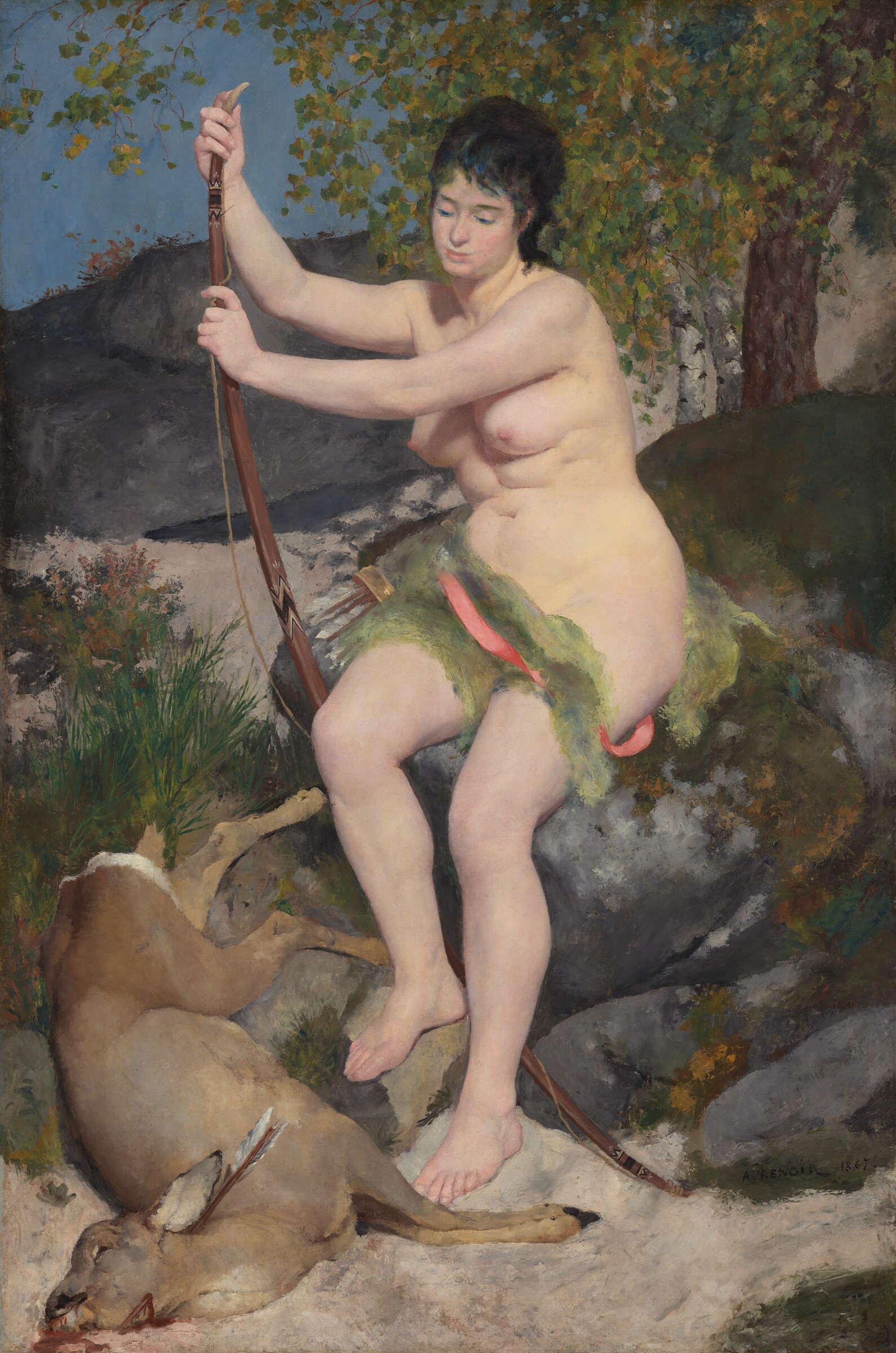
Renoir's first success at the Salon came with the painting "Lise with a Parasol" (1867), for which Lise Tréhot posed.
1870
Birth of his daughter Jeanne
Lise Tréhot gave birth to a daughter, Jeanne Marguerite; Renoir refused to officially acknowledge paternity or to marry Lise.
21. juli 1870
Daughter born: Jeanne Tréhot
1870–1871
Service in a cuirassier regiment
During the Franco-Prussian War Renoir was called up and served in a cuirassier regiment, where he learned to ride. On 10 March 1871 he was discharged from the army and returned to Paris in April.
1871
Incident on the Seine during the Commune
During the Paris Commune, Communards took Renoir, who was painting on the banks of the Seine, for a spy and nearly threw him into the river; the artist was recognized and saved by the Commune leader Raoul Rigault, whom Renoir had once helped.