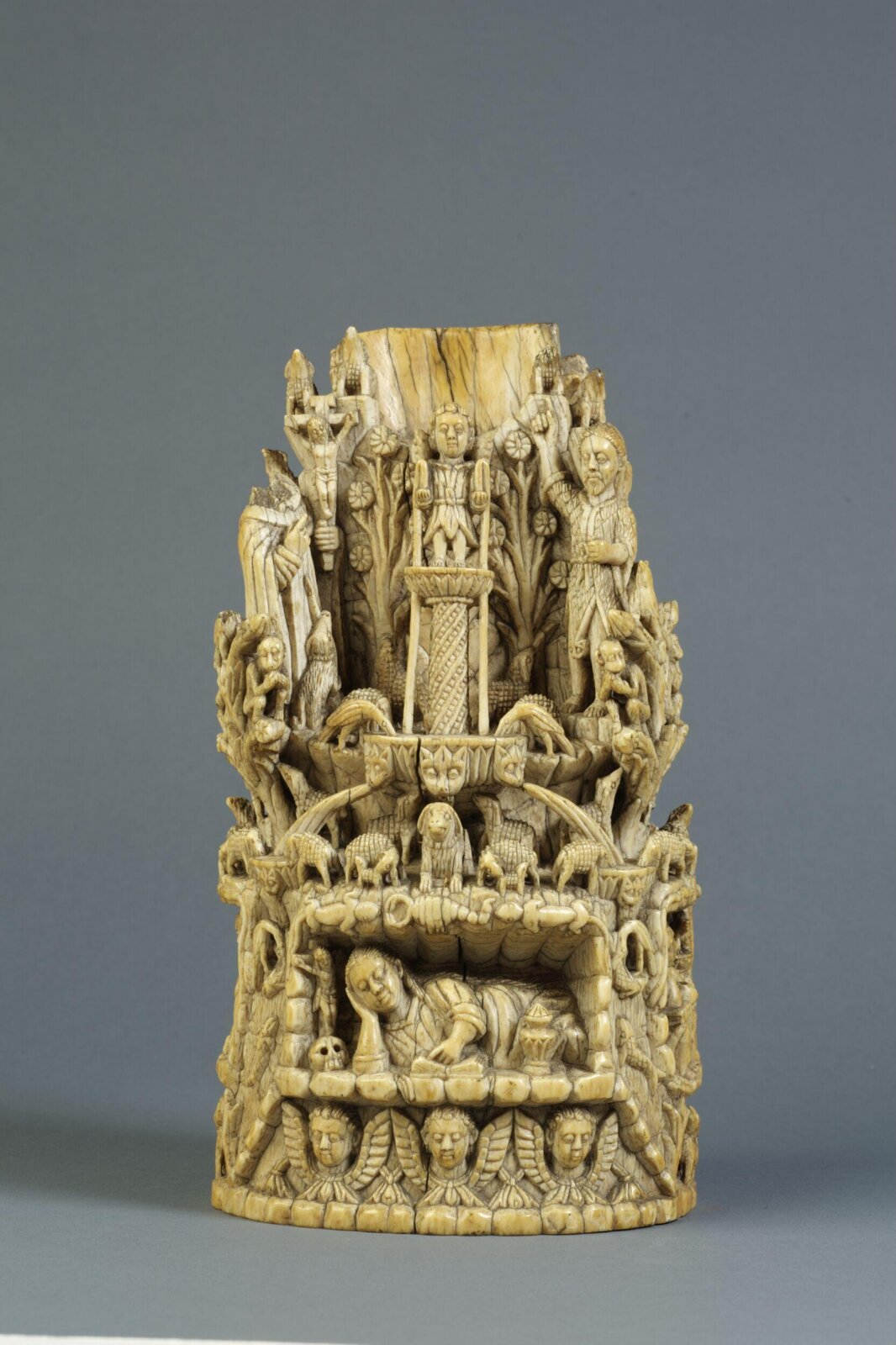
The Mount of the Good Shepherd
Kan det ses?
Ikke udstillet lige nu
Hvor er »The Mount of the Good Shepherd« i dag? Samling: Victoria and Albert Museum, London. Ikke udstillet lige nu. Kontrolleret 25. september 2026.

London, Storbritannien
Det hører til samlingen, men er ikke udstillet for tiden.
- Kontrolleret
- Uændret siden
- Kilde
- Museet
Om skulpturen
Indian ivory carvers blended Christian subject matter with representation of their own natural surroundings. The imagery here includes lush vegetation and wild cockerel, deer and monkeys. Also shown is St John the Baptist at the top right, and below the reclining Magdalene reading a book with a skull beside her.
Læs videre
Goa was the second base in India to be established by the Portuguese, having been conquered by Alfonso de Albuquerque (about 1453-1515) during the reign of Manuel I of Portugal initially in 1510, and then reconquered in 1512. Portugal was interested first and foremost in trade, and the discovery of India was motivated by a desire to dominate trade-routes. But the Christian settlers and missionaries were also keen to convert the native populace to Christianity, and religious images in ivory were commissioned to assist in this. Some were exported to Europe, but others evidently remained and were used for evangelical purposes. From the sixteenth century onwards, the four main missionary Orders (Augustinians, Jesuits, Dominicans and Franciscans) built churches and aimed to convert the inhabitants of India.
Despite the control of the Church over subject matter, the iconography of Indian art also permeated Christian ivories; the most obvious and at the same time strangest instance of this is the 'Mount of the Good Shepherd'. This is a common subject in Indo-Portuguese ivories, and seems to be unique to Goa. The figure of God the Father, carved in relief above the Christ Child, represents the Holy Spirit. Although the precise parallels and/or sources in Indian are uncertain, this distinctive composition recurs again and again in Goan ivories, and the combination of the Christ Child in the guise of the shepherd with saints, a fountain, vegetation and animals suggest the richness of the natural world, in conjunction with Christian imagery.
Victoria and Albert Museum
Oplysninger
- Inventarnummer
- A.28-1984
Hvad det viser
I kataloget
Kilder
- Victoria and Albert Museum
- Billede: Victoria and Albert Museum — © Victoria and Albert Museum, London










