The Crucifixion
Kan det ses?
Ja, udstillet nu
Hvor er »The Crucifixion« i dag? Victoria and Albert Museum, Sculpture, Room 111, The Gilbert Bayes Gallery, London. Ja, udstillet nu. Kontrolleret 23. november 2026.

Åbent nu· til kl. 22.00
Udstillet for publikum.
- Kontrolleret
- Uændret siden
- Kilde
- Museet
Om skulpturen
The techniques used in carving in wood and stone were fundamentally the same. First the sculptor carved the rough shape of the piece, a process known as ‘blocking out’. Then, he would work the surface with knives or chisels and abrasives. The figure was generally held horizontally at a workbench and attached to cylindrical shafts, so the sculptor could turn the piece as he carved. Small-scale pieces were generally carved at a workbench.
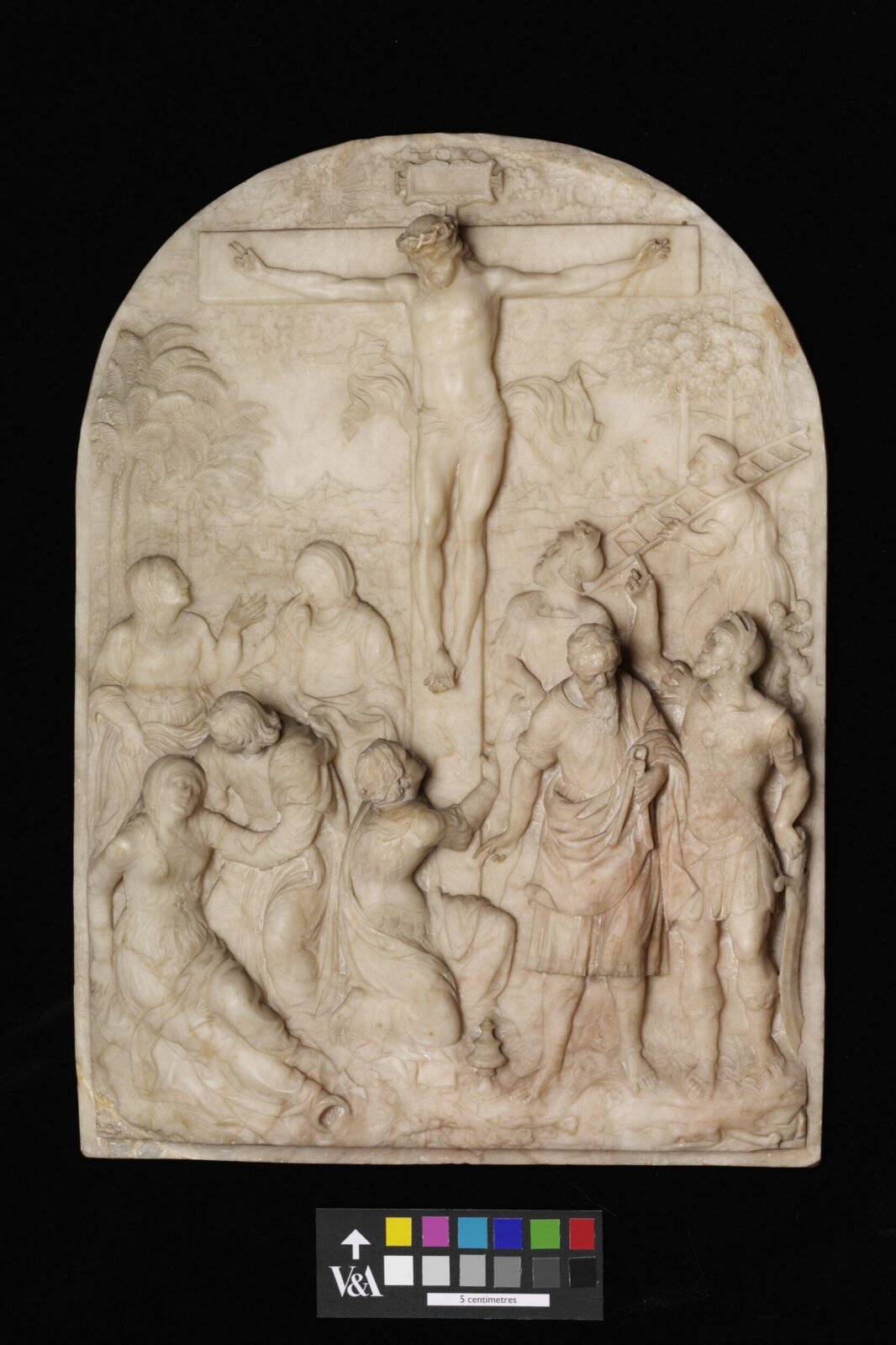
The relief shows the range of effects made possible by the relative softness of alabaster. The sculptor has carved the figures in the foreground in high relief, but rendered the background – with the city of Jerusalem, the clouds and mountains – in low relief. This gives the scene a sense of perspective.
Læs videre
There are two sorts of alabaster. Calcite alabaster is very hard and was used in ancient times. This object is made of gypsum alabaster which is a fine-grained, soft and smooth stone. Although at first glance it looks a little like marble, which it was intended to imitate, it was much easier to carve due to its softness, and alabaster objects were therefore significantly cheaper to produce. England was a major centre for the production of objects such as this one. During period, they were exported in very large numbers to Europe where they survive, unlike many examples which remained in England and were destroyed or greatly damaged during the Reformation.
Victoria and Albert Museum
Oplysninger
- Inventarnummer
- A.10-1916
Hvad det viser
I kataloget
Kilder
- Victoria and Albert Museum
- Billede: Victoria and Albert Museum — © Victoria and Albert Museum, London