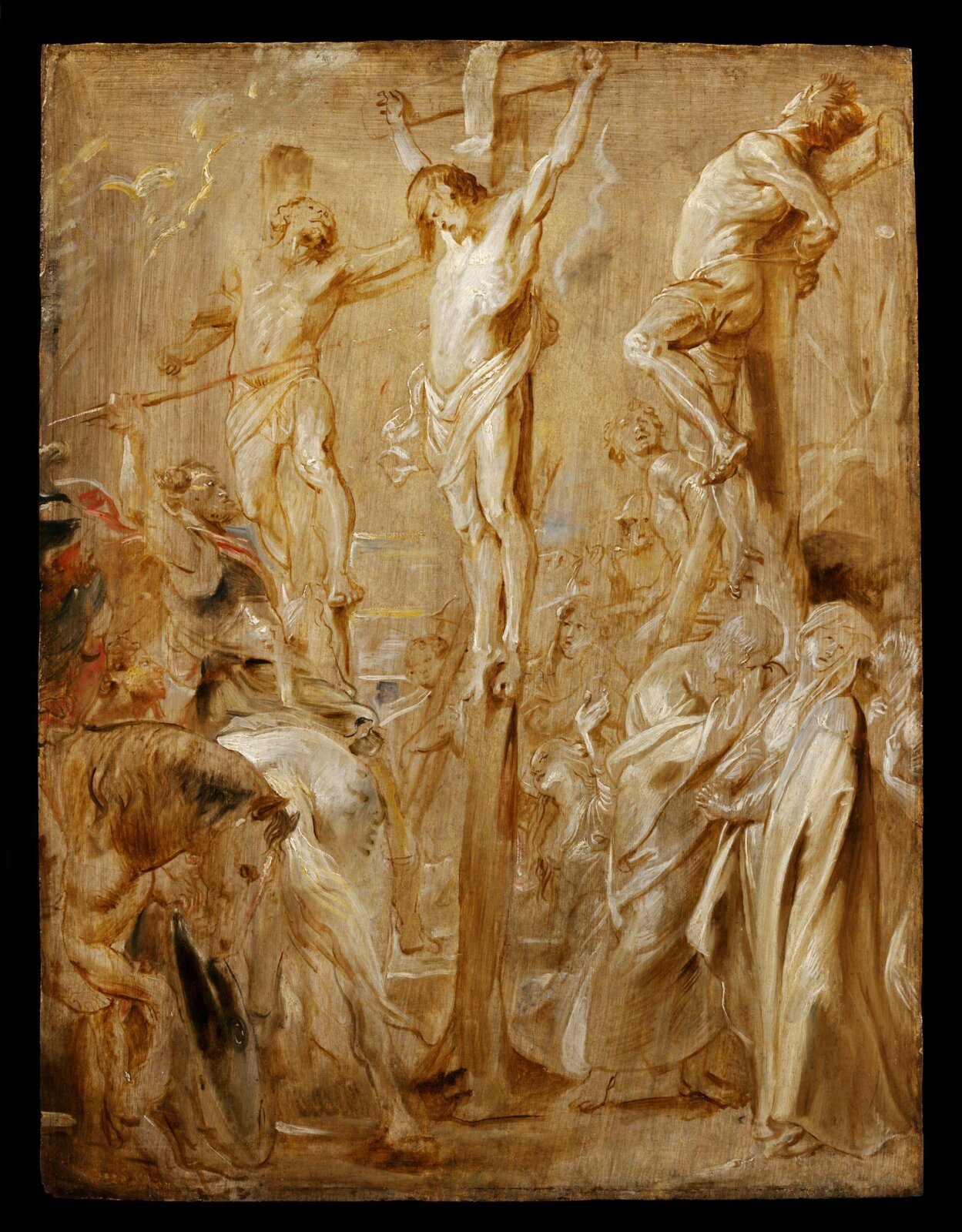
The Coup de Lance
Om maleriet
This painting is a preparatory study in grisaille (monochrome painting) for the high altarpiece of the church of the Récollets, in the city of Antwerp where the artist lived and worked for most of his life. It depicts a scene from the New Testament in which a Roman soldier pierces Christ’s side with a spear to ensure he is dead. The present sketch is fine example of Rubens’ art which imported the monumental Baroque style from Italy in Flanders and deeply influenced the development of 17th-century Flemish painting.
Victoria and Albert Museum

Oplysninger
- Inventarnummer
- 351-1878
Imens i livet hos Peter Paul Rubens
Hele livet23. marts 1618
Son born: Nicolaas Rubens, Lord of Rameyen
1619–1620
Privileges for Engravings (Copyright)
Rubens obtained "privileges" — an early analogue of copyright — for the reproduction of his engravings: in France for 10 years on 3 July 1619, in Holland for 7 years on 24 February 1620, and also in the territory of the Spanish Netherlands.
1621
Marie de' Medici's Commission for the Luxembourg Palace Cycles
The Queen Mother of France, Marie de' Medici, commissioned from Rubens two large allegorical cycles for the Luxembourg Palace — one on her own life and one on the life of the late Henry IV; the second series was never completed.
1621
Employed by: Marie de' Medici
1622
Publication of "The Palaces of Genoa"
The two-volume Palazzi di Genova, with 139 engraved plates, was published; Rubens had prepared it with Deodato del Monte as early as 1607 to acquaint the Flemish with Italian architecture.
1622
Paris: Discussing the Cycle and Covert Intelligence Gathering
While in Paris to discuss the Marie de' Medici cycle, Rubens covertly gathered information on the political situation in France, relying on his friendship with Nicolas-Claude Fabri de Peiresc.