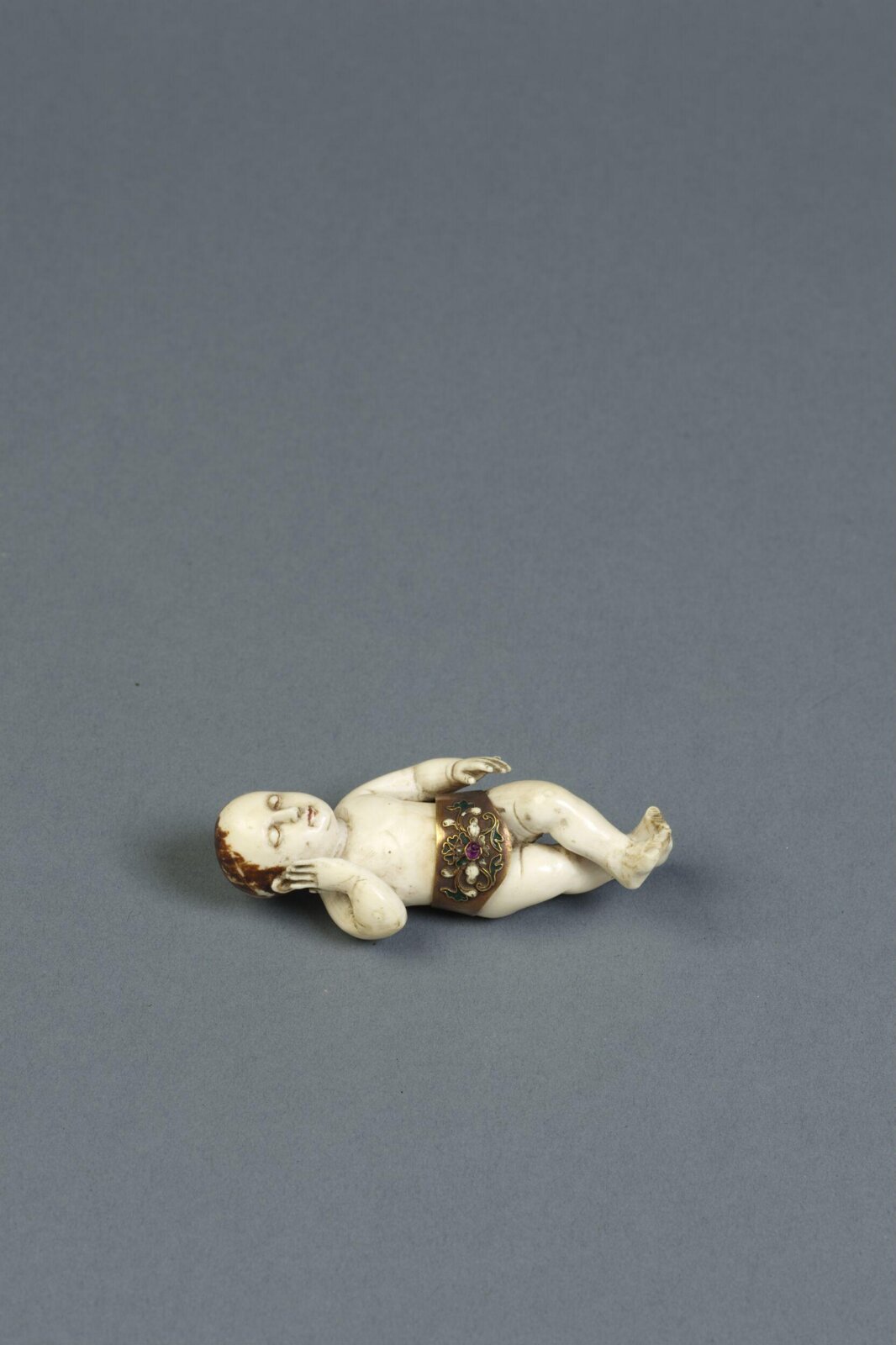
The Christ Child
Må man se det?
Tager ikke imod for tiden

Victoria and Albert Museum
London, Storbritannien
Det hører til samlingen, men er ikke udstillet for tiden.
- Kontrolleret
- Uændret siden
- Kilde
- Museets egne samlingsdata
About the sculpture
This ivory statuette representing the infant Christ was probably made in ca. 1650-1700 in Goa. The metal belt is modern. It is apparently intended to be viewed horizontally. It resembles in general form the seated figures of Christ on The Mount of the Good Shepherd. The enamelled belt was previously thought to have been added in Mexico (Museum records), but is now considered to be more probably European, perhaps Netherlandish or Spanish, although it is likely to date from the seventeenth century, and therefore to be approximately contemporary with the ivory.
Read on
Goa was the second base in India to be established by the Portuguese, having been conquered by Alfonso de Albuquerque (about 1453-1515) during the reign of Manuel I of Portugal initially in 1510, and then reconquered in 1512. Portugal was interested first and foremost in trade, and the discovery of India was motivated by a desire to dominate trade-routes. But the Christian settlers and missionaries were also keen to convert the native populace to Christianity, and religious images in ivory were commissioned to assist in this. Some were exported to Europe, but others evidently remained and were used for evangelical purposes. From the sixteenth century onwards, the four main missionary Orders (Augustinians, Jesuits, Dominicans and Franciscans) built churches and aimed to convert the inhabitants of India. Despite the control of the Church over subject matter, the iconography of Indian art also permeated Christian ivories.
Victoria and Albert Museum
Oplysninger
- Inventarnummer
- A.16-1922
What it shows
I kataloget
Kilder
- Victoria and Albert Museum: the museum's own open data · hentet for 10 dage siden
- Billede: Victoria and Albert Museum — © Victoria and Albert Museum, London