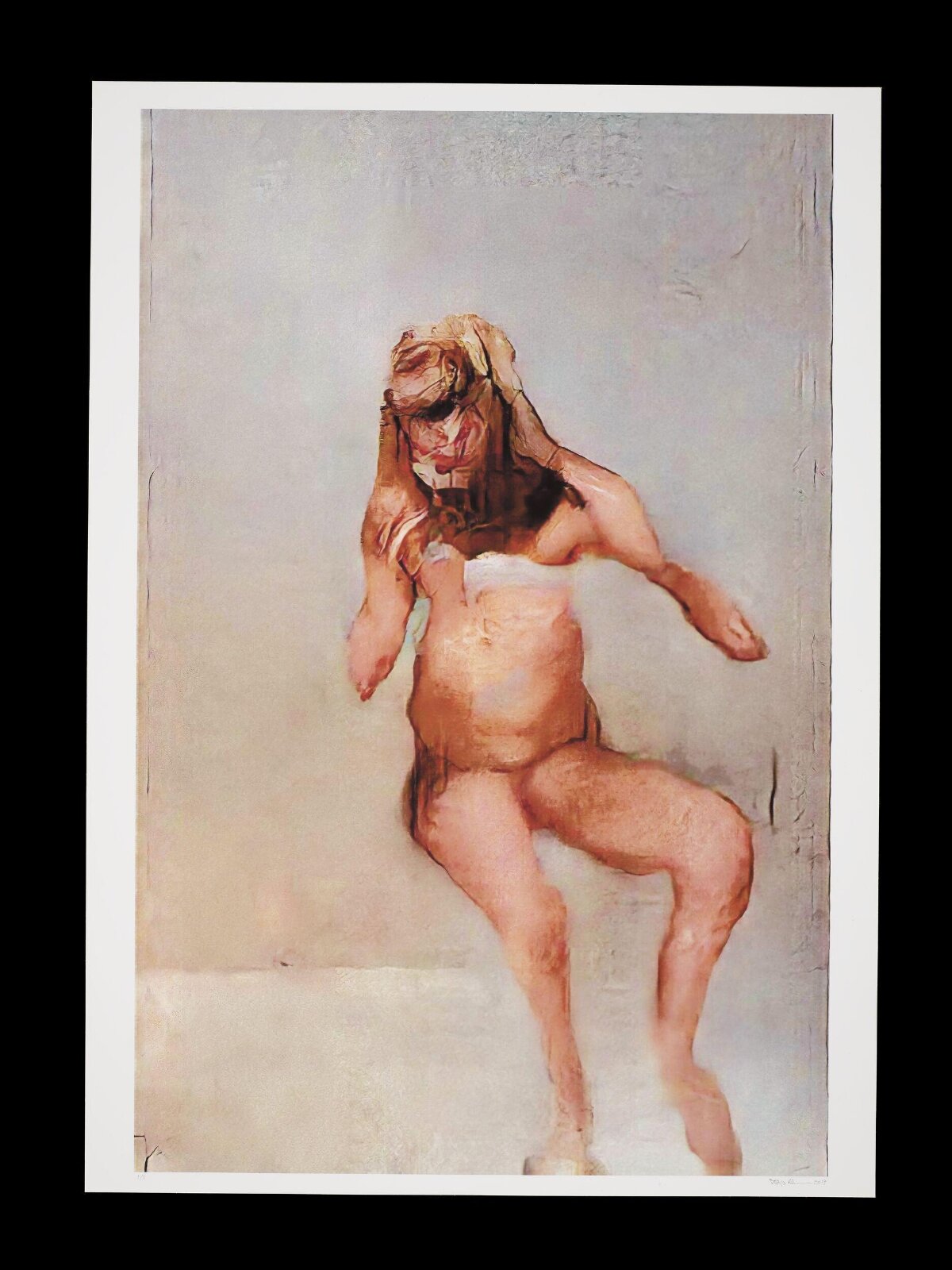
The Butcher's Son
Kan det ses?
Ikke udstillet lige nu
Hvor er »The Butcher's Son« i dag? Samling: Victoria and Albert Museum, London. Ikke udstillet lige nu. Kontrolleret 25. september 2026.

London, Storbritannien
Det hører til samlingen, men er ikke udstillet for tiden.
- Kontrolleret
- Uændret siden
- Kilde
- Museet
Om værket
The Butcher's Son was created by Mario Klingemann using a Generative Adversarial Network (GAN) trained on stick figures and images of the human body from the web. The piece is part of Klingemann’s Imposture Series, which sought to transform stick figures into figurative “paintings” to explore posture and the machinic depiction of the human body.
Læs videre
A GAN is a machine learning model that generates new data, such as an image, that resembles a given dataset. Developed in 2014, it consists of two neural networks: a generator, which creates a new image from random noise, and a discriminator, which evaluates the new image’s similarity to the training dataset. GANs “learn” by analysing many images to recognise patterns. As both networks improve, the process continues until the generator has produced an image almost indistinguishable from the dataset. The distinct aesthetic results of this process – the visible AI “artefacts” and the surreal, occasionally grotesque and non-human forms generated by the machine – are important for Klingemann as the complexity of the human figure challenges and reveals the limits of AI capabilities in the 2010s.
Mario Klingemann (b.1970) is a German artist who works with machine learning, code and algorithms, and is interested in generative and evolutionary art, data visualisation and robotics. Since learning programming in the early 1980s, he has explored human creativity, questioned the capacities of advanced technologies to emulate and augment these processes, and sought to understand and subvert the inner workings of opaque systems.
Victoria and Albert Museum
Oplysninger
- Inventarnummer
- E.57-2021
I kataloget
Kilder
- Victoria and Albert Museum
- Billede: Victoria and Albert Museum — © Victoria and Albert Museum, London







