Barnett NewmanUSA, 1905–1970
The Beginning
Må man se det?
Ja, det tager imod

Art Institute of Chicago
Sal291Chicago, USA
Udstillet for publikum. Hvem der står inde for det, står nedenfor.
- Kontrolleret
- for 40 minutter siden
- Uændret siden
- 19. aug. 2026
- Kilde
- Museets egne samlingsdata
About the painting
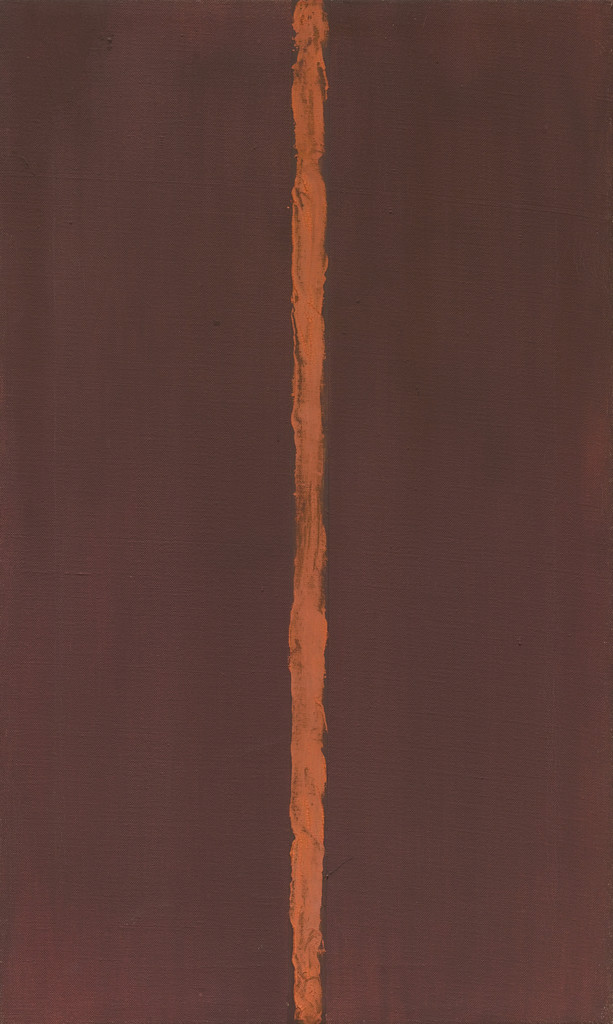
A key figure in the Abstract Expressionist movement, Barnett Newman is widely considered one of the most innovative and influential painters of the twentieth century. A brilliant colorist and a master of expansive spatial effects, he pioneered a new pictorial language that was at once emphatically abstract and powerfully emotive. For Newman, the spiritual content of abstract art was of paramount importance. Although his works seem largely focused on the formal qualities of painting, he insisted that they possessed symbolic meaning. This meaning was never explicit, but he often alluded to it in the titles of his works, as with The Beginning. In the mid-1940s Newman became preoccupied with the Old Testament story of Creation and began selecting titles in reference to the book of Genesis.
Read on
In this painting, the bands of paint that emerge from the base of the canvas interrupt a richly variegated field of color, a sort of primordial fog. The artist created these three stripes with the aid of masking tape, which he applied to the canvas as a guideline before adding the surrounding color. This work is an important precursor to Newman’s mature paintings, which are characterized by a single vertical band, or “zip,” that divides the composition.
Art Institute of ChicagoCC BY 4.0
Oplysninger
- Inventarnummer
- 1989.2
What it shows
I kataloget
Kilder
- Art Institute of Chicago: the museum's own open data · hentet for 6 dage siden
- Billede: Art Institute of Chicago — © the artist or rights holder
Imens i livet hos Barnett Newman
Hele livet1944
A list of “the men in the new movement”
Trying to explain America’s newest art movement, he draws up a list of “the men in the new movement”: ex-Surrealists such as Matta, Wolfgang Paalen (named twice), Gottlieb, Rothko, Pollock, Hofmann, Baziotes, Gorky and others, with Motherwell followed by a question mark. He also writes catalogue forewords and reviews and organises exhibitions.
1947
A mature style and a declaration on art’s content
Reaches his mature style — in 1946–1947 he paints “The Command” and “The Euclidean Abyss” — and declares that any art worthy of the name must address “life”, “man”, “nature”, “death” and “tragedy”.
1947
Death of his father
His father, Abraham, dies; two years later his name will be given to one of Newman’s darkest paintings.
1948
The Subjects of the Artist school
With William Baziotes, Mark Rothko, Robert Motherwell and David Hare he founds the Subjects of the Artist School at 35 East 8th Street; its well-attended public lectures feature speakers such as Jean Arp, John Cage and Ad Reinhardt.