Jacques JordaensFlandern, 1593–1678
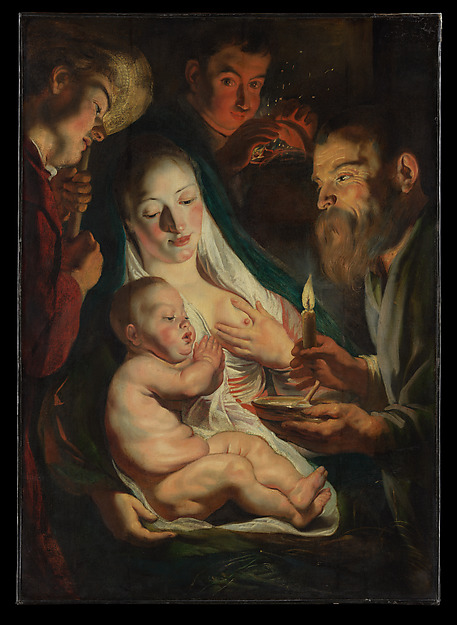
Holy Family
Kan det ses?
Ikke udstillet lige nu
Hvor er »Holy Family« i dag? Samling: Eremitagen, Sankt Petersborg. Ikke udstillet lige nu. Kontrolleret 29. august 2026.

Sankt Petersborg, Rusland
Det hører til samlingen, men er ikke udstillet for tiden.
- Kontrolleret
- Uændret siden
- Kilde
- Museet
Om maleriet
Med museets ord — på russisk
Повторение картины, находящейся в Музее Метрополитен в Нью-Йорке, исполненной Йордансом в начале 1620-х годов и дополненной в 1650-е годы. На картине Музея Метрополитен Младенец Христос, поддерживаемый Девой Марией, попирает ногами змия, обвившегося вокруг земной сферы (глобуса), выступая, таким образом, как будущий Спаситель Мира. Этот протестантский мотив в эрмитажном повторении заменен другим, имеющим также протестантские корни. В эрмитажной картине Младенец Христос попирает ногами змия, стоя не на земной сфере, а на черепе. Череп в данном случае является символом смерти, а змий – греха. В таком контексте Христос предстает как будущий Победитель греха и смерти.
Eremitagen
Oplysninger
- Inventarnummer
- ГЭ-3337
I kataloget
Kilder
- Eremitagen
- Billede: Eremitagen — Museum open access
Imens i livet hos Jacques Jordaens
Hele livet1615
Admitted to the guild as a master “water painter”
After eight years of training Jordaens was admitted to the Antwerp Guild of Saint Luke as a master waterscilder (“water painter”), one who painted in water-based paints the canvases that served as substitutes for tapestries or as tapestry cartoons; other accounts give 1616. Unlike Rubens and van Dyck, he never went to Italy and, apart from short trips within the Low Countries, lived in Antwerp all his life.
15 May 1616
Marries his master's daughter Catharina van Noort
Jordaens married Adam van Noort's eldest daughter Catharina (other accounts call her Anna Catharina). At first the couple lived with or near his father-in-law; they had three children: Elisabeth, Jacob, who became a painter, and Anna Catharina.
1639–1640
Charles I's commission: “The Story of Cupid and Psyche”
Through the English king's agent in Brussels, Balthazar Gerbier, and the diplomat Cesare Alessandro Scaglia, Jordaens received a commission for 22 paintings for the Queen's House at Greenwich without knowing the patron or the destination; when Rubens, Gerbier's preferred choice, died on 30 May 1640, the whole commission passed to Jordaens. But Scaglia died in May 1641, only eight paintings reached the English court, and a dispute with his heirs over payment for seven of them dragged on into the next generation.
1640–1641
After Rubens's death, Antwerp's leading painter
With the deaths of Rubens in 1640 and van Dyck in 1641, Jordaens became the leading painter of Antwerp, and commissions came increasingly from abroad; Rubens's heirs asked him to finish “Perseus and Andromeda” for Philip IV. He never became a court painter: he worked mainly for wealthy townspeople and the clergy.
1645
Converts to Calvinism
Raised a Catholic, Jordaens converted to Calvinism (other accounts say only that this was towards the end of his life), yet the Catholic Church went on commissioning altarpieces from him. He belonged to the Protestant community De Brabantse Olijfberg and towards the end of his life opened his house for private services.
18. oktober 1678
Died