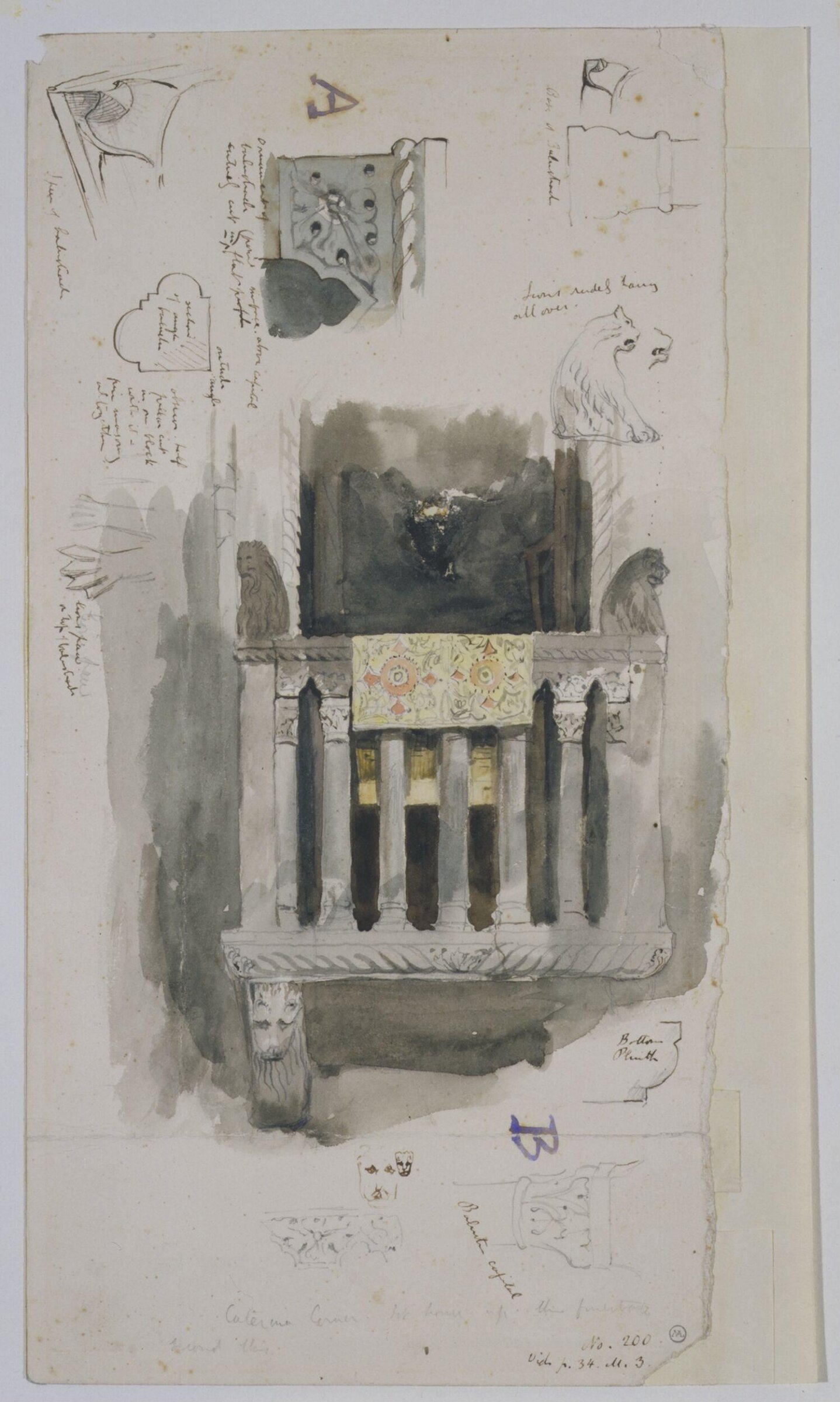
John RuskinEngland, 1819–1900
Street in Bologna
Kan det ses?
Ikke udstillet lige nu
Hvor er »Street in Bologna« i dag? Samling: Art Institute of Chicago, Chicago. Ikke udstillet lige nu. Kontrolleret 29. september 2026.

Chicago, USA
Det hører til samlingen, men er ikke udstillet for tiden.
- Kontrolleret
- Uændret siden
- Kilde
- Museet
Oplysninger
- Inventarnummer
- 1970.1267
I kataloget
Kilder
- Art Institute of Chicago
- Billede: Art Institute of Chicago — CC0
Imens i livet hos John Ruskin
Hele livet1834–1900 · Virkested
Great Britain
1843
In defence of Turner: the first volume of “Modern Painters”
The first volume of “Modern Painters” — an answer to Turner's critics — is published by Smith, Elder & Co. under the name “A Graduate of Oxford”; Ruskin controversially argues that modern landscape painters, above all Turner, surpass “Old Masters” such as Gaspard Dughet, Claude and Salvator Rosa in “truth to nature”, moral as well as material. Reviews are mixed, but Charlotte Brontë and Elizabeth Gaskell are impressed, and the book cements Ruskin's relationship with Turner.
1845
“Venice is lost to me”: restoration is destruction
Alarmed by the combined effects of decay and modernisation on the city, Ruskin writes that Venice is lost to him, and becomes convinced that architectural restoration is destruction and that the only true and faithful action is preservation and conservation.
1845
First journey without his parents
At 26 Ruskin travels without his parents for the first time to study medieval art and architecture in France, Switzerland and above all Italy: in Lucca he sees the tomb of Ilaria del Carretto by Jacopo della Quercia, which he considers the finest example of Christian sculpture; he draws inspiration from the Campo Santo in Pisa, is especially struck by Fra Angelico and Giotto in Florence, and in Venice by the mosaics of St Mark's and Tintoretto's paintings in the Scuola di San Rocco.
April 1846
The second volume of “Modern Painters”
The second volume, written on the strength of his travels, concentrates on Renaissance and pre-Renaissance artists rather than Turner and is more theoretical than the first: Ruskin links the beautiful with the divine, and critics receive it more warmly, although many find his attack on the aesthetic orthodoxy of Joshua Reynolds hard to accept. That summer he is abroad again with his father, who still hopes his son might become a poet — one of many factors raising the tension between them.
October 1847
Engagement to Effie Gray
During 1847 Ruskin grows closer to Euphemia “Effie” Gray, the daughter of family friends, for whom he had once written “The King of the Golden River”; they become engaged in October.