Satyress
Må man se det?
Ja, det tager imod

Udstillet for publikum.
- Kontrolleret
- Uændret siden
- Kilde
- Museet
Om skulpturen
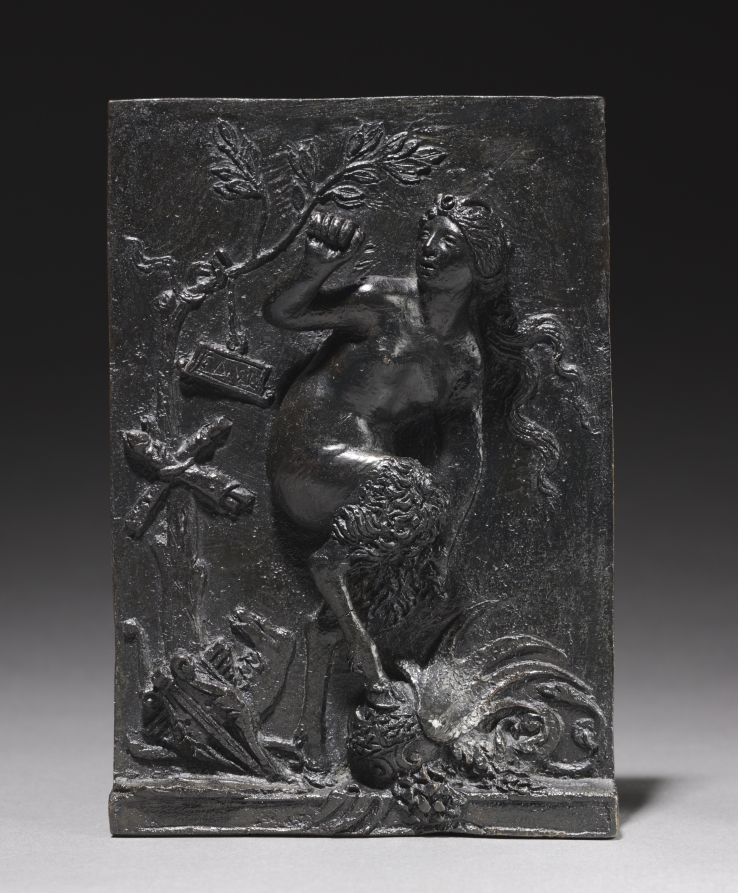
In antiquity, satyrs were lustful woodland deities who delighted in wine and revelry. Renaissance artists adopted them as symbols of vice and carnal love; the female satyr, or satyress, on this bronze plaquette, recently reattributed from Riccio to Mosca, was probably derived from a copper engraving of a Roman sarcophagus by Marcantonio Raimondi (c. 1470/82-1527/34). Both the sarcophagus and subsequent engraving depicted a bacchanalia, or scene of orgiastic carousal; the peculiar objects surrounding the satyress have been added by the artist, possibly in an effort to remove the figure from her lewd original composition and give a more refined meaning. The satyress rests her right hoof upon a plumed helmet. A coiled shape, possibly a snake, winds out of the helmet. To her left, a laurel tree stands with only half of its branches in bloom.
Læs videre
Two severed animal legs are tied around its trunk and an illegible plaque hangs from one of its branches. A lyre, a pan pipe, an animal jawbone and a bow are gathered at the base of the tree. The highly allegorical nature of the work uses obscure symbols, rather than a distinct narrative, to convey meaning and could possibly be read as an allegory of physical pleasure overcoming virtue.
The Cleveland Museum of Art
Oplysninger
- Inventarnummer
- 1947.29
I kataloget
Kilder
- The Cleveland Museum of Art
- Billede: The Cleveland Museum of Art — Museum open access
Imens i livet hos Giovanni Maria Mosca
Hele livet1515–1530 · Virkested
Venice
1515–1530 · Virkested
Padua
1530–1553 · Virkested
Kraków