
 Frank StellaUSA, 1936–2024
Rowley
Må man se det?
Tager ikke imod for tiden

National Gallery of Art
Washington, D.C., USA
Det hører til samlingen, men er ikke udstillet for tiden.
- Kontrolleret
- for 17 timer siden
- Uændret siden
- 19. aug. 2026
- Kilde
- Museets egne samlingsdata
Oplysninger
- Inventarnummer
- 2004.30.17
What it shows
I kataloget
Kilder
- National Gallery of Art: the museum's own open data · hentet for 4 dage siden
- Billede: National Gallery of Art — © the artist or rights holder
Imens i livet hos Frank Stella
Hele livet1959–1960
“Sixteen Americans” at MoMA
Four of his black pinstripe paintings are shown at the Museum of Modern Art in the exhibition Sixteen Americans, alongside works by Louise Nevelson, Ellsworth Kelly, Jasper Johns and Robert Rauschenberg. Many critics were outraged, but today the works are considered seminal in 20th-century American art.
1960
First show at Leo Castelli's gallery
His first show at the New York gallery of the dealer Leo Castelli brings few sales. Stella shares studio space with Hollis Frampton and Carl Andre, who also attended Phillips Academy, and scrounges a living by renting cold-water flats and painting houses.
1960s
Travels in the Middle East
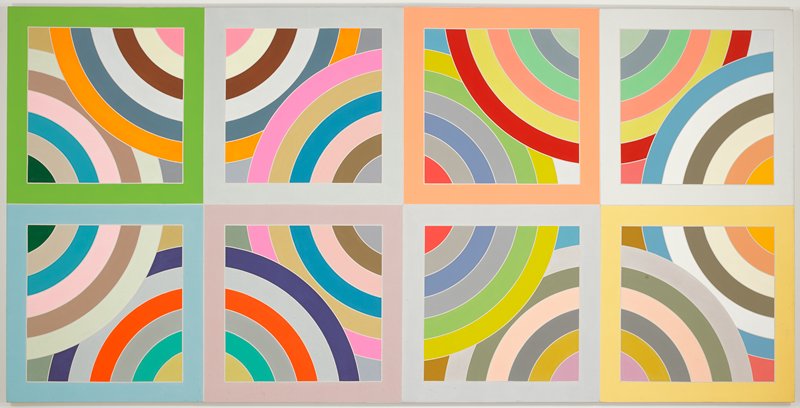
He visits circular-plan cities in the Middle East and is especially intrigued by the arches and decorative patterns he sees in the architecture and art of Iran; these cities will later give their names to works of the Protractor series.
1961
Married: Barbara Rose
1961
Follows Barbara Rose to Pamplona
Barbara Rose, later a well-known art critic, goes to Spain on a Fulbright fellowship; Stella follows her, and they marry in London that November. On their return to New York the couple move into an apartment near Union Square.
1964
Radio discussion with Judd and Flavin
In a radio discussion of contemporary art with fellow artists Donald Judd and Dan Flavin, Stella sums up his approach: only what can be seen is there — “What you see is what you see.” The tautology later became known as the unofficial motto of minimalism.






![Scenes from the Passion of Christ: The Descent into Limbo [right panel], Andrea Vanni, 1380s](https://api.nga.gov/iiif/4205a539-eadd-4486-89a7-3cff9c1ba428/full/!2400,2400/0/default.jpg)


