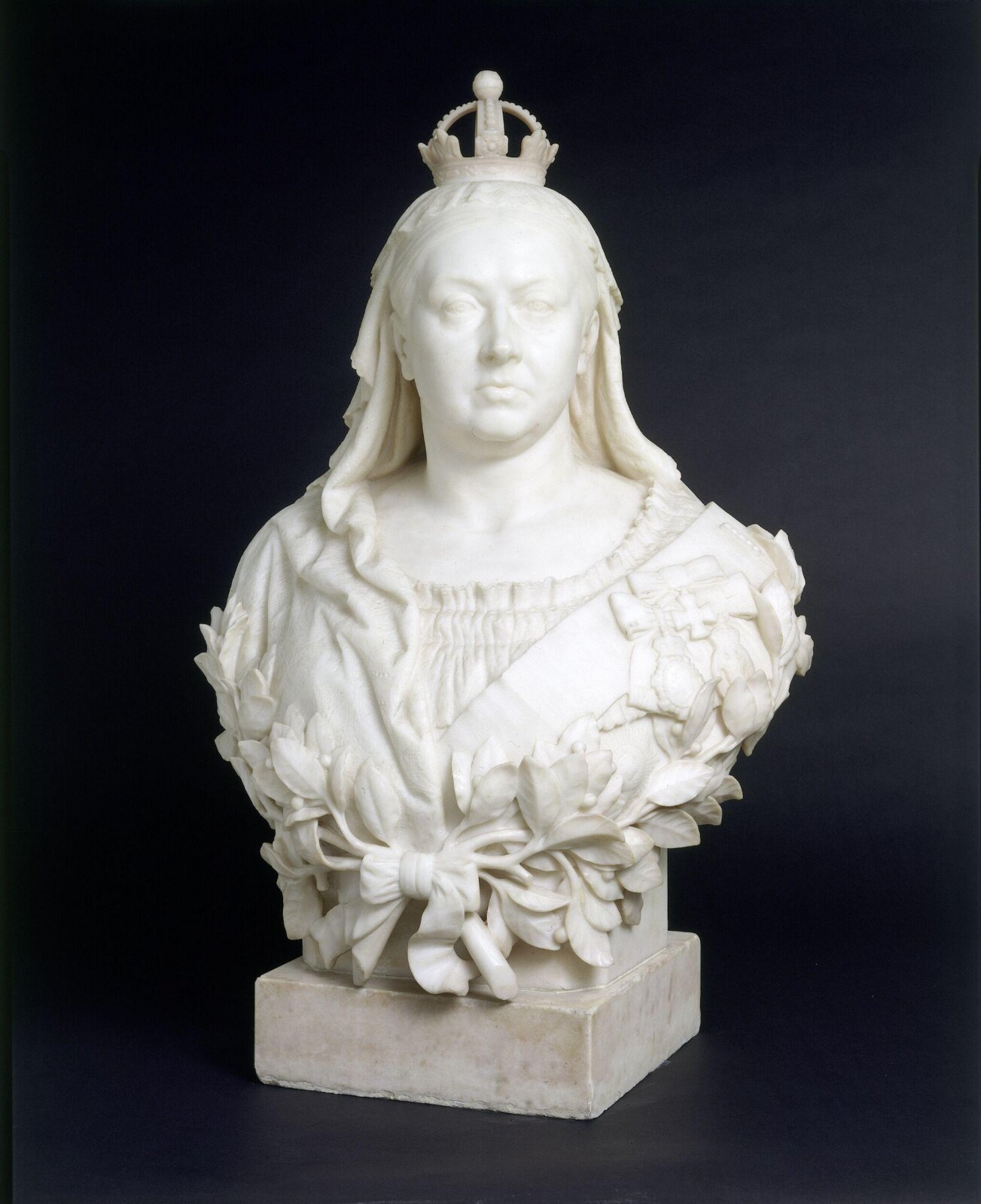
Count Victor Gleichen
Queen Victoria
Må man se det?
Ja, det tager imod

Victoria and Albert Museum
London, Storbritannien
SalBritish Galleries, Room 125, Edwin and Susan Davies Gallery
Udstillet for publikum. Hvem der står inde for det, står nedenfor.
- Kontrolleret
- Uændret siden
- Kilde
- Museets egne samlingsdata
About the sculpture
Object Type
The occasion for the commission of this formal marble bust is unknown; the piece was acquired by the Museum in 1963. In addition to her other decorations, the Queen is shown wearing the badge of the Imperial Order of the Star of India and the Royal Red Cross (instituted in 1883).
People
Count Gleichen (Viktor Ferdinand Franz Eugen Gustav Adolf Constantin Friedrich Prinz von Hohenlohe-Langenburg) was the son of a half-sister of Queen Victoria. He served in the Royal Navy, and was promoted Admiral in 1887. After losing all his fortune in a bank crash, he became a professional sculptor and was accorded a studio in St James's Palace. He had been a pupil of William Theed (1804-1891), one of the sculptors favoured by Queen Victoria. Gleichen exhibited frequently at the Royal Academy, and his daughter Fedora, Countess Gleichen, also became a sculptor.
Materials & Making
Read on
Marble busts were among the most popular and prestigious types of public portrait undertaken in Britain during the Victorian period. The marble, a relatively expensive material, was imported, usually from Italy via The Netherlands, since there are no marble quarries in this country. The skills needed to carve marble might also be learned abroad, where an aspiring artist would probably gain his most important training assisting an established sculptor.
Victoria and Albert Museum
Oplysninger
- Inventarnummer
- A.16-1963
What it shows
I kataloget
Kilder
- Victoria and Albert Museum: the museum's own open data · hentet for 10 dage siden
- Billede: Victoria and Albert Museum — © Victoria and Albert Museum, London