Hendrick GoltziusHolland, 1558–1617
Portret van Julius Caesar Scaliger
Må man se det?
Ukendt

Amsterdam, Holland
Ejeren er kendt; om værket er udstillet i dag, vides ikke.
- Kilde
- Museet
Om værket
Med museets ord — på nederlandsk
Julius Caesar Scaliger oftewel Giulio Cesare della Scala (1484–1558) was een Italliaanse humanist en natuurkundige die een groot deel van zijn leven doorbracht in Frankrijk. Zijn portretbuste is in een ovaal geplaatst, de blik gericht naar rechts. Rondom het portret een architecturale ornamentomlijsting met allegorische en mythologische figuren. Rond het ovaal en in de cartouche onder het portret teksten in Latijn. Onder de prent (op hetzelfde blad) een tekst in boekdruk bestaande uit 24 regels Latijn van Janus Dousa Filius.
Rijksmuseum Amsterdam
Oplysninger
- Inventarnummer
- RP-P-OB-10.157
Hvad det viser
I kataloget
Kilder
- Rijksmuseum Amsterdam
- Billede: Rijksmuseum Amsterdam — public domain
Imens i livet hos Hendrick Goltzius
Hele livetlate 1580s
Depression and consumption
From the late 1580s he suffered from depression and consumption; his family life was unhappy.
1590
Departure for Italy
He fled from his wife and, despite his illnesses, set out for Italy — via Hamburg and Munich to Venice, Bologna and Florence. Part of the way he traveled on foot, passing himself off as a commoner, "partly out of a love of mystification."
1591
Eight months in Rome
He arrived in Rome in January 1591 and stayed eight months (with a brief sojourn in Naples). He discovered Raphael, was especially impressed by Michelangelo and Giambologna, and studied art from classical sculpture to the masters of the Renaissance.
1591
Return to Haarlem with a collection of drawings
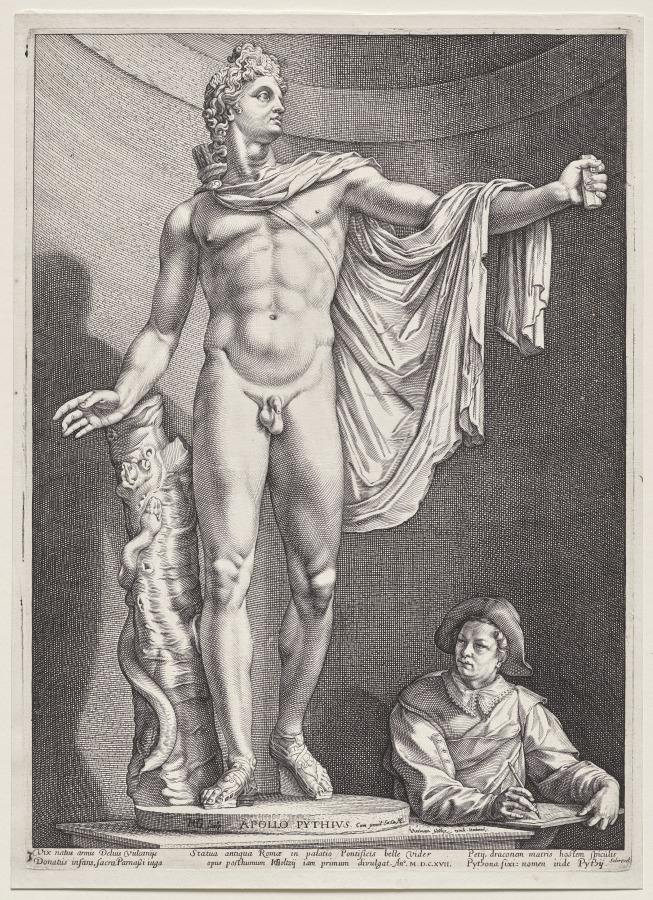
He returned to Haarlem, bringing from Italy a large collection of drawings that he used for the rest of his life; from the Roman material three engravings of classical statues are known, including the Farnese Hercules.
mid-1590s
Turn toward classicism
In the mid-1590s his art underwent a gradual stylistic turn toward classicism; at the same time he began executing large finished pen drawings on parchment in a calligraphic technique imitating the methods of burin engraving.