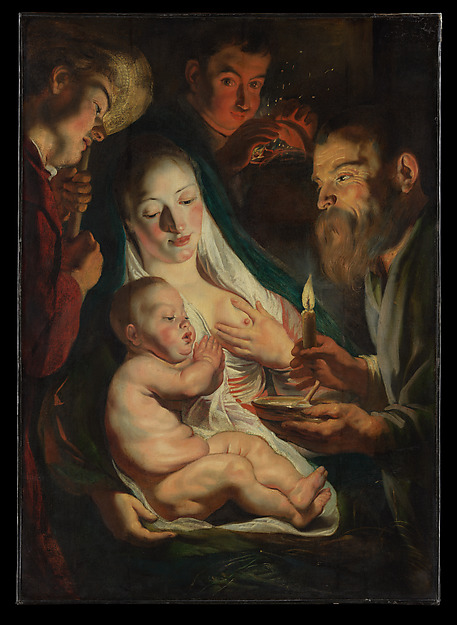
Jacques JordaensFlandern, 1593–1678
Portrait of an Old Man
Kan det ses?
Ja, udstillet nu
Hvor er »Portrait of an Old Man« i dag? Eremitagen, Sal 248, Sankt Petersborg. Ja, udstillet nu. Kontrolleret 29. august 2026.

Sankt Petersborg, Rusland
Lukket· åbner i morgen kl. 12.00
Udstillet for publikum.
- Kontrolleret
- Uændret siden
- Kilde
- Museet
Om maleriet
Med museets ord — på russisk
Эта картина - пример из числа многочисленных заказов, выполненных Йордансом на протяжении 1630-х - 1640-х гг., где он использовал весь набор приемов, традиционно применяемых при написании официальных портретов, жанр которых был блестяще развит Рубенсом и Ван Дейком. Такой портрет обязательно включает в себя архитектурный фон и драпировку, модель изображается в богатом костюме. Выбранная художником точка зрения на портретируемого снизу позволяет и в прямом и в переносном смысле возвысить человека, подчеркнуть его значимость. Однако, если главная задача Ван Дейка состоит в передаче высокой сословной принадлежности своих заказчиков, их врожденной знатности и могущества, то Йорданс, используя эти же приемы, представляет нам особый класс удачливых представителей буржуазии.
Læs videre
В эрмитажном портрете он изображает пожилого человека без всякой лести, с опухшими глазками и тучным телом, едва помещающимся в кресле. Тем не менее, богатое архитектурное окружение и масштаб фигуры, заполняющей весь передний план, бесспорно, придают значимость и величие личности портретируемого. Работа была выполнена около 1637 г. и является парной к "Портрету женщины в кресле" (Коллекция Фарингдона, Беркшир, Англия).
Eremitagen
Oplysninger
- Inventarnummer
- ГЭ-486
I kataloget
Kilder
- Eremitagen
- Billede: Eremitagen — Museum open access
Imens i livet hos Jacques Jordaens
Hele livet1621–1667
His workshop: fifteen pupils in the guild records
Between 1621 and 1667 the guild registered fifteen pupils with Jordaens (the best known being Jan Boeckhorst), and six more are named in court documents; his son Jacob and his cousin Arnoldus also trained with him. His fame drew foreigners: after 1642 the Polish painter Aleksander Jan Tricius became his pupil, and in 1645 Queen Christina of Sweden meant to send her protégé Georg Waldau, but the threat of war in Flanders prevented it.
1635
Decorations for the entry of Cardinal-Infante Ferdinand
For the Joyous Entry into Antwerp of the new governor of the Habsburg Netherlands, designed by Rubens, Jordaens painted decorative pictures after Rubens's designs and, with Cornelis de Vos, completed the triumphal Arch of Philip on the Huidenvetterstraat. The arch was temporary and has not survived.
c. 1635 – 1645
Publishes prints after his own designs
Like Rubens and van Dyck, Jordaens realised that prints spread an artist's fame and on his own initiative issued 14 engravings under privilege (cum privilegio), cut by Marinus Robyn van der Goes, Schelte a Bolswert, Paulus Pontius and other Antwerp engravers. Beneath each image stood his name as inventor and a short explanation in Latin verse.
1637–1638
Paintings for Philip IV's hunting lodge
In 1636 Rubens received a commission for a mythological series after Ovid's Metamorphoses for the Torre de la Parada near Madrid and enlisted Antwerp painters. Jordaens painted “Apollo and Pan” (1637, after a sketch by Rubens) and “Vertumnus and Pomona” (1638).
1639
Buys “De Halle van Lier” and rebuilds his home
Jordaens bought the large house “De Halle van Lier” (“Turnhoutsche Halle”) at Hoogstraat 43, opposite his home, and turned the three houses into one large complex: he designed the façades of the inner courtyard in the manner of Rubens's house and decorated the rooms with sculpture, carpets and fine furniture. He lived and worked there until his death.
1639–1640
Charles I's commission: “The Story of Cupid and Psyche”
Through the English king's agent in Brussels, Balthazar Gerbier, and the diplomat Cesare Alessandro Scaglia, Jordaens received a commission for 22 paintings for the Queen's House at Greenwich without knowing the patron or the destination; when Rubens, Gerbier's preferred choice, died on 30 May 1640, the whole commission passed to Jordaens. But Scaglia died in May 1641, only eight paintings reached the English court, and a dispute with his heirs over payment for seven of them dragged on into the next generation.