Salvator RosaItalien, 1615–1673
Philosophy
Kan det ses?
Ja, udstillet nu
Hvor er »Philosophy« i dag? National Gallery, Sal 32, London. Ja, udstillet nu. Kontrolleret 16. november 2026.

London, Storbritannien
Lukket· åbner kl. 10.00
Udstillet for publikum.
- Kontrolleret
- Uændret siden
- Kilde
- Museets hjemmeside
Om maleriet
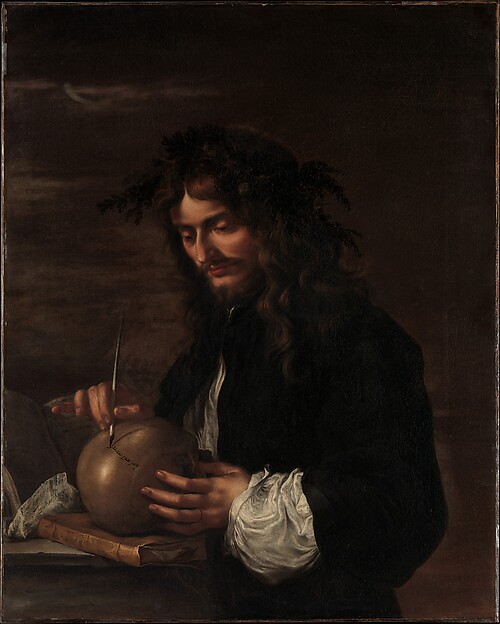
Philosophy is an oil-on-canvas self-portrait of Salvator Rosa, the Italian Baroque artist who is best known for his imaginary landscapes. The painting is usually interpreted as a personification of philosophy. It is dated to c. 1645 and has been held by the National Gallery in London since 1933.
Læs videre
The painting measures 116.3 cm × 94 cm (45.8 in × 37.0 in). The artist has depicted himself in this three-quarter-length portrait wearing a black scholar's cap over his long and untidy hair, against a stormy grey sky. The viewpoint is below the sitter, who looks down at the viewer with a sombre expression. The right side of his unshaven face is heavily shadowed, emphasising his long narrow nose. His left-hand holds his gown closed, with the collar of a white shirt appearing at the neck. The right hand holds a plaque which bears the Latin inscription AVT TACE / AVT LOQVERE MELIORA / SILENTIO, which may be translated as "Be quiet, unless your speech be better than silence" or "Either keep quiet, or say something better than silence". The Latin is taken from the Anthologia of Stobaeus, a collection of quotations from Ancient Greek authors published in the 5th century AD.
Rosa wished to increase his artistic reputation by becoming known as a painter of philosophical subjects, rather than landscapes less valued in the hierarchy of genres. Rosa published his anthology of sayings, Il Teatro della Politica, in 1669; this included entries on the virtue of silence.
Rosa made the painting around 1645 for Filippo Niccolini, who was among his circle of friends in Florence and had served as tutor and then as chamberlain to Rosa's patron Giovanni Carlo de' Medici. Though the work was long thought to be a self-portrait due to an inscription on the reverse of the painting, recent scholarship has suggested that it was intended as a personification of philosophy. It may have been intended as a pendant painting to his 1640 painting Poetry, 116.2 cm × 94.6 cm (45.7 in × 37.2 in), now held in the Wadsworth Atheneum, which depicts Rosa's female companion Lucrezia as a personification of Poetry with a similar size and composition against a similarly plain background. That work was also owned by the Niccolini family in Florence until it was sold to Rev. John Sanford (1777–1855) in the 1830s. It later entered the collection of the Marquess of Lansdowne at Bowood House, where it remained until 1955 (when most of the dilapidated house was demolished); it was sold to the Wadsworth Atheneum in 1956.
Philosophy was presented to the National Gallery in 1933, by Henry Petty-Fitzmaurice, 6th Marquess of Lansdowne, in memory of his father, the 5th Marquess, who had died in 1927.
A different self-portrait by Rosa, dating to c. 1645 and in the Musée des Beaux-Arts de Strasbourg, depicts the artist with a bushy beard and dark hair; another of 1647 in the Metropolitan Museum of Art similarly has a long beard and hair, while a third in Detroit, of c. 1650–1660, is similar to a painting of Rosa dressed as a soldier in Siena, c. 1640–1649.
Oplysninger
- Inventarnummer
- NG4680
I kataloget
Udstillingshistorik
Udstillet · Sal 32
National Gallery · 12. okt. 2026 — nu · Kontrolleret
Om værket var udstillet, vides ikke
National Gallery · 29. sep. 2026 — 12. okt. 2026 · Ubekræftet
Kilder
- Wikidata
- Billede: National Gallery — Salvator Rosa · Public domain · Wikimedia Commons
Imens i livet hos Salvator Rosa
Hele livet1640–1649
Den florentinske periode ved Medici-hoffet
Efter skandaløse skænderier med Bernini og hans mislykkede forsøg på optagelse i Accademia di San Luca flyttede han til Firenze på Giovanni Carlo de’ Medicis invitation, hvor han blev til 1649.
1640s
Grundlæggelsen af Accademia dei Percossi i Firenze
I Firenze grundlagde han Accademia dei Percossi, en kombination af atelier og salon for digtere, dramatikere og malere, hvor satirer og komedier blev læst ved middage.
1640s
Satirerne "Musik", "Poesi", "Maleri" og "Krig"
Mens han opholdt sig hos brødrene Maffei i Volterra, skrev han fire satirer, Musik, Poesi, Maleri og Krig; samtidig malede han billedet Filosofi (nu i National Gallery, London).
1647
Deltagelse i Masaniellos opstand
Ifølge en udbredt beretning deltog han i folkeopstanden ledet af Masaniello i Napoli; han malede et portræt af Masaniello og udtrykte sympati for opstanden i en af sine satirer.