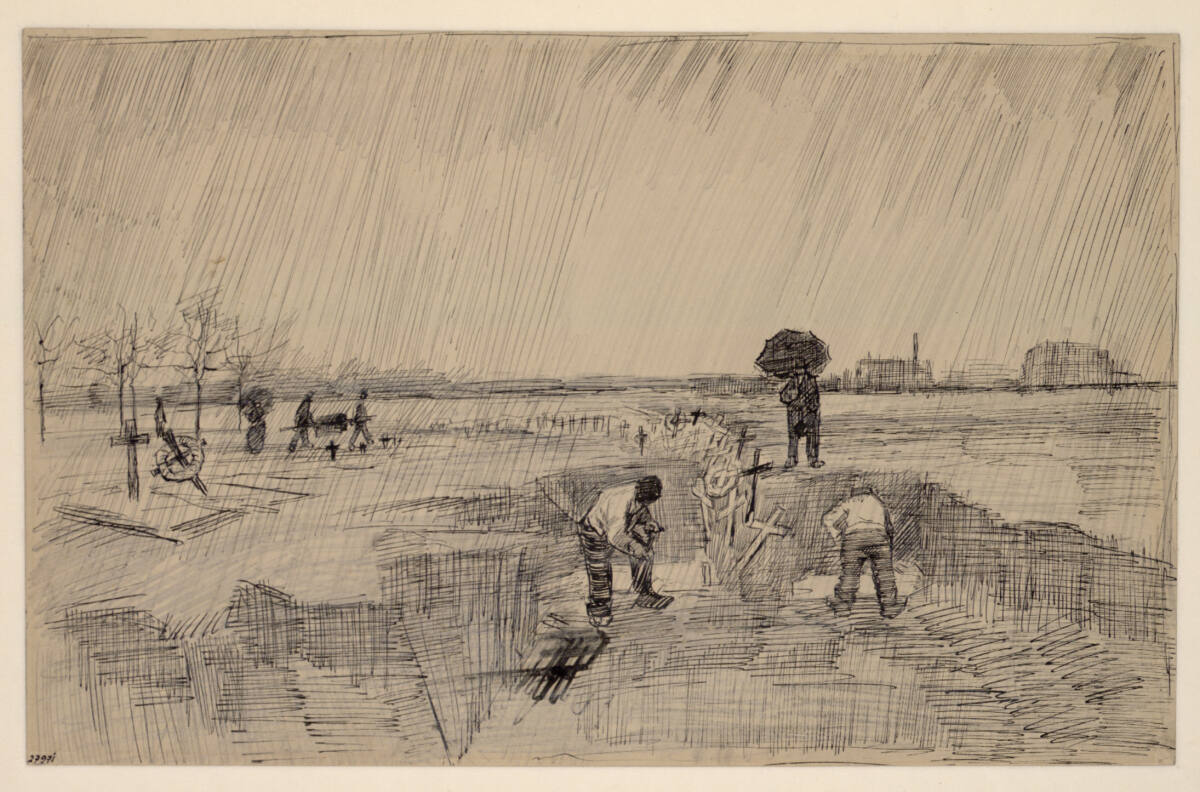
Max KlingerTyskland, 1857–1920
Pest (Opus XIII, Blatt 5)
Må man se det?
Ukendt

Wien, Østrig
Ejeren er kendt; om værket er udstillet i dag, vides ikke.
- Uændret siden
- Kilde
- Museet
Oplysninger
I kataloget
Kilder
- Albertina
- Billede: Albertina — Public Domain Mark 1.0
Imens i livet hos Max Klinger
Hele livetspring 1902
Klinger’s Beethoven at the Vienna Secession
His “Beethoven”, a sculpture of bronze, ivory, alabaster and several marbles, is the centrepiece of the 14th Vienna Secession exhibition, where Klimt’s Beethoven Frieze is visible in an adjoining room and Gustav Mahler is persuaded to transcribe music from the Ninth Symphony for trumpets. The exhibition causes a scandal: the sculpture is dismissed as kitsch and some are offended by a nude Beethoven, while Rodin is reported to have walked past it without comment, later saying it had nothing to do with sculpture.
1903
Move to Großjena
He leaves Leipzig and buys a house with a vineyard in Großjena near Naumburg, where he settles for the last years of his life.
1903
Vice-president of the German Artists’ League
He is elected vice-president of the Deutscher Künstlerbund (German Artists’ League).
1904
A contract for the Brahms monument in Hamburg
He signs a contract for a monument to Brahms for the Hamburg Musikhalle and travels to Italy again to buy marble.
22 November 1904
His mother dies
His mother, Auguste Friederike Eleonore Klinger, née Richter, dies.
1905
Villa Romana: a prize for young artists
A founder of the Villa Romana Prize for young German artists, he buys the villa in Florence as a study centre and converts it with Georg Hirzel; the first laureate, Gustav Klimt, declines the honour and passes it on to Maximilian Kurzweil. Other accounts say the prize was founded in 1906.