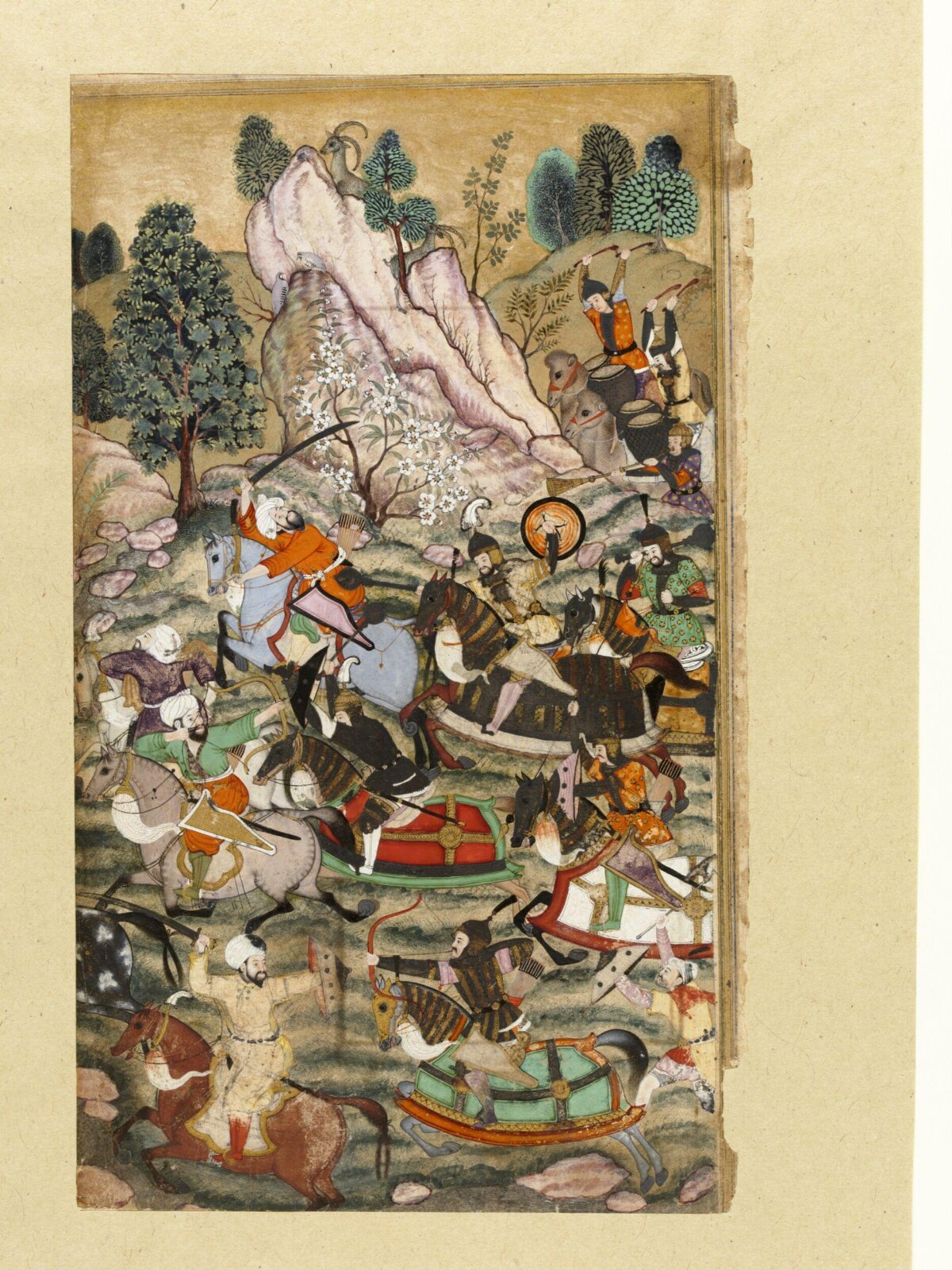
Painting
Må man se det?
Tager ikke imod for tiden

Victoria and Albert Museum
London, Storbritannien
Det hører til samlingen, men er ikke udstillet for tiden.
- Kontrolleret
- Uændret siden
- Kilde
- Museets egne samlingsdata
About the painting
This folio has been detached from a late 16th century manuscript copy of the Baburnama, or History of Babur. Babur was the founder of the Mughal empire, and a prince descended from the Central Asian conqueror Timur. He wrote a lively memoir in Eastern Turkish rather than Persian, the language of culture and literature of his time and place and which he also knew well. By the late 16th century, when his grandson Akbar had consolidated Mughal rule in the Indian subcontinent, few people at court were able to understand the memoirs in their original language, and Akbar commissioned a Persian translation. This was completed in 1589 by the great bibliophile Abdul-Rahim, who presented it to Akbar on the emperor's return from visiting Babur's tomb in Kabul. Many copies were made, some illustrated at the time by Akbar's artists.
Read on
This painting depicts an incident that took place in February 1507, when Babur and his companions travelled in bitter cold and through deep snow from Herat to Kabul. A group of Hazara tribesmen blocked the passage of Babur's advance force and began shooting arrows to prevent them continuing. Babur's army took the men captive, and he intended to execute them, but they were freed when one of Babur's closest companions, Qasim Beg, showed them clemency.
Victoria and Albert Museum
Oplysninger
- Inventarnummer
- IM.272-1913
What it shows
I kataloget
Kilder
- Victoria and Albert Museum: the museum's own open data · hentet for 10 dage siden
- Billede: Victoria and Albert Museum — © Victoria and Albert Museum, London