Painting
Må man se det?
Tager ikke imod for tiden

Victoria and Albert Museum
London, Storbritannien
Det hører til samlingen, men er ikke udstillet for tiden.
- Kontrolleret
- for 8 dage siden
- Uændret siden
- 25. sep. 2026
- Kilde
- Museets egne samlingsdata
About the painting
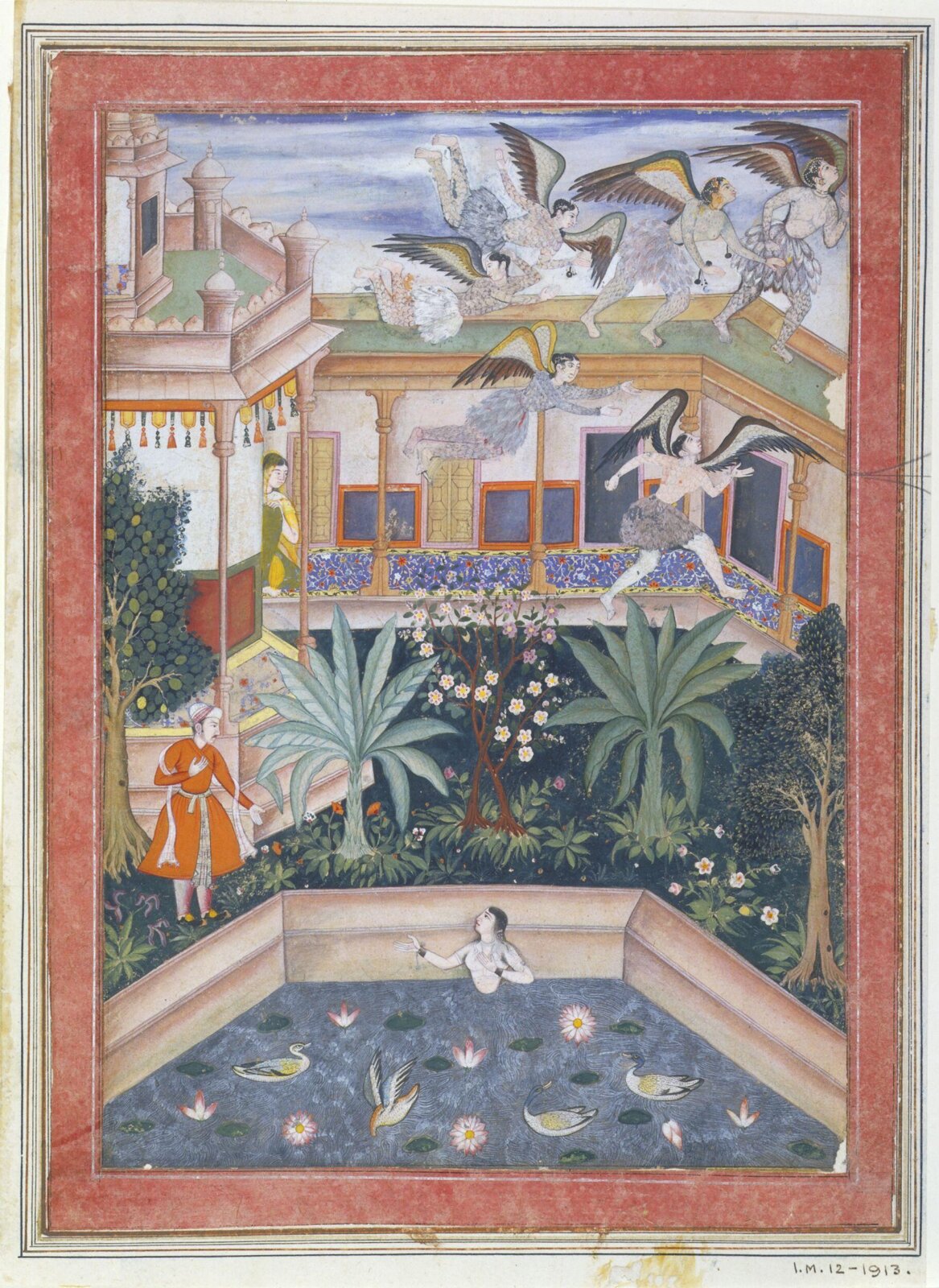
This painting was done within the Mughal empire, probably between about 1580 and 1600. It depicts a lady bathing, remonstrating with a prince, while her six female companions, dressed in leaf garments, escape. It is an illustration to a poetical romance, and has been identified by Robert Skelton with an episode in the awadhi romance Mrigivati, written by the poet Qutban in AD 1504. Qutban was in the service of the Jaunpur king Husain Shah Sharqi, who lost his throne to Sikander Shah Lodi and lived as a refugee at Kahalgaon in Bengal.
Read on
According to the story the king had a favourite son who went hunting and followed a beautiful doe. The doe escaped into a lake and turned into a maiden. The prince remained at the lakeside waiting for her to reappear, and requested his father build a temple by the lake. He was advised that the maiden would return on the day of a religious festival and that he should steal her magic clothes to prevent her escape. He did this, but her six companions saw him, took their own clothes, and flew away. He then declared his love for her and they were married. [Robert Skelton, 25.8.1987]
A paraphrase of the story is found in K.J. Khandalavala and Moti Chandra, New Documents of Indian Painiting- a reappraisal, Bombay, 1969, p. 104.
Victoria and Albert Museum
Oplysninger
- Inventarnummer
- IM.12-1913
What it shows
I kataloget
Kilder
- Victoria and Albert Museum: the museum's own open data · hentet for 8 dage siden
- Billede: Victoria and Albert Museum — © Victoria and Albert Museum, London