Claude MichelFrankrig, 1738–1814
Offering to Priapus
Kan det ses?
Ja, udstillet nu
Hvor er »Offering to Priapus« i dag? J. Paul Getty Museum, Museum South Pavilion, Upper Atrium, Los Angeles. Ja, udstillet nu. Kontrolleret 5. oktober 2026.
Lukket· åbner i morgen kl. 10.00
Udstillet for publikum.
- Kontrolleret
- Uændret siden
- Kilde
- Museet
Om skulpturen
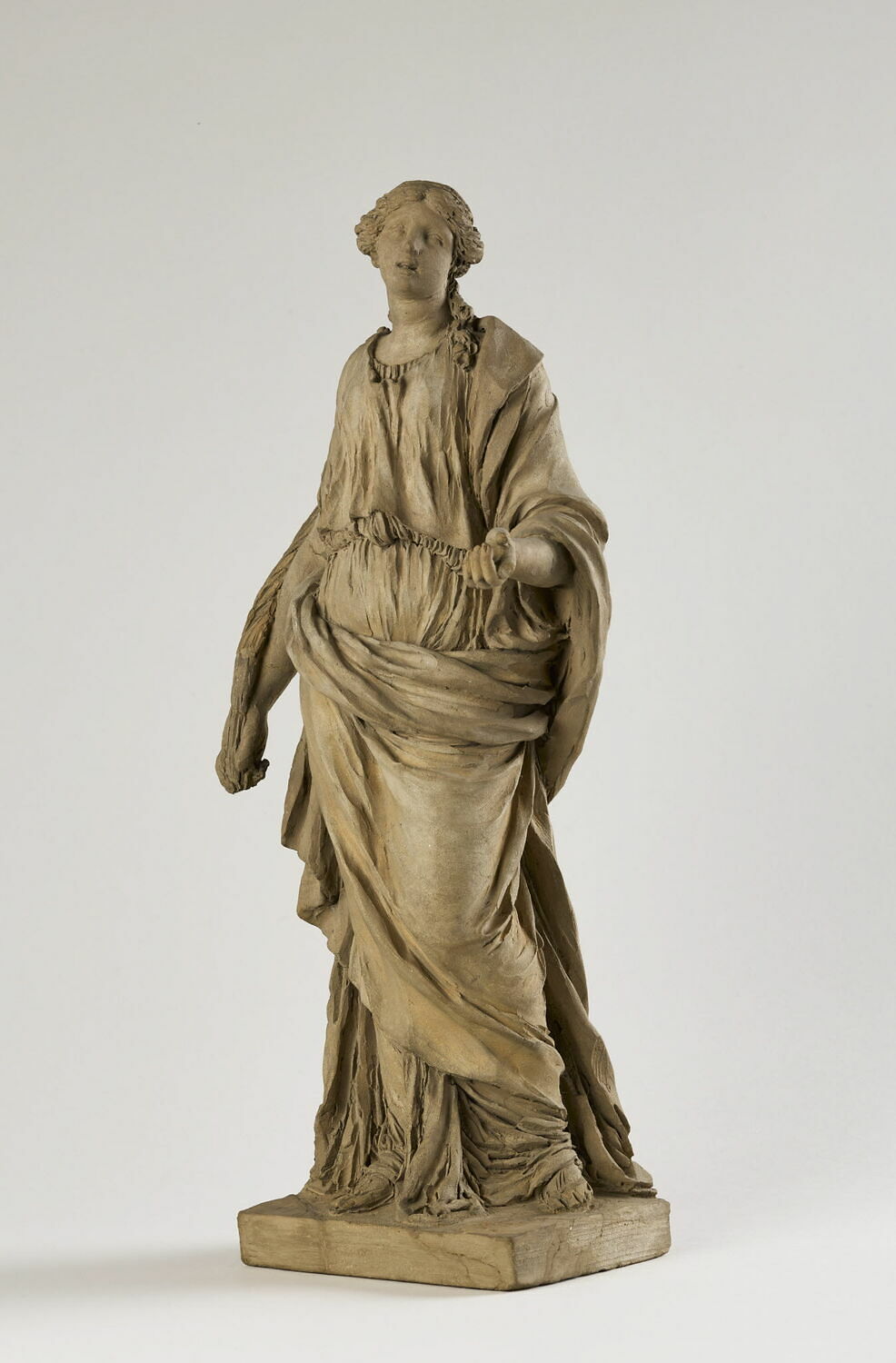
A priestess leads a cloth-draped young woman towards a statue in Clodion's Offering to Priapus, a terracotta of about 1775 at the J. Paul Getty Museum, Los Angeles. The fertility god appears as a boundary marker with goat-like ears. Incense and a sacrificial tripod indicate an offering of the woman's charms, while Cupid wraps a flower garland around the statue, concealing its erect phallus. Though finished all around, the group was designed for frontal viewing on furniture or a mantelpiece. Clodion varied the clay's surface to distinguish flowing or clinging cloth from smooth skin. On view in the South Pavilion's Upper Atrium.
Med museets ord
A woman dressed as a priestess leads a young girl, covering herself with a swath of cloth, toward a statue of Priapus, the ancient god of fertility. With distinctive goatlike ears, Priapus appears in the form of a term, a statue marking a territorial boundary. The smoking incense and the sacrificial tripod indicate that the young girl is making an offering of her charms. Cupid winds a floral garland around the statue of Priapus, camouflaging his characteristic erect phallus. Sculptor Claude Michel, called Clodion, frequently drew from ancient mythology for his terracottas, but his borrowings rarely focused on grand events. For Clodion, ancient culture provided a classical figure style, a repertory of characters and settings, and perhaps most importantly, a nostalgic mood. As was typical of the Rococo style, his works tended to be playful and erotic.
Læs videre
Although Clodion finished the piece in the round, he designed it to be seen from the front, placed on a piece of furniture or on a mantelpiece. Known for his masterful handling of wet clay, the artist focused on texture, differentiating clingy or billowing drapery from satin-textured skin.
J. Paul Getty Museum
Oplysninger
- Inventarnummer
- 85.SC.166
I kataloget
Kilder
- J. Paul Getty Museum
- Billede: J. Paul Getty Museum — Open Content