Christoffer Wilhelm EckersbergDanmark, 1783–1853
Oedipus and Antigone
Kan det ses?
Ikke udstillet lige nu
Hvor er »Oedipus and Antigone« i dag? Samling: Sveriges Nationalmuseum, Stockholm. Ikke udstillet lige nu. Kontrolleret 9. oktober 2026.

Stockholm, Sverige
Det hører til samlingen, men er ikke udstillet for tiden.
- Kontrolleret
- Uændret siden
- Kilde
- Museets hjemmeside
Om maleriet
New acquisitions, November 2016 Five paintings by Christoffer Wilhelm Eckersberg Nationalmuseum has added no fewer than five works by Christoffer Wilhelm Eckersberg to its Danish art collection. Each of the works represents a different segment of Eckersberg’s artistic career: from his student years in Paris, via his artistic rebirth in Paris and Rome, to his firmly established but never stagnant later life in Copenhagen. Christoffer Wilhelm Eckersberg (1783–1853) held a travel scholarship from the Royal Danish Academy of Fine Arts from 1812 to 1816, having already left Copenhagen for Paris in 1810. In Paris, he studied under Jacques-Louis David for about a year. Eckersberg’s art is often viewed in relation to that of his teacher, but in fact he had been in Paris for over a year before beginning his studies with David.
Læs videre
Oedipus and Antigone (1812) is an interesting work in this connection. Encountering the artistic treasures of Paris proved an overwhelming experience for Eckersberg, who wrote in a letter home in November 1811 that he was suffering from an inferiority complex. A year later, he reported that he now felt like part of the city’s artistic life. Could Oedipus and Antigone have played an important part in restoring his self-confidence? The painting must have been one of his greatest challenges up until that point, especially when it came to creating a spatial effect in the composition through the interplay of light with strategically positioned image components. The high standard of the work shows that Eckersberg had reached a degree of maturity and fulfilled much of his potential even before setting foot in David’s studio.
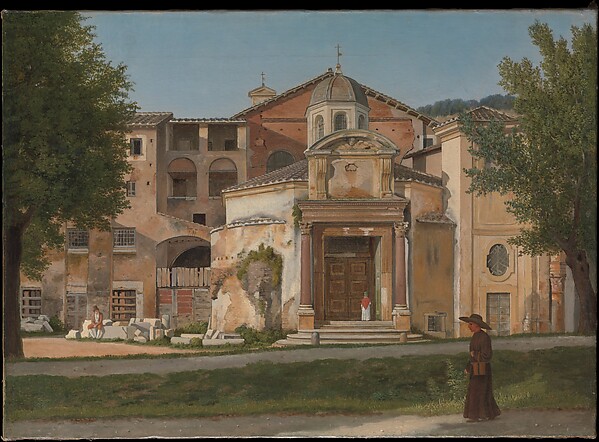
From Paris, Eckersberg’s journey took him to Rome, where he stayed for more than three years before returning to Copenhagen. In Rome, he developed his art further, as can be clearly seen in his famous views of the city and its surroundings. As well as these, he produced a small number of figure paintings, of which Una Ciociara (from Ciociaria, a district near Rome), painted in 1816, was the last. The very high technical standard of this work encapsulates Eckersberg’s development as an artist while in Italy. The creation of this piece was unusually well documented. Eckersberg’s diary tell us that he took great pains in composing his image of the Roman girl. For instance, he rented the model’s costume for two weeks. After his return to Copenhagen, the painting was significant because he used it for teaching purposes and made his students copy it.
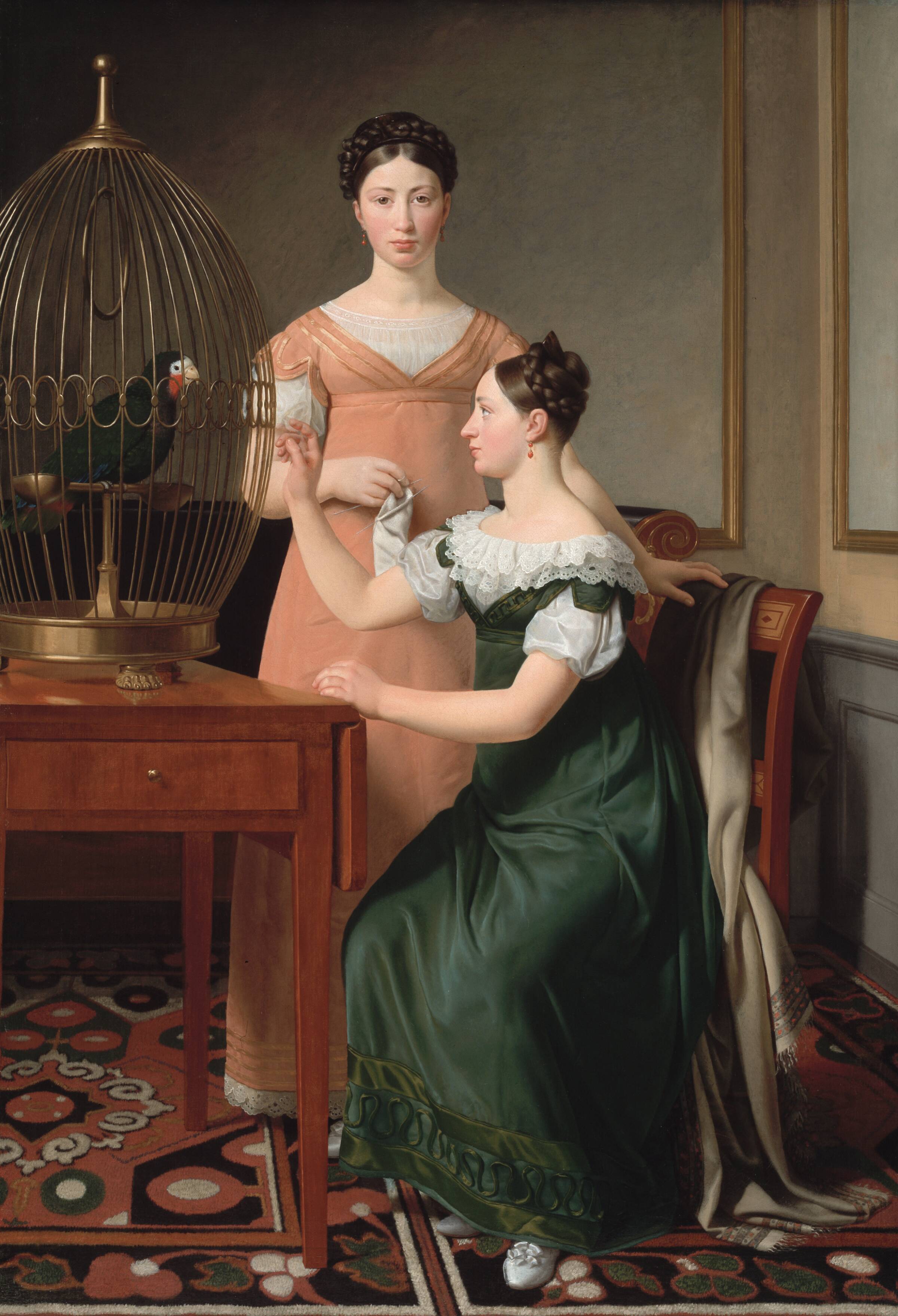
Back in Copenhagen, Eckersberg became a professor at the Royal Danish Academy of Fine Arts in 1818. The following year, he received his most prestigious commission to date: painting portraits of King Frederik VI and the royal family. The first part of the job was to paint the king’s portrait in profile. The resulting depiction was adopted as official and reproduced many times by Eckersberg himself and by copyists. Nationalmuseum’s version, dating from 1820, is believed to be the second in Eckersberg’s own series. This version was commissioned by the king as a gift to José Maria O’Neill, an Irish merchant who served as Danish consul general in Lisbon. In his diary, Eckersberg frequently mentions Rasmus Borch, an art collector who commissioned a number of works, including a portrait of his daughter Karen Margrethe Borch.
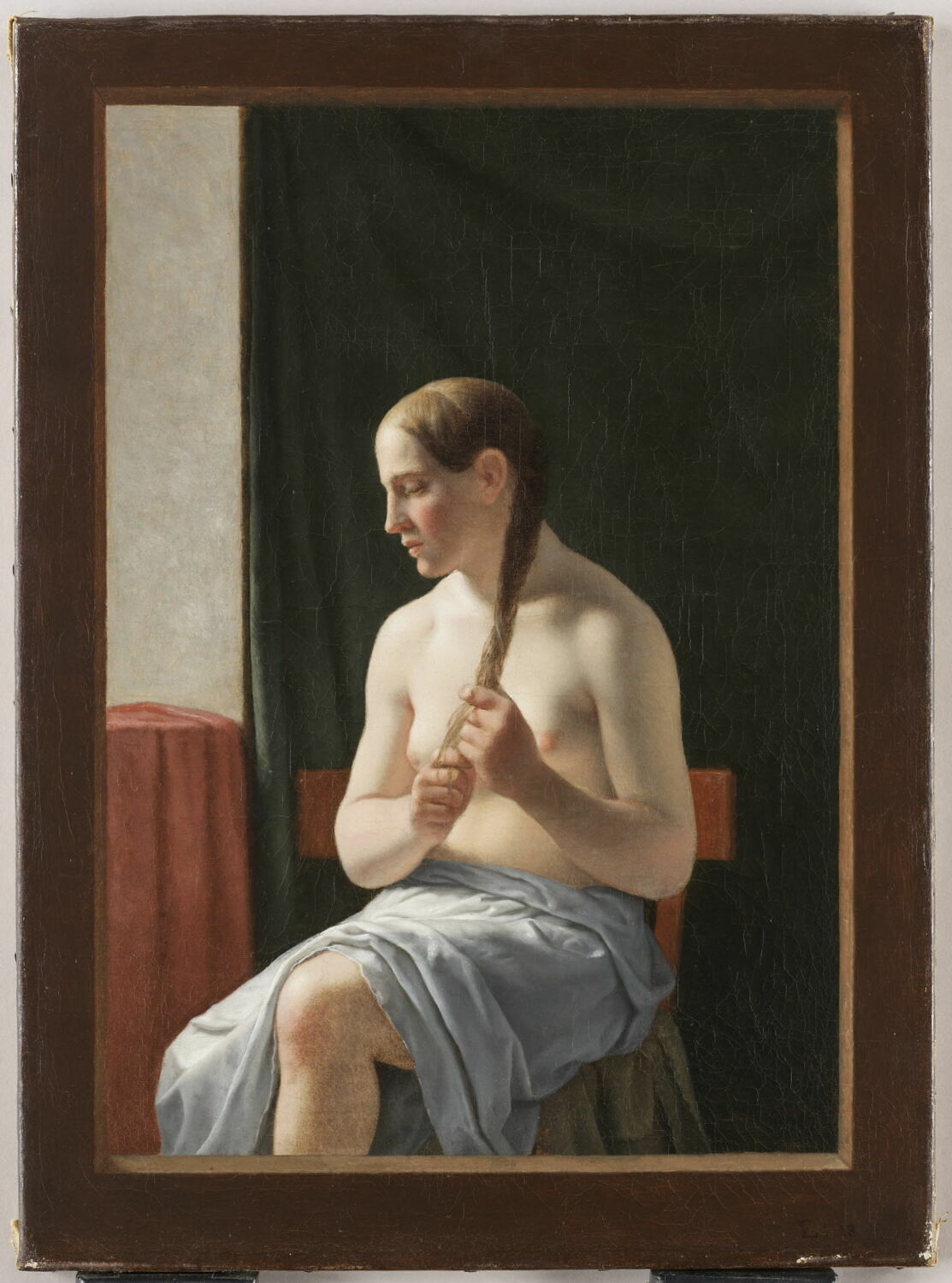
This portrait is special in various ways: it is almost full-figure, and an illusionistic frame surrounds the motif. There is another similar work by Eckersberg with a painted frame: a nude, now in the Louvre, that was sold by the artist to the same Rasmus Borch. Like the latter work and other nudes by Eckersberg, the portrait features a delicate, classically cool depiction of skin; in other words, the fusion of reality and ideal pursued by Eckersberg throughout his life. As a professor at the Academy of Fine Arts, Eckersberg occupied an apartment in Charlottenborg Palace in Copenhagen. Nationalmuseum’s recently acquired drawing depicts three of
Sveriges Nationalmuseum
Oplysninger
I kataloget
Udstillingshistorik
Ikke udstillet for tiden
Sveriges Nationalmuseum · 9. okt. 2026 — nu · Kontrolleret
Om værket var udstillet, vides ikke
Sveriges Nationalmuseum · 27. sep. 2026 — 9. okt. 2026 · Ubekræftet
Kilder
- Sveriges Nationalmuseum
- Billede: Sveriges Nationalmuseum — Public Domain Mark 1.0
Imens i livet hos Christoffer Wilhelm Eckersberg
Hele livet1 July 1810
Marries Christine Rebecca Hyssing
Against his wishes he marries E. Christine Rebecca Hyssing in order to “legitimize” her son, Erling Carl Vilhelm Eckersberg. Erling will later get an academy education and become a copperplate engraver.
3 July 1810
Leaves the country with de Neergaard
A few days after the wedding he sets out abroad with the writer, art lover and patron Tønnes Christian Bruun de Neergaard, travelling through Germany to Paris. He is eager to stretch his skills and knowledge and partly to escape the reality of his marriage, and he arranges the money for the journey himself, since the stipend has not yet been paid.
1810–1813 · Virkested
Paris
1811–1812
Studies under Jacques-Louis David in Paris
He improves his skill in painting the human form and follows his teacher's admonition to paint after Nature and the Antique in order to find Truth.
1811–1812
Lifelong friends: Møller and Clemens
In Paris he forms a lifelong friendship with his roommate, the fellow artist Jens Peter Møller, and with the engraver Johan Frederik Clemens, a collaborator of Jens Juel.
1813
Travels to Rome via Florence
After two years in Paris he travels on via Florence to Rome to continue his studies.