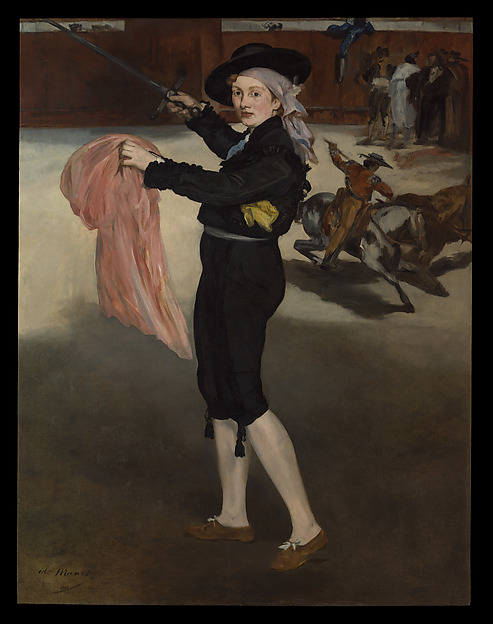
Édouard ManetFrankrig, 1832–1883
Odalisque
Må man se det?
Tager ikke imod for tiden

Art Institute of Chicago
Chicago, USA
Det hører til samlingen, men er ikke udstillet for tiden.
- Kontrolleret
- i forgårs
- Uændret siden
- 19. aug. 2026
- Kilde
- Museets egne samlingsdata
Oplysninger
- Inventarnummer
- 1984.1128
I kataloget
Kilder
- Art Institute of Chicago: the museum's own open data · hentet for 6 dage siden
- Billede: Art Institute of Chicago — CC0
Imens i livet hos Édouard Manet
Hele livet1867
His own pavilion near the Pont de l'Alma
In 1867, during the World's Fair in Paris, Manet set up his own pavilion near the Pont de l'Alma and showed fifty of his best works of the past ten years. Possibly this step led to his works being accepted at the next two Salons.
1867
Zola defends Manet in print
In 1867 Émile Zola, who supported Manet publicly in the press, wrote that the public was not accustomed to such simple and direct translations of reality and that this luminous and serious painting interprets nature with a gentle brutality.
1867
First contacts with the future Impressionists
When Manet was excluded from the International Exhibition of 1867 he set up his own; it was enormously expensive, his mother worried he would waste his inheritance, and it earned poor reviews from the major critics, but it provided his first contacts with several future Impressionist painters, including Degas.
1868
Friendship with Berthe Morisot
In 1868 Manet became a friend and colleague of Berthe Morisot; she is credited with convincing him to attempt plein air painting, to which Camille Corot had introduced her. Through Morisot, Manet became friends with Degas, Monet, Renoir, Sisley, Cézanne and Pissarro.
1870
The siege of Paris: Manet in the army
During the siege of Paris Manet, a convinced republican, sent his family to Oloron-Sainte-Marie in the south of France, while he himself, with many fellow artists, joined the army and took part in the defence of the capital; he was lucky to survive.
1870s
Refuses to exhibit with the Impressionists
Although his own work influenced and anticipated the Impressionist style, Manet resisted involvement in Impressionist exhibitions: he did not wish to be seen as the representative of a group identity and held that modern artists should seek to exhibit at the Salon.