Henri RousseauFrankrig, 1844–1910
Oak Branch
Må man se det?
Tager ikke imod for tiden

Art Institute of Chicago
Chicago, USA
Det hører til samlingen, men er ikke udstillet for tiden.
- Kontrolleret
- Uændret siden
- Kilde
- Museets egne samlingsdata
Om værket
According to his close friend, artist Robert Delaunay, all of Rousseau’s drawings were destroyed after his death. However, as the inscription indicates, this rare drawing was a gift from the artist to a certain “Mademoiselle Herminie,” and it survived as a result. Rousseau often used flowers in his work for their symbolic meanings. He was particularly fond of daisies, which traditionally represent innocence and purity. Perhaps a more heartfelt message was intended here, as the petals of daisies are often plucked, one by one, to find out if one is loved: “she loves me, she loves me not.”
Art Institute of ChicagoCC BY 4.0
Oplysninger
- Inventarnummer
- 2013.1019
I kataloget
Kilder
- Art Institute of Chicago: the museum's own open data · hentet for 7 dage siden
- Billede: Art Institute of Chicago — CC0
Imens i livet hos Henri Rousseau
Hele livet1893–1910
A studio in Montparnasse
In 1893 Rousseau moved to a studio in Montparnasse, where he lived and worked until his death in 1910.
1905
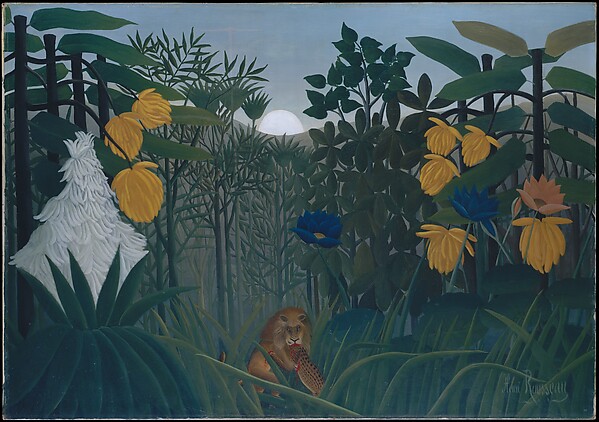
“The Hungry Lion” beside the Fauves
In 1905 “The Hungry Lion” was shown at the Salon d’Automne beside paintings by the Fauves Matisse, Vlaminck and Derain; this is when the attitude of the mass of critics to Rousseau’s work turned.
after 1905
Vollard buys his works
After “The Hungry Lion” was shown, Ambroise Vollard, France’s leading dealer in modern art, bought several of Rousseau’s works.
after 1905
Exotic scenes without travel: the Botanical Garden
Rousseau never left France, yet his exotic canvases became especially prominent after 1905: to render foliage accurately he studied plants in the Paris Botanical Garden, and he often copied figures from magazine illustrations and postcards.
1907
A commission from Countess Delaunay: “The Snake Charmer”
In 1907 Berthe, Countess Delaunay, mother of the painter Robert Delaunay, commissioned “The Snake Charmer” from Rousseau.
1908
Picasso’s banquet in Rousseau’s honour
Picasso came across a Rousseau painting being sold on the street as a canvas to be painted over, instantly recognised his genius and went to meet him; in 1908 he gave a half-serious, half-burlesque banquet for Rousseau in his Bateau-Lavoir studio, attended by Apollinaire, Gertrude Stein, Max Jacob, Marie Laurencin, Juan Gris and others.