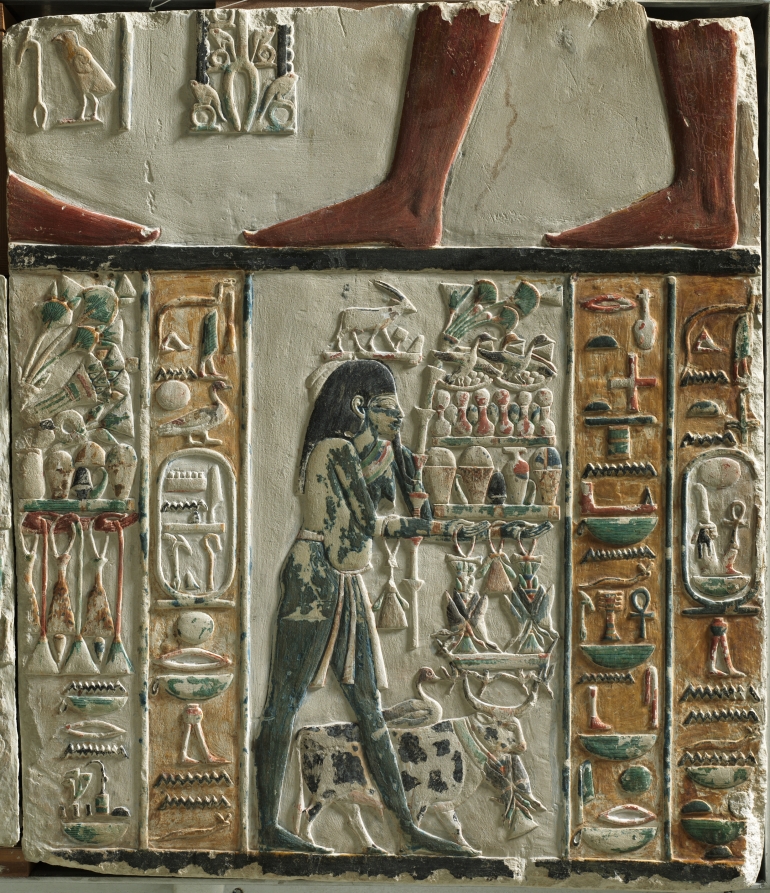
Nome Gods Bearing Offerings
Kan det ses?
Ja, udstillet nu
Hvor er »Nome Gods Bearing Offerings« i dag? The Cleveland Museum of Art, 107 Egyptian, Cleveland. Ja, udstillet nu. Kontrolleret 29. september 2026.

Udstillet for publikum.
- Kontrolleret
- Uændret siden
- Kilde
- Museet
Om skulpturen
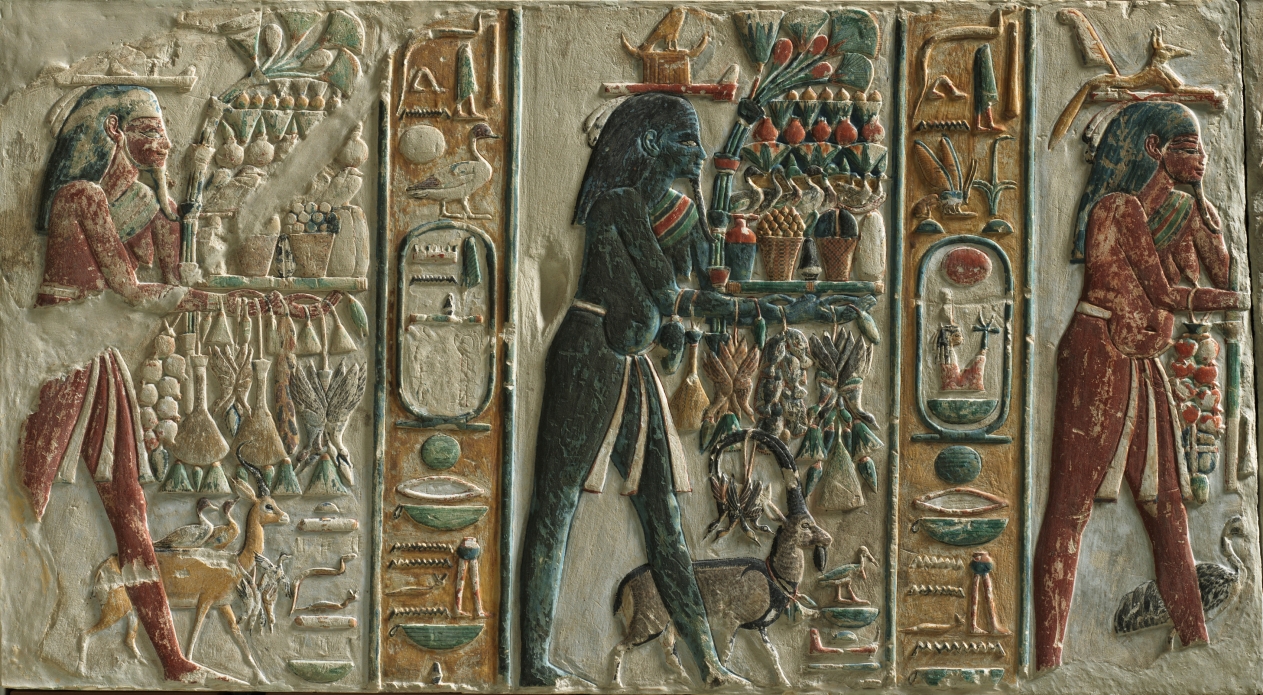
These blocks from a temple wall have preserved their original painted decoration to a remarkable degree. The four portly figures in the lower register bear emblems on their heads identifying them as nomes, or provinces, of ancient Egypt. Carrying trays heaped with offerings and leading sacrificial animals, they personify the bounty of the land. First (on the right) is the Oryx Nome, followed by the Dog Nome, the Falcon Nome, and the Double Scepter Nome. The face of each nome figure is a miniature portrait of Amenhotep III, and each recites a speech in the king's name. The first figure says, "King Nebmaatra [Amenhotep III] has come, bringing to you every good thing that is in this land, that you may give him all life, stability, dominion, and all health from you." The second, third, and fourth figures bring "all greens,"
Læs videre
"the produce of the Two Lands [Upper and Lower Egypt]," and "all offerings and provisions." The god to whom the nomes bring offerings stood in the fragmentary upper register, facing a standing figure of the king, Amenhotep III. The pair of legs on the right belonged to the god; the single foot on the left belonged to the king. The god held a scepter, forked at the bottom, embellished with coils of rope (for eternity), tadpoles (for hundreds of thousands), and notched palm ribs (for years), the whole signifying "an eternity of hundreds of thousands of years." These blocks may be from Amenhotep III's temple at Kom el-Ahmar, ancient Hebenu, in Middle Egypt, dedicated to the god Horus. Hebenu was the capital of the Oryx Nome, which leads the procession of nome gods. Amenhotep III's temple was later dismantled, and its blocks were reused in the foundations of another structure, which would account for the excellent preservation of the paint.
The Cleveland Museum of Art
Oplysninger
- Inventarnummer
- 1976.51
I kataloget
Kilder
- The Cleveland Museum of Art
- Billede: The Cleveland Museum of Art — Museum open access