 Honoré DaumierFrankrig, 1808–1879
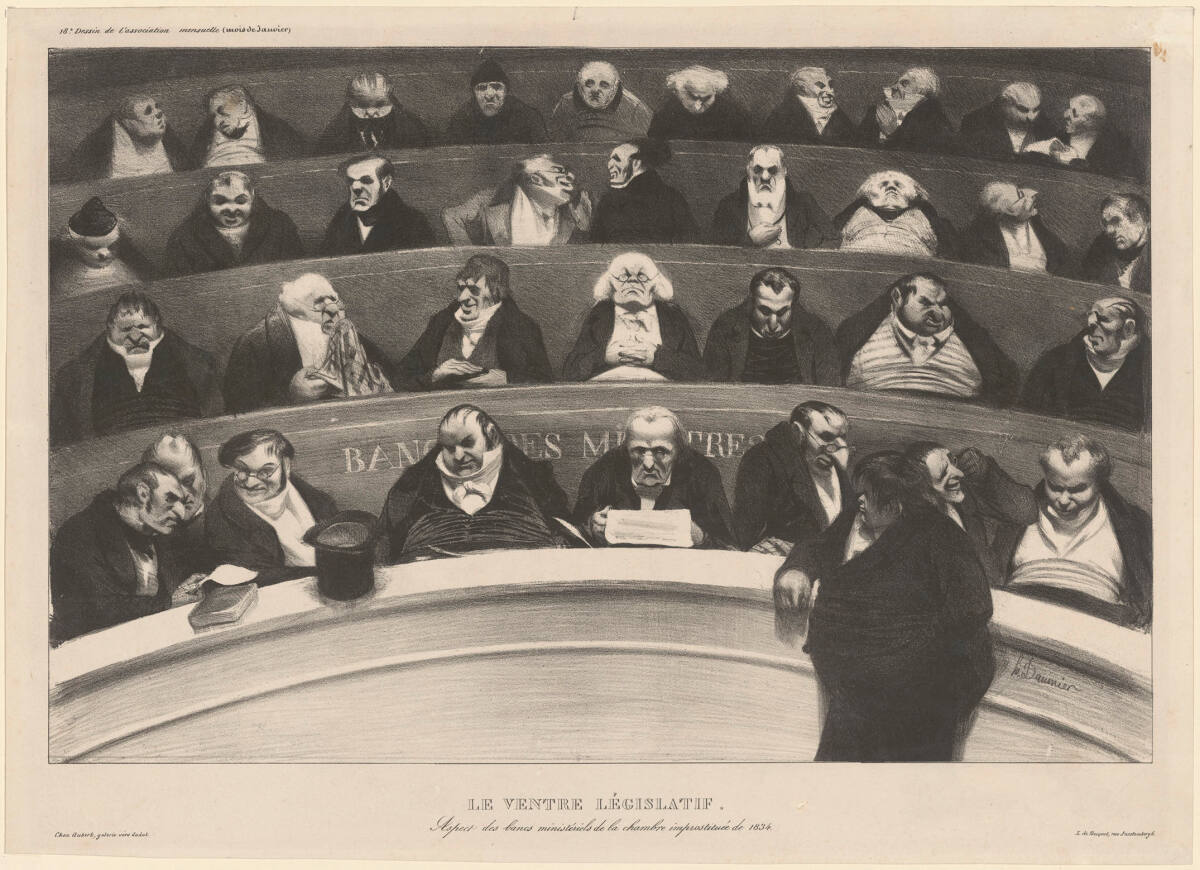
Le ventre législatif
Må man se det?
Ukendt: museet holder tæt

Albertina
Wien, Østrig
Ejeren er kendt. Om det er udstillet i dag, siger museet ikke, og at gætte har vi ikke lært.
- Uændret siden
- Kilde
- Museets egne samlingsdata
Oplysninger
I kataloget
Kilder
- Albertina: museets åbne data · hentet for 8 dage siden
- Billede: Albertina — Public Domain Mark 1.0
Imens i livet hos Honoré Daumier
Hele livetFebruary 1832
Trial for Insulting the King
In February 1832 Daumier stood trial on charges of "inciting hatred and contempt for the government and insulting the king" and was sentenced to six months in prison and a fine of 500 francs; execution of the sentence was deferred.
August 1832
Arrest and Imprisonment at Sainte-Pélagie
In August 1832 Daumier was arrested at his parents' apartment and placed in the Sainte-Pélagie prison to serve his six-month sentence; in prison he remained defiant and continued to draw "to spite the government." His imprisonment brought him considerable fame.
14 February 1833
Release and Move to an Artists' Phalanstery
After his release from prison on 14 February 1833, Daumier, who had until then lived with his parents, moved into an artists' phalanstery on the Rue Saint-Denis, where his friends included Diaz, Huet, Jeanron, Decamps, and Préault.
1834
Closure of La Caricature; Move to Le Charivari
In 1834 La Caricature collapsed under the weight of the monarchy's prosecutions and fines; Daumier continued working for Philipon's journal Le Charivari, founded in December 1832, where he published scenes from "The Adventures of Robert Macaire" and other series.
September 1835
The "September Laws" Restricted Press Freedom
After an assassination attempt on Louis-Philippe, the "September Laws" were enacted, imposing harsh fines and prison terms for criticizing the king; Daumier's caricatures softened and turned to satire of the bourgeoisie and everyday Parisian life.