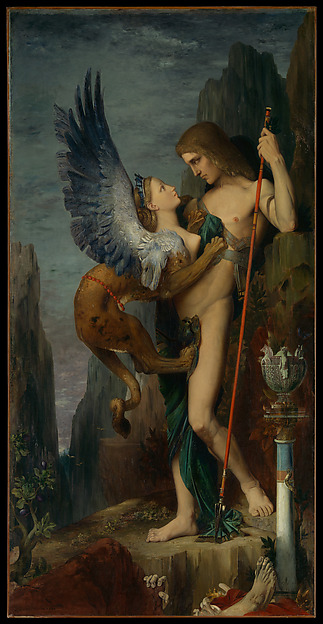
Gustave MoreauFrankrig, 1826–1898
The Apparition
Må man se det?
Ukendt: museet holder tæt

Musée d'Orsay
Paris, Frankrig
Ejeren er kendt. Om det er udstillet i dag, siger museet ikke, og at gætte har vi ikke lært.
- Uændret siden
- 29. sep. 2026
- Kilde
- Museets egne samlingsdata
About the painting
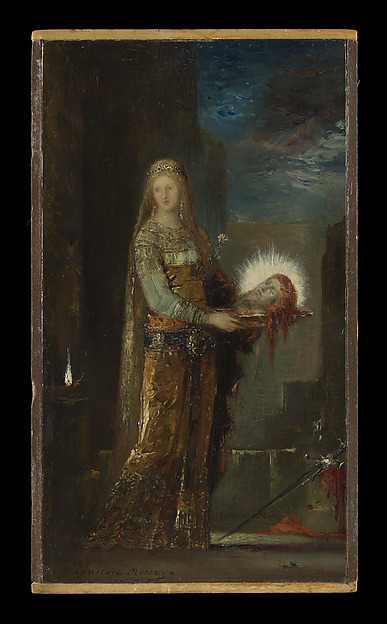
The Apparition (French: L'Apparition) is a watercolour by French artist Gustave Moreau, painted between 1874 and 1876. It shows the biblical character of Salome dancing in front of Herod Antipas with a vision of John the Baptist's severed head. The 106 cm high and 72,2 cm wide watercolor held by the Musée d'Orsay in Paris elaborates on an episode told in the Matthew 14:6–11 and Mark 6:21–29. On a feast held for Herod Antipas's birthday, the princess Salome dances in front of the king and his guests. This pleased him so much he promises her anything she wished for. Incited by her mother Herodias, who was reproved by John the Baptist for her illegitimate marriage to Herod, Salome demands John's head on a charger. Regretful but compelled to keep his word in front of everyone present, Herod complies with Salome's demand. John the Baptist is beheaded, his head brought on a charger and given to Salome, who in turn gives it to her mother.
Read on
Moreau approached the biblical theme in 19 paintings, 6 watercolors and more than 150 drawings. Part of a series of at least 8 closely resembling paintings and more than 40 sketch drawings, it is regarded as a key work of Moreau's opus, symbolism and fin de siècle art in general. Upon its first presentation 1876 in Salon (French: Salon de Paris), the painting caused a sensation. It has since made a lasting impression on various artists, notably from the Decadent movement.
Oplysninger
- Inventarnummer
- RF 2130, Recto
Ankomster og afgange
Om det er udstillet i dag, er ukendt
Musée d'Orsay · 29. sep. 2026 — nu · Ubekræftet
Om det er udstillet i dag, er ukendt
Louvre · 26. sep. 2026 — 29. sep. 2026 · Ubekræftet
Kilder
- Louvre: the museum's own open data · hentet for 5 dage siden
- Billede: Musée d'Orsay — Gustave Moreau · Public domain · Wikimedia Commons
Imens i livet hos Gustave Moreau
Hele livet1859–1888 · Virkested
Paris
1870–1875
Years without exhibiting: renewing his art
Disturbed by criticism that his work had become formulaic, Moreau stopped exhibiting for a few years and concentrated on renewing his art.
18. september 1875 · Udmærkelse
Knight of the Legion of Honour
1876
Return to the Salon: “Salome”
After the break Moreau returned to the Salon. That year he completed “Salome Dancing before Herod”, which announced the more painterly style that would characterize his later works.
1878
“Phaeton” at the World’s Fair stuns Redon
At the 1878 World’s Fair Moreau’s watercolour “Phaeton” so struck Odilon Redon that he wrote of its power to renew old art. Redon, like many critics of the time, saw Moreau’s chief merit in giving traditional painting a new direction, building a bridge between past and future.