 Nicolas PoussinFrankrig, 1594–1665
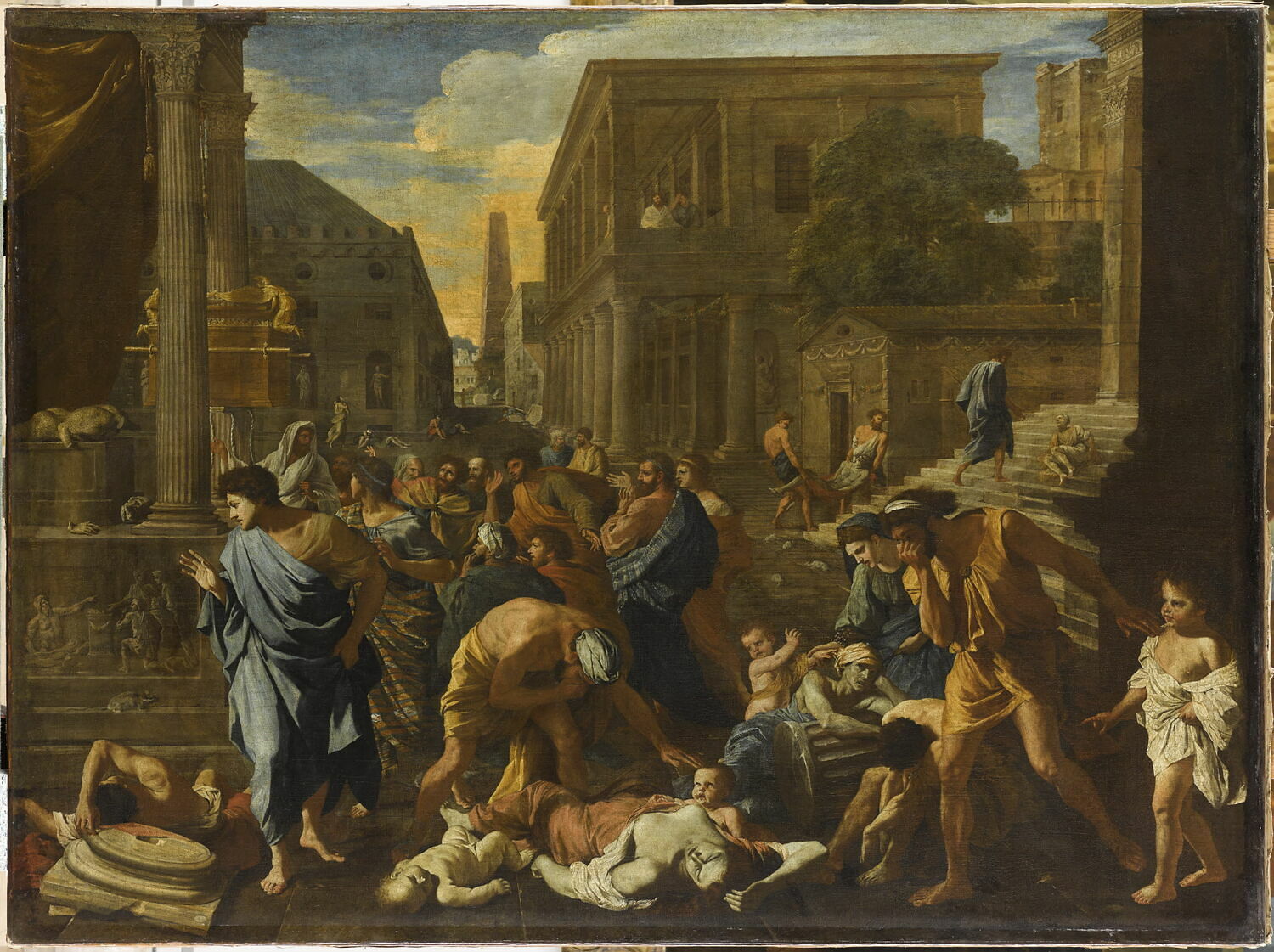
La Peste d'Asdod
Må man se det?
Ja, det tager imod

Udstillet for publikum. Hvem der står inde for det, står nedenfor.
- Kontrolleret
- for 9 dage siden
- Uændret siden
- 26. sep. 2026
- Kilde
- Museets egne samlingsdata
About the painting
The Plague of Ashdod is also known as The Miracle of the Ark in the Temple of Dagon, by the French artist Nicolas Poussin. The painting represents a story from 1 Samuel in the Old Testament. The original painting currently hangs in the Louvre in Paris. Poussin was commissioned to paint The Plague of Ashdod by Fabrizio Valguarnera. Fabrizio Valguarnera was a Sicilian merchant who was put on trial for laundering money through the purchase of this painting; he also commissioned more than one version of this piece. Poussin painted this during a plague that took place in Italy from 1629 to 1631, which influenced his accurate portrayal of the epidemic.
Oplysninger
- Inventarnummer
- INV 7276
Kilder
- Louvre: the museum's own open data · hentet for 9 dage siden
- Billede: Louvre — © 2014 GrandPalaisRmn (musée du Louvre) / Mathieu Rabeau
Imens i livet hos Nicolas Poussin
Hele livet1620s
The Cavaliere Marino takes the painter under his wing
Poussin’s work caught the attention of the Italian poet Cavaliere Marino, then living in France; his patronage let the thirty-year-old painter work in peace. According to Bellori the poet took him into his house and helped him with the invention of subjects and the rendering of emotion, and in Marino’s house Poussin gained access to a library with treatises by Alberti and Dürer and manuscripts and drawings by Leonardo.
c. 1629
A grave illness: the Dughet family nurses Poussin
Around 1629 Poussin fell gravely ill and was nursed by the family of the French pastry-cook Dughet; on recovering he became engaged to the eldest daughter, Anne-Marie. The wedding in the church of San Lorenzo in Lucina took place on 1 September 1630.
1630
Gives up monumental commissions
In 1630 the commission headed by Domenichino and d’Arpino gave the decoration of the Chapel of the Immaculate Conception in San Luigi dei Francesi to the Lorrainer Charles Mellin, not to Poussin. After that he firmly renounced the monumental genre and turned to “cabinet painting” for private patrons.
9. august 1630
Married: Anne-Marie Dughet
1630s
Cassiano dal Pozzo — his chief patron
Poussin’s flowering coincided with his complete abandonment of church commissions: he gathered a circle of patrons around him but strove for independence, accepting commissions from connoisseurs without binding himself to any of them permanently. The most important was Cassiano dal Pozzo; in the surviving correspondence the relationship comes close to servitude, although the painter did not live in his house.
1632
Elected to the Academy of St Luke
In 1632 Poussin was elected a member of the Academy of St Luke — two years after he had given up monumental commissions for cabinet painting.