Henri RousseauFrankrig, 1844–1910
La encantadora de serpientes
Kan det ses?
Ukendt
Hvor er »La encantadora de serpientes« i dag? Samling: Musée d'Orsay, Paris. Ukendt.

Paris, Frankrig
Ejeren er kendt; om værket er udstillet i dag, vides ikke.
- Uændret siden
- Kilde
- Museet
Om maleriet
The Snake Charmer (French: La Charmeuse de Serpents) is a 1907 oil-on-canvas painting by French Naïve artist Henri Rousseau (1844–1910). It is a depiction of a woman with glowing eyes playing a flute in the moonlight by the edge of a dark jungle with a snake extending toward her from a nearby tree, two near her legs, and one wrapped around her shoulders.
Oplysninger
- Inventarnummer
- RF 1937 7
I kataloget
Kilder
- Wikidata
- Billede: Musée d'Orsay — Henri Rousseau · Public domain · Wikimedia Commons
Imens i livet hos Henri Rousseau
Hele livet1893–1910
A studio in Montparnasse
In 1893 Rousseau moved to a studio in Montparnasse, where he lived and worked until his death in 1910.
1905
“The Hungry Lion” beside the Fauves
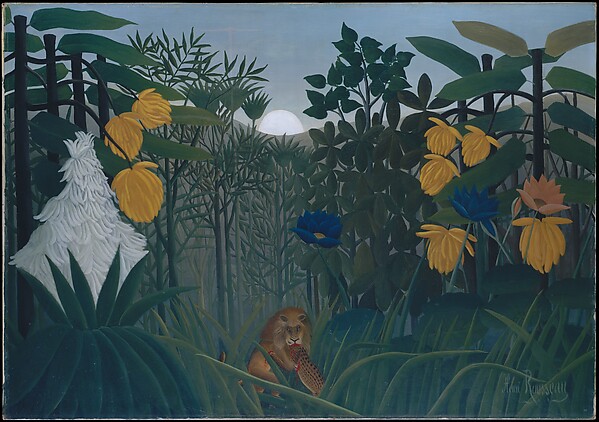
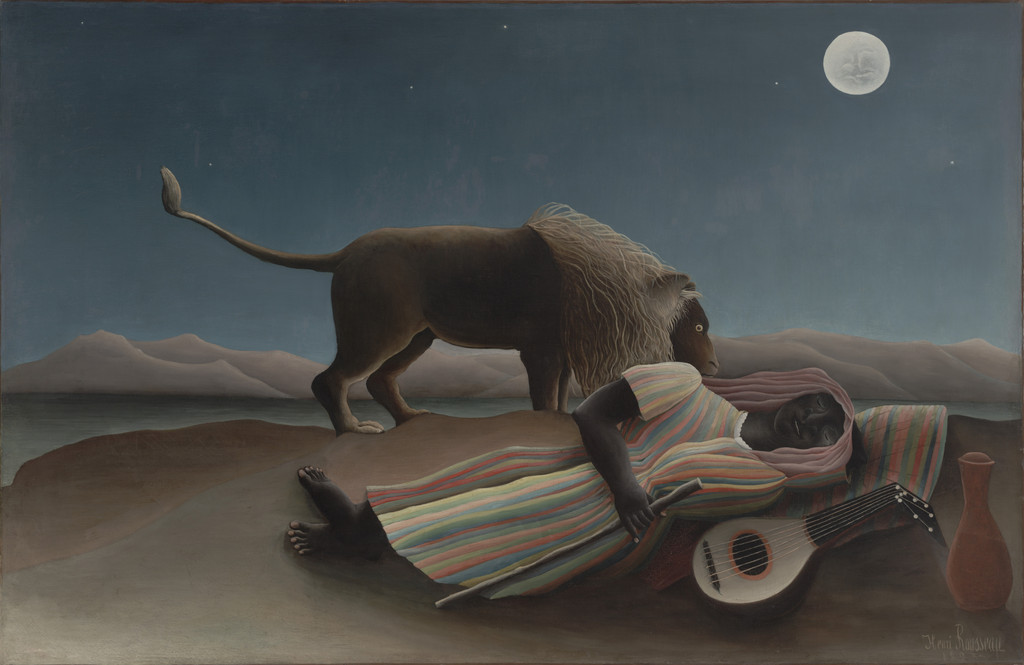
In 1905 “The Hungry Lion” was shown at the Salon d’Automne beside paintings by the Fauves Matisse, Vlaminck and Derain; this is when the attitude of the mass of critics to Rousseau’s work turned.
after 1905
Vollard buys his works
After “The Hungry Lion” was shown, Ambroise Vollard, France’s leading dealer in modern art, bought several of Rousseau’s works.
after 1905
Exotic scenes without travel: the Botanical Garden
Rousseau never left France, yet his exotic canvases became especially prominent after 1905: to render foliage accurately he studied plants in the Paris Botanical Garden, and he often copied figures from magazine illustrations and postcards.
1907
A commission from Countess Delaunay: “The Snake Charmer”
In 1907 Berthe, Countess Delaunay, mother of the painter Robert Delaunay, commissioned “The Snake Charmer” from Rousseau.
1908
Picasso’s banquet in Rousseau’s honour
Picasso came across a Rousseau painting being sold on the street as a canvas to be painted over, instantly recognised his genius and went to meet him; in 1908 he gave a half-serious, half-burlesque banquet for Rousseau in his Bateau-Lavoir studio, attended by Apollinaire, Gertrude Stein, Max Jacob, Marie Laurencin, Juan Gris and others.