
 Albrecht DürerTyskland, 1471–1528
Knight, Death and Devil
Må man se det?
Tager ikke imod for tiden

National Gallery of Art
Washington, D.C., USA
Det hører til samlingen, men er ikke udstillet for tiden.
- Kontrolleret
- Uændret siden
- Kilde
- Museet
Om værket
Knight, Death and the Devil (German: Ritter, Tod und Teufel) is a large 1513 engraving by the German artist Albrecht Dürer, one of the three Meisterstiche (master prints) completed during a period when he almost ceased to work in paint or woodcuts to focus on engravings. The image is infused with complex iconography and symbolism, the precise meaning of which has been argued over for centuries.
Læs videre
A stolid armoured knight on a proud horse, accompanied by his faithful dog, rides through a wild narrow gorge flanked by a goat-headed devil and the figure of death riding a pale horse. Death's rotting corpse holds an hourglass, a reminder of the shortness of life. The rider moves through the scene looking away from the creatures lurking around him, and appears almost contemptuous of the threats, and is thus often seen as symbol of courage; the knight's armour, the horse which towers in size over the beasts, and the oak leaves are symbolic of the resilience of faith, while the knight's plight may represent Christians' earthly journey towards the Kingdom of Heaven symbolized by the city on the hill.
It was widely copied and had a large influence on later German writers. Philosopher Friedrich Nietzsche referenced the work in his work on dramatic theory The Birth of Tragedy (1872) to exemplify pessimism. Later in the 20th century the engraving was used by the Nazis, identifying their cause with that of the knight on horseback.
Med museets ord
In this tour de force engraving, considered one of his three greatest “masterworks,” Albrecht Dürer portrayed a mounted soldier who resolutely forges through a dark gorge, ignoring a horned devil in his path. Confronted by Death itself, crowned with snakes and holding an hourglass indicating mortality, the soldier and his faithful dog demonstrate the strength of righteousness required to stay upon the right path. The skull underfoot suggests that others have not been
so resolute. Indeed, this road of life is full of obstacles, with the city on the hill accessible, it seems, only by way of treacherous peaks.
National Gallery of Art
Oplysninger
- Inventarnummer
- 1943.3.3519
Hvad det viser
I kataloget
Ankomster og afgange
Ikke udstillet for tiden
National Gallery of Art · 29. sep. 2026 — nu · Kontrolleret
Var ikke udstillet
The Cleveland Museum of Art · 29. sep. 2026 — 29. sep. 2026 · Kontrolleret
Var ikke udstillet
National Gallery of Art · 29. sep. 2026 — 29. sep. 2026 · Kontrolleret
Var ikke udstillet
The Cleveland Museum of Art · 28. sep. 2026 — 29. sep. 2026 · Kontrolleret
Var ikke udstillet
National Gallery of Art · 28. sep. 2026 — 28. sep. 2026 · Kontrolleret
Var ikke udstillet
The Cleveland Museum of Art · 27. sep. 2026 — 28. sep. 2026 · Kontrolleret
Var ikke udstillet
National Gallery of Art · 27. sep. 2026 — 27. sep. 2026 · Kontrolleret
Var ikke udstillet
Rijksmuseum Amsterdam · 26. sep. 2026 — 27. sep. 2026 · Kontrolleret
Var ikke udstillet
National Gallery of Art · 26. sep. 2026 — 26. sep. 2026 · Kontrolleret
Var ikke udstillet
The Cleveland Museum of Art · 25. sep. 2026 — 26. sep. 2026 · Kontrolleret
Var ikke udstillet
Rijksmuseum Amsterdam · 30. aug. 2026 — 25. sep. 2026 · Kontrolleret
Var ikke udstillet
The Cleveland Museum of Art · 19. aug. 2026 — 30. aug. 2026 · Kontrolleret
Kilder
- The Cleveland Museum of Art
- Billede: National Gallery of Art — Museum open access
Imens i livet hos Albrecht Dürer
Hele livet1507–1528 · Virkested
Nuremberg
1511
Publishes the Great Passion and the Life of the Virgin
Dürer published two woodcut series as books, the Great Passion and the Life of the Virgin, with a second edition of the Apocalypse and the 37 woodcuts of the Little Passion. His post-Venetian woodcuts developed chiaroscuro modelling.
1512
Emperor Maximilian I becomes his chief patron
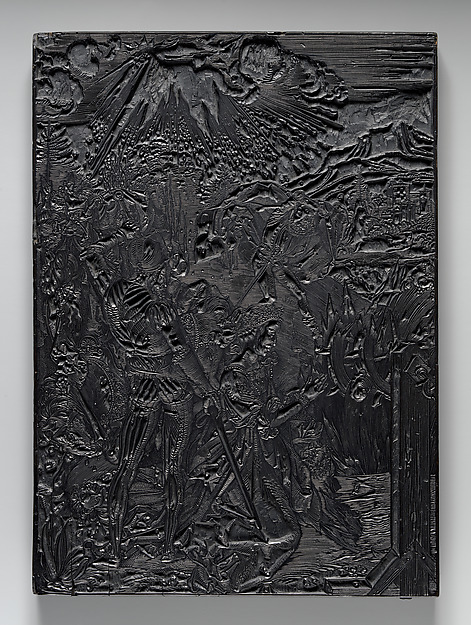
From 1512 Emperor Maximilian I was Dürer's chief patron. For him Dürer and his workshop produced the Triumphal Arch, a giant woodcut 295 × 357 cm printed from 192 blocks and modelled on the triumphal arches of ancient Rome.
3 January 1512
Nuremberg's privilege against forgeries
Nuremberg's city council granted Dürer a privilege for the sale of his prints, with penalties for anyone who forged them.
1514
Death of his mother
In the year of Melencolia I and St Jerome in His Study, the artist's mother, Barbara Holper, died.
1515
A life pension from the emperor
The perpetually cash-strapped Maximilian could not pay on time and offered to exempt the artist from city taxes, which the Nuremberg Council opposed. At Dürer's request the emperor granted him a life pension of 100 guilders a year from the sums Nuremberg paid into the imperial treasury.
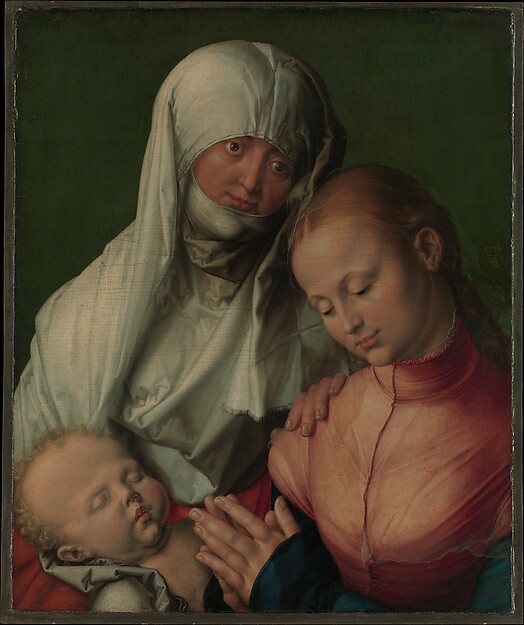
![Madonna and Child [obverse], Albrecht Dürer, c. 1496/1499](https://api.nga.gov/iiif/878db7e6-10ae-4cae-ba5d-6d6f5c413ae8/full/!2400,2400/0/default.jpg)
![Lot and His Daughters [reverse], Albrecht Dürer, c. 1496/1499](https://api.nga.gov/iiif/7565a449-f82a-414b-9bda-c93f55a51b4d/full/!2400,2400/0/default.jpg)


![Ginevra de' Benci [obverse], Leonardo da Vinci, c. 1474/1478](https://api.nga.gov/iiif/8f29e3c9-a289-4d53-abf0-31a66e9e98fa/full/!2400,2400/0/default.jpg)
![Wreath of Laurel, Palm, and Juniper with a Scroll inscribed Virtutem Forma Decorat [reverse], Leonardo da Vinci, c. 1474/1478](https://api.nga.gov/iiif/ff62e8d0-45c4-498f-ad36-6358de827e04/full/!2400,2400/0/default.jpg)


