Kitagawa UtamaroJapan, 1754–1806
Kintoki en Yamauba
Kan det ses?
Ukendt
Hvor er »Kintoki en Yamauba« i dag? Samling: Rijksmuseum Amsterdam, Amsterdam. Ukendt.

Amsterdam, Holland
Ejeren er kendt; om værket er udstillet i dag, vides ikke.
- Kilde
- Museet
Om værket
Med museets ord — på nederlandsk
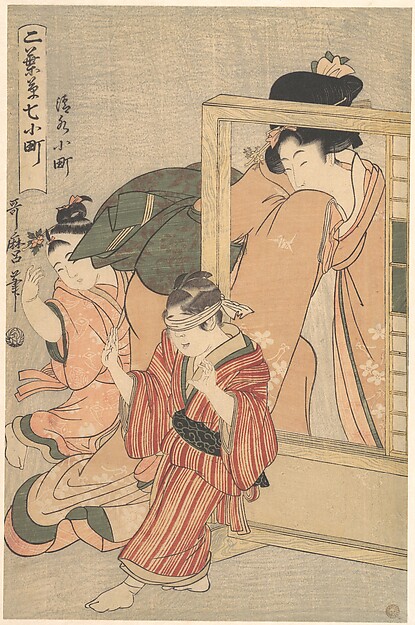
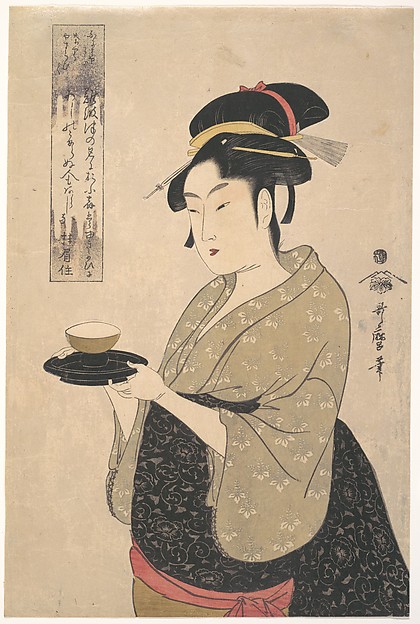
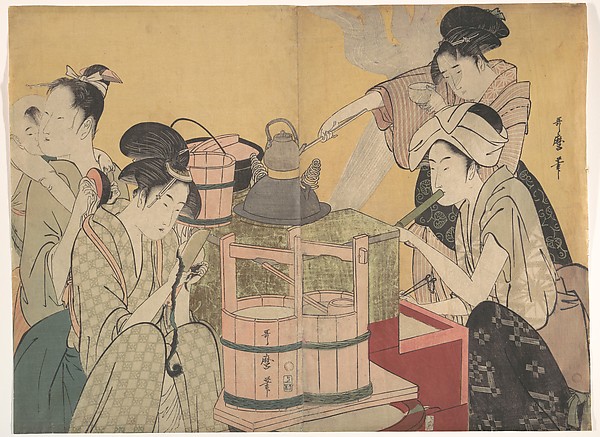
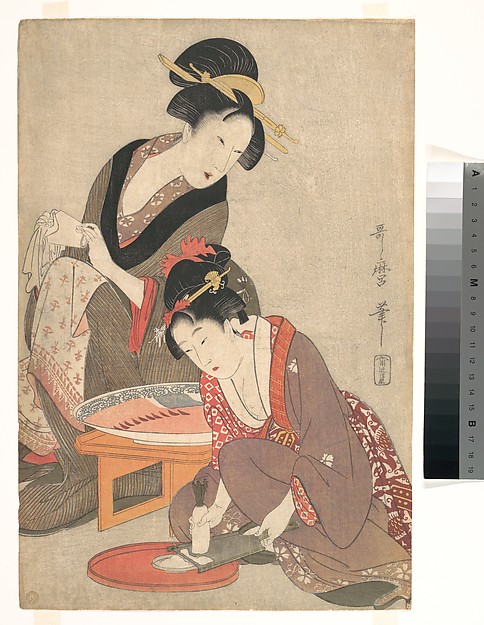
Vrouw met loshangend haar en waaier in rechter hand, lachend naar op schoot zittend kind met kat in handen. In cartouche rechtsboven de geparodieerde voorstelling van Yamauba met staf, kijkend naar haar zoon Kintoki, worstelend met berenjong.
Rijksmuseum Amsterdam
Oplysninger
- Inventarnummer
- RP-P-1956-607
Hvad det viser
I kataloget
Kilder
- Rijksmuseum Amsterdam
- Billede: Rijksmuseum Amsterdam — public domain
Imens i livet hos Kitagawa Utamaro
Hele livet1790–1801
Tightening censorship: seals on prints
From 1790 prints can be sold only with a censor's seal of approval; over the following decades censorship grows stricter, and violators can receive harsh punishments. From 1799 even preliminary drafts need approval, and in 1801 the works of a group of Utagawa-school offenders, including Toyokuni, are repressed.
c. 1791
Giving up book prints for half-length portraits of beauties
Around 1791 Utamaro gives up designing prints for books and concentrates on single portraits of women shown half-length, rather than the group scenes favoured by other ukiyo-e artists. He was the first in Japanese woodblock printing to use half-length compositions for women's portraits; none of his work from 1790–1792 has survived.
1793
Recognition and the end of the arrangement with Tsutaya
In 1793 Utamaro achieves recognition as an artist, and his semi-exclusive arrangement with the publisher Tsutaya Jūzaburō ends. He then goes on to produce several well-known series featuring women of the Yoshiwara district, and becomes one of the few ukiyo-e artists to win fame throughout Japan in his lifetime.
1797
The death of his friend and patron Tsutaya Jūzaburō
In 1797 Utamaro's long-time friend and supporter, the publisher Tsutaya Jūzaburō, dies; the artist is apparently very upset by the loss, and some commentators feel that his work never reached its former heights afterwards. He later lives in Kyūemon-chō, then Bakuro-chō, and finally near the Benkei Bridge.