
Horse Rearing
Oplysninger
- Inventarnummer
- 1999.80.17
Imens i livet hos Edgar Degas
Hele livetautumn 1879 – April 1880
The prints journal: Degas abruptly withdraws
In the autumn and winter of 1879–1880 Degas and Cassatt worked closely together on a prints journal; he owned a small printing press. In April 1880 Degas abruptly withdrew, and without his support the project folded.
by 1880
The end of his financial crisis
By 1880 Degas had fully overcome his financial crisis and become a respected figure in the Paris art world; the Impressionist exhibitions, which proved commercially useful to him, helped.
1881
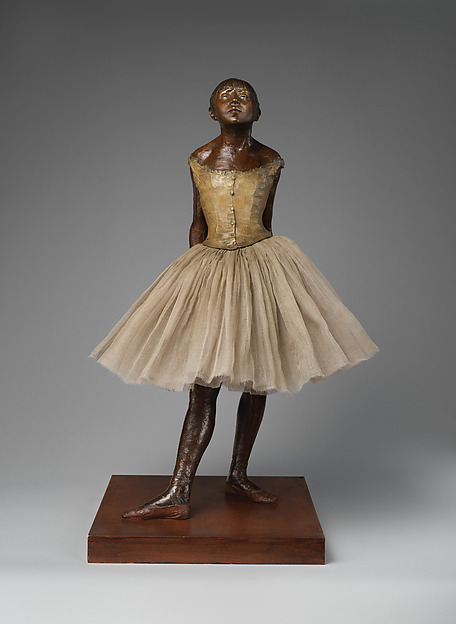
“The Little Dancer of Fourteen Years” on show
The nearly life-size wax figure with real hair and a cloth tutu, modelled on Marie van Goethem, provoked a strong reaction: critics found its realism extraordinary, but many denounced the dancer as ugly. It was the only sculpture Degas showed in his lifetime.
by 1882
His eyesight sharply worsens
By 1882 Degas's eyesight began to worsen sharply: he turned to pastel and then to sculpture, where he could rely more on touch.
1886
The eighth exhibition: pastel nudes, and the end of the group
At the last Impressionist exhibition Degas showed a suite of pastel nudes, which drew more critical writing than anything else in his lifetime, mostly laudatory. The group broke up, partly through rancour over the inclusion of non-Impressionists such as Forain and Raffaëlli.




![The Watering Place (Horses Bathing) [L'abreuvoir (chevaux au bain)], Pablo Picasso, 1906](https://api.nga.gov/iiif/bbac782b-88ea-4477-97a5-4369aa47b98a/full/!2400,2400/0/default.jpg)


![The Watering Place (Horses Bathing) [L'abreuvoir (chevaux au bain)], Pablo Picasso, 1906, published 1913](https://api.nga.gov/iiif/e28f9c4c-435b-4af0-849d-79adeb9ad2d5/full/!2400,2400/0/default.jpg)


