Gustave MoreauFrankrig, 1826–1898
Figurenstudie
Må man se det?
Ukendt: museet holder tæt

Herzog Anton Ulrich-Museum
Braunschweig, Tyskland
Ejeren er kendt. Om det er udstillet i dag, siger museet ikke, og at gætte har vi ikke lært.
- Uændret siden
- 27. sep. 2026
- Kilde
- Museets egne samlingsdata
Oplysninger
Kilder
- Herzog Anton Ulrich-Museum: the museum's own open data · hentet for 6 dage siden
- Billede: Herzog Anton Ulrich-Museum — CC BY-NC-SA 4.0
Imens i livet hos Gustave Moreau
Hele livet1859–1888 · Virkested
Paris
c. 1860
Alexandrine Dureux: a companion for life
Moreau apparently met Adelaide-Alexandrine Dureux soon after his return from Italy. In the following years he made many drawings and watercolours of her, as well as romantic caricatures of the two of them walking on clouds; he subsidised an apartment for her on rue Notre-Dame de Lorette, a few blocks from his home. The relationship was very discreet and known to only a few; his mother knew of it and was fond of Alexandrine.
1860
Degas paints Moreau’s portrait — and their paths part
In 1860 Degas painted a small portrait of Moreau, which hung in Moreau’s studio for the rest of his life. Their friendship began to drift: Degas soon fell under the influence of Manet and Impressionism, while Moreau stayed focused on history painting. Moreau once asked Degas whether he thought he could renew art through ballet, and Degas replied by asking whether Moreau thought he could do it with jewellery.
1862
The death of his father
In 1862 Moreau’s father, the architect Louis Moreau, died; he had encouraged his son’s drawing and instilled in him a classical culture.
1864
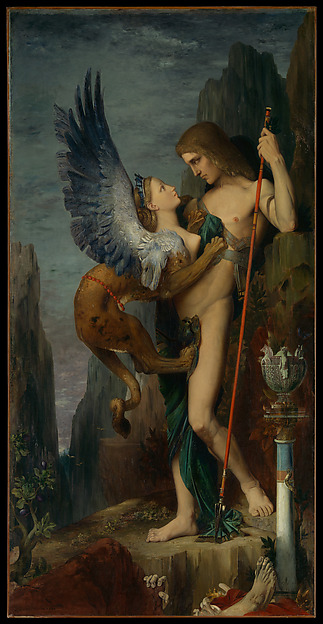
A Salon medal for “Oedipus and the Sphinx”
“Oedipus and the Sphinx”, one of Moreau’s first Symbolist paintings, won a medal at the Paris Salon of 1864 and established his reputation. One commentator likened it to a pastiche of Mantegna created by a German student who relaxes from his painting by reading Schopenhauer.