 Emil NoldeTyskland, Danmark, 1867–1956
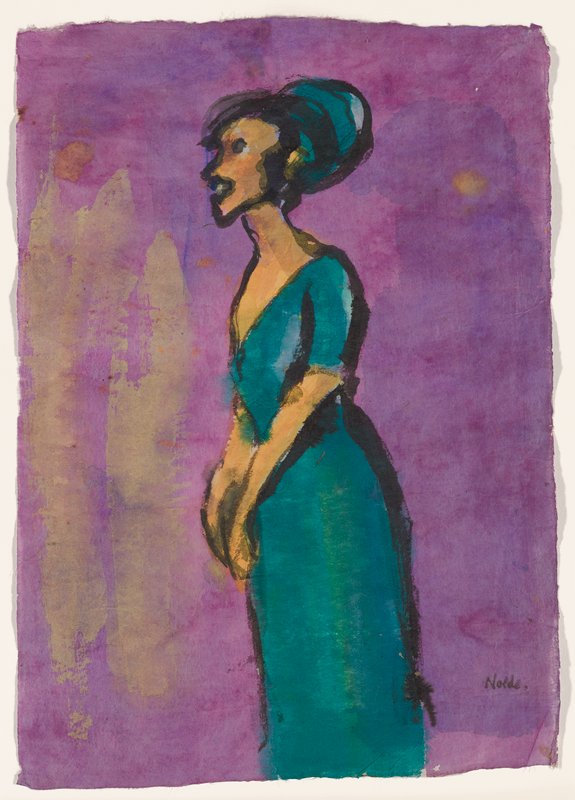
Diseuse
Må man se det?
Tager ikke imod for tiden

Minneapolis Institute of Art
Minneapolis, USA
Det hører til samlingen, men er ikke udstillet for tiden.
- Kontrolleret
- for 16 timer siden
- Uændret siden
- 25. sep. 2026
- Kilde
- Museets egne samlingsdata
Om værket
Emil Nolde found inspiration in the decadent pleasures of urban nightlife, showing a preference for entertainers who performed in lurid artificial light. He frequented theaters, dance halls, and cabarets, recording his impressions in quick sketches that provided the basis for oil paintings and watercolors produced in his studio.
Read on
The seemingly primitive treatment of this woman’s features belies the sophistication of Nolde’s watercolor technique. A marvelous balancing act of freedom, control, and chance, his handling of the brush allowed the liquid color to flow across and soak into the Japanese paper. Combining and overlapping, his wet-in-wet colors give a vivid sense of the harsh light entering from the left and casting varied shadows on the woman’s green dress. Nolde held it all together with his deft application of opaque black contours, from narrow in full light to thick in the shadows. The single stroke that separates the figure’s arm from her chest, articulating the shape and volume of both, delivers a concise statement of Nolde’s brilliance.
Minneapolis Institute of Art
Oplysninger
- Inventarnummer
- 2000.242.14
I kataloget
Kilder
- Minneapolis Institute of Art: the museum's own open data · hentet for 4 dage siden
- Billede: Minneapolis Institute of Art — © Nolde Stiftung Seebüll
Imens i livet hos Emil Nolde
Hele livet1908 – 17. december 1910 · Medlemskab
Berlin Secession
1909
Poisoned water: a brush with death
In 1909, at the age of forty-two, Nolde nearly died after drinking poisoned water; the experience hastened his turn to religious painting.
1910
Expelled from the Berlin Secession
In 1910, after a disagreement with the leadership, Nolde was expelled from the Berlin Secession, of which he had been a member since 1908.
1910–1912
First success at exhibitions in Hamburg, Essen and Hagen
In 1910–12 Nolde had his first success at exhibitions in Hamburg, Essen and Hagen.
1912
Exhibits with Kandinsky’s Blaue Reiter
In 1912 Nolde exhibited with Wassily Kandinsky’s Munich-based group Der Blaue Reiter; by then he had achieved some fame and could support himself through his art.