 Philipp Otto RungeTyskland, 1777–1810
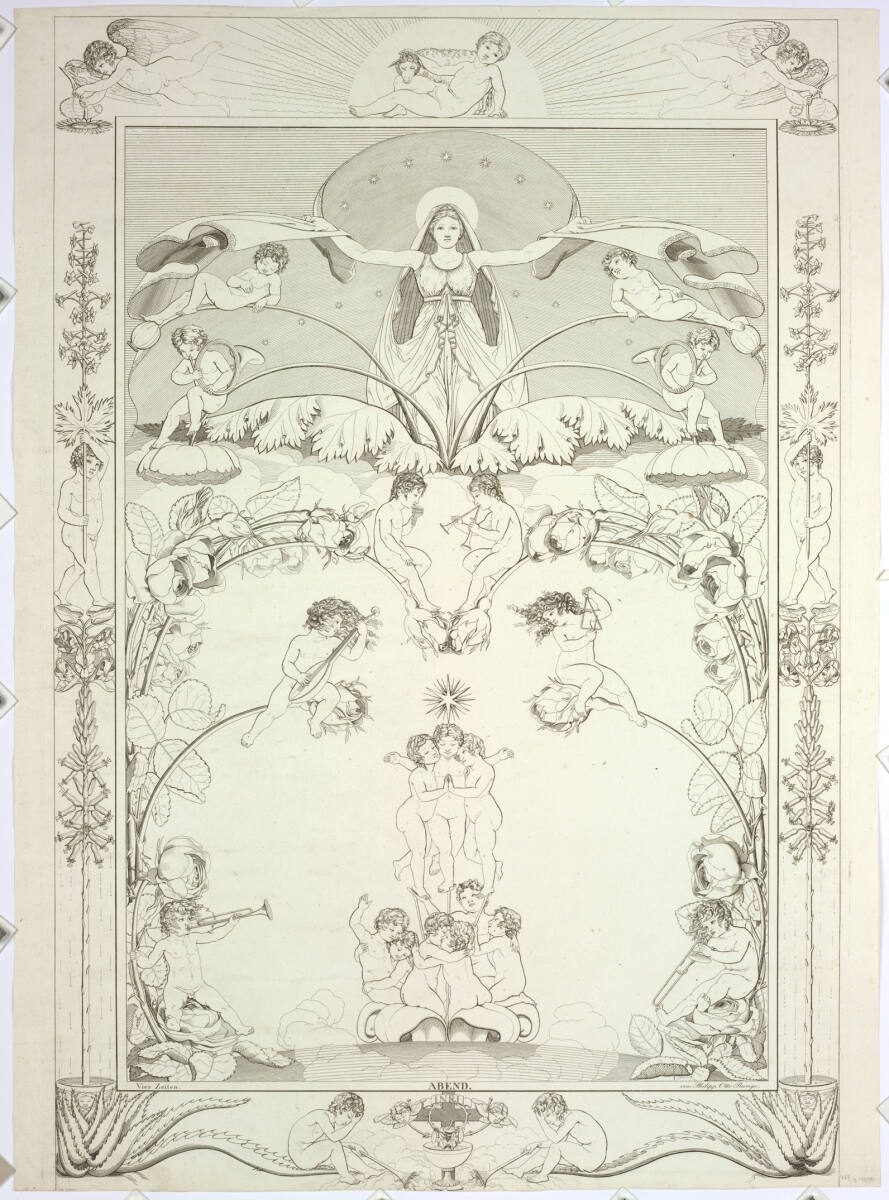
Die vier Tageszeiten: Abend
Kan det ses?
Ukendt
Hvor er »Die vier Tageszeiten: Abend« i dag? Samling: Albertina, Wien. Ukendt.

Wien, Østrig
Ejeren er kendt; om værket er udstillet i dag, vides ikke.
- Uændret siden
- Kilde
- Museet
Oplysninger
I kataloget
Kilder
- Albertina
- Billede: Albertina — Public Domain Mark 1.0
Imens i livet hos Philipp Otto Runge
Hele livet1798–1801
Studies at the Royal Academy in Copenhagen
Having decided to become an artist, Runge studies at the Copenhagen Academy under Jens Juel and Nicolai Abildgaard with the financial support of his brother Daniel; Caspar David Friedrich had studied there shortly before him. He draws from the nude and studies anatomy, geometry and perspective. Some accounts date the start of his studies to 1799.
1801
Meets Pauline Bassenge
In Dresden Runge meets the sixteen-year-old Pauline Bassenge, his future wife.
1801–1804
The Dresden Academy and the circle of Romantics
In 1801 Runge moves to Dresden and studies at the Academy under Anton Graff until 1804. He grows close to the “Dresden Romantics” — Caspar David Friedrich, Johann Gottfried Quistorp and Ludwig Tieck; Tieck introduces him to the mystical treatises of Jakob Böhme and to the ideas of Novalis.
14 – 19 November 1803
Meets Goethe in Weimar
On a trip to Weimar Runge meets Goethe at the house of Christian Gottlob von Voigt and visits the poet with Ludwig Tieck on 17 and 18 November; they discuss art and natural philosophy at length. It is the start of a friendly and working relationship based on their shared interest in color and art.
3. april 1804
Married: Pauline Runge
1807
Arrives at the idea of the color sphere
In 1807 Runge arrives at the concept of the color sphere, expanding the hue circle into a sphere with white and black as its opposite poles, as his letter to Goethe of 21 November 1807 shows. He hoped that his disk color-mixing experiments, dated 1807 or by other accounts 1808, would give the sphere scientific support.