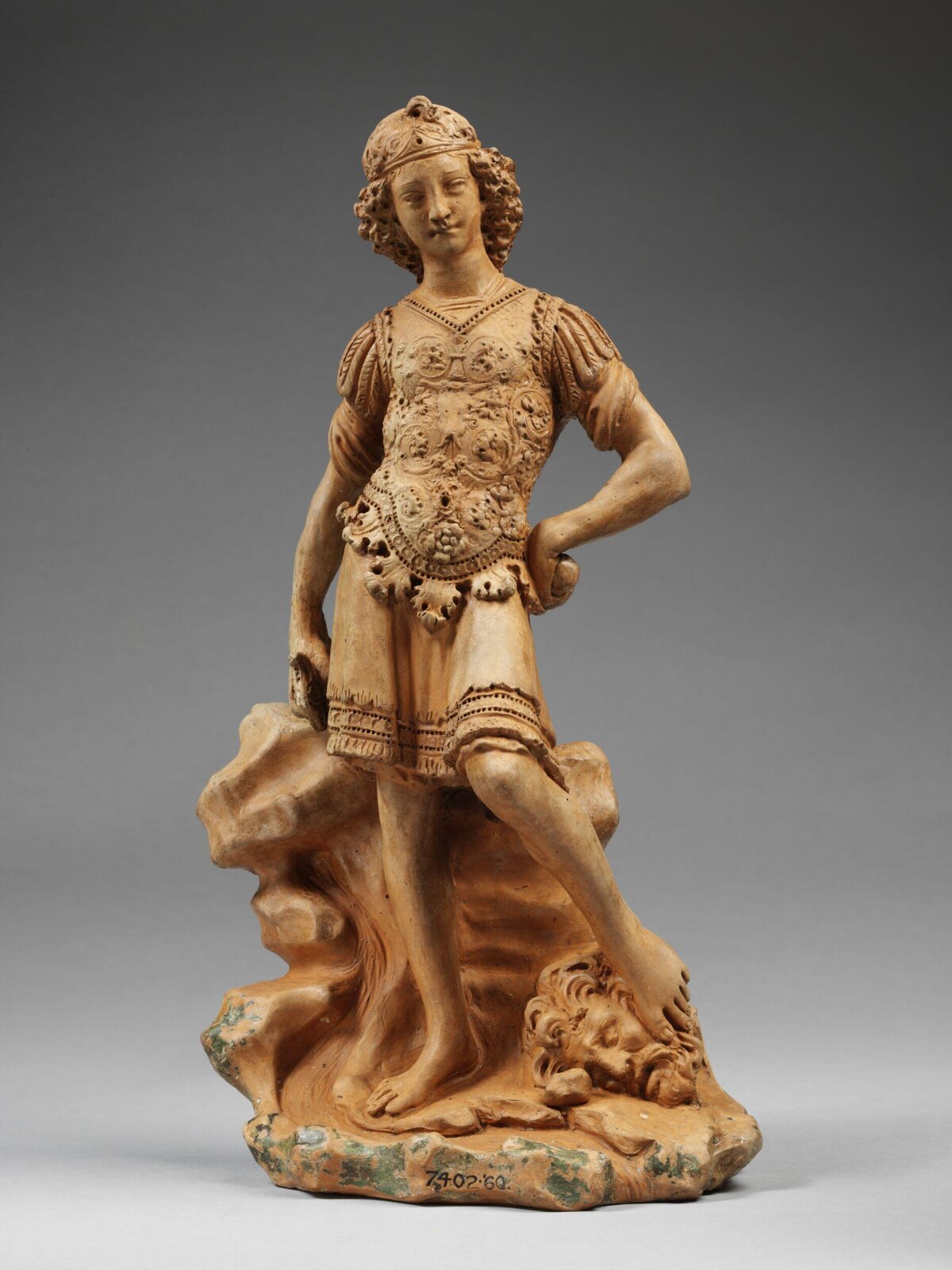
David
Kan det ses?
Ja, udstillet nu
Hvor er »David« i dag? Victoria and Albert Museum, Sculpture, Room 111, The Gilbert Bayes Gallery, London. Ja, udstillet nu. Kontrolleret 12. oktober 2026.

Lukket· åbner i morgen kl. 10.00
Udstillet for publikum.
- Kontrolleret
- Uændret siden
- Kilde
- Museet
Om skulpturen
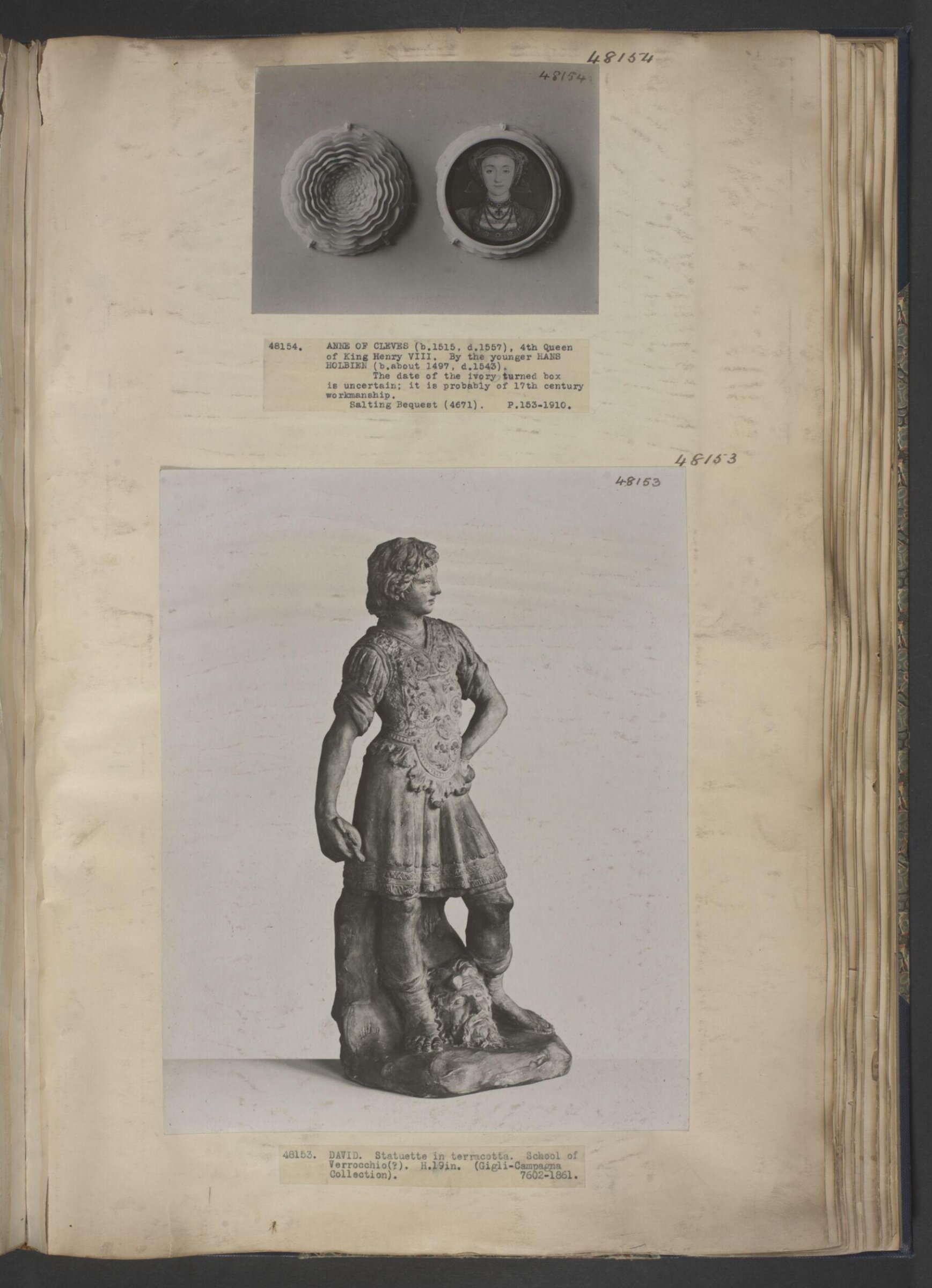
The youthful David rests his leg on the head of the giant Goliath. This terracotta statuette recalls the biblical episode (Samuel 1:17) in which David defeats the giant Goliath with a slingshot and stones collected from a nearby stream. The triumphant David then took Goliath’s sword and severed his head. Here, the details are carefully chosen to illustrate the story: stones near Goliath’s head and in David’s proper left hand, the sword held by David (the blade has broken off), and the stream running from the top left to the bottom right of the base.
Trapped air bubbles visible in an x-radiograph indicate the clay was pressed into a mould. Some areas of the figure are more defined than others, notably David’s breastplate, hair, and helmet.
Læs videre
The more defined areas may have been modelled with tools after the clay was taken out of the mould. Stamps were used to create the patterning along the edge of the tunic and the classically inspired breastplate.
The back was roughly modelled by hand with minimal detailing, suggesting the statuette was intended for a shelf or niche where the back was not visible .
Traces of gesso (a white priming layer often made from gypsum and a binding medium) and paint across the statuette, most notably the green (possibly copper resinate) along the base, indicate it was fully polychromed. There are traces of blue (azurite) and gold on the sleeves and red (vermillion) on the skirt hem. Most sculptures during this period were entirely painted but were often stripped of the polychromy at a later date.
David took on political symbolism in fifteenth- and sixteenth-century Florence, representing the strength and liberty of the city. Several large-scale David statues stood in public spaces. Notable examples include Donatello’s bronze David (ca. 1435-40), made for the Medici Palace and later moved to the Palazzo Vecchio; Andrea del Verrocchio’s bronze David (ca. 1475), probably initially owned by the Medici, but purchased in 1476 by the city government and relocated to the Palazzo Vecchio; and Michelangelo’s marble David (1501-4), placed in the Piazza della Signoria (See Bormand 2009 and Butterfield 1995). Plaster casts of all three statues are on display in the V&A’s Cast Courts.
Smaller statuettes like this example intentionally evoked the large-scale David sculptures visible throughout the city. Their small size suggests that these were likely intended to be displayed instead in the domestic sphere (Bormand 2009).
Multiple surviving models of this composition, such as V&A 7602-1861, indicate that such statuettes were popular among wealthy and middle-class Florentine families. Multiple copies could be easily produced using moulds and then could be customised.
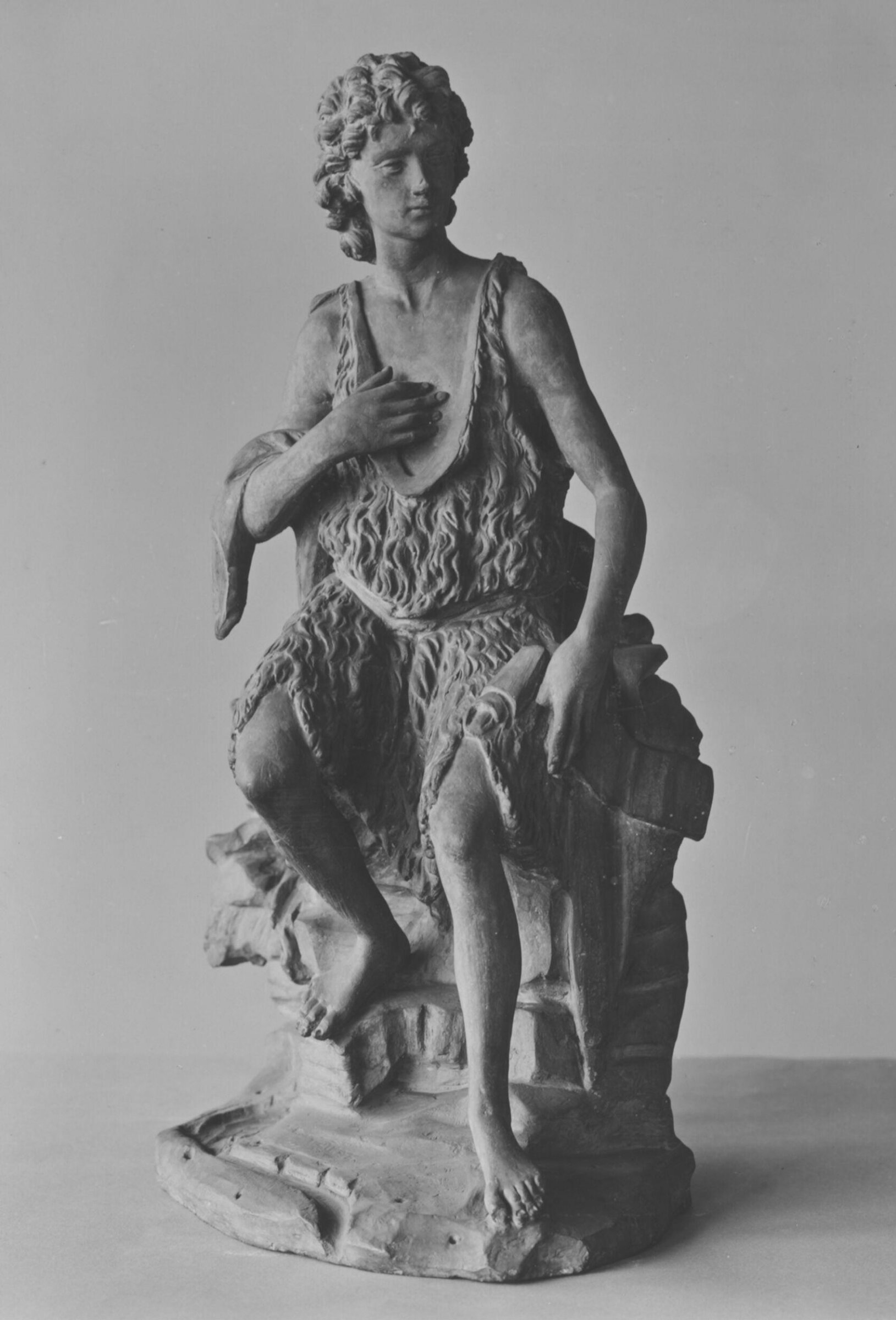
This figure of David and the head of Goliath are more detailed and refined than those in 7602-1861, indicating this statuette is of higher quality and potentially pointing to different hands in the workshop. Furthermore, multiple variants of 7602-1861 are known, while this composition seems unique. Its detailing and style may indicate it was customised by the workshop for a particular client.
Last updated 31/07/2025
Victoria and Albert Museum
Oplysninger
- Inventarnummer
- 7402-1860
Hvad det viser
I kataloget
Kilder
- Victoria and Albert Museum
- Billede: Victoria and Albert Museum — © Victoria and Albert Museum, London