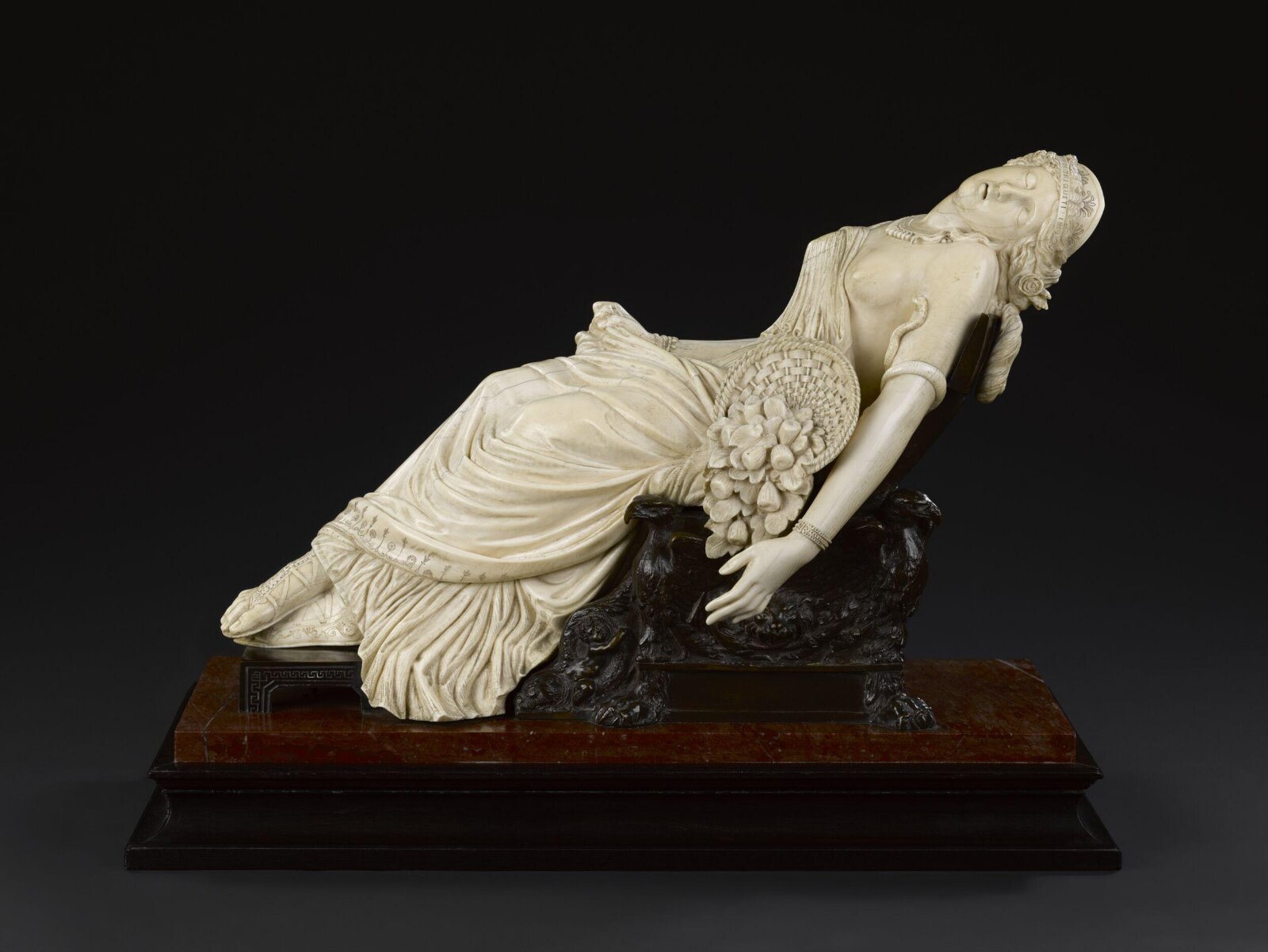
Cleopatra Dying
Kan det ses?
Ja, udstillet nu
Hvor er »Cleopatra Dying« i dag? Victoria and Albert Museum, Sculpture, Room 21a, The Dorothy and Michael Hintze Galleries, London. Ja, udstillet nu. Kontrolleret 25. september 2026.

London, Storbritannien
SalSculpture, Room 21a, The Dorothy and Michael Hintze Galleries
Lukket· åbner kl. 10.00
Udstillet for publikum.
- Kontrolleret
- Uændret siden
- Kilde
- Museet
Om skulpturen
‘Sculptor to the princes’ Henri-Joseph-François (Henry) Baron de Triqueti (1803-1874) was among the foremost sculptors of the nineteenth century, obtaining prestigious commissions from the French and British royal families. Triqueti scholar Richard Dagorne identifies two phases in the career of the artist: the “French” phase (1831-48), when Triqueti obtained the patronage of King Louis-Philippe and became official sculptor of the July Monarchy, and the “English” phase (1849-his death), when Triqueti turned to England in search of new patrons after the Revolution of 1848 overthrew the French crown. ‘Cleopatra Dying’ is emblematic of this period and production.
Læs videre
‘Cleopatra Dying’ represents the suicide of the Egyptian queen Cleopatra after her and her Roman lover Mark Antony’s defeat at the Battle of Actium in 31 BCE. A masterpiece of Triqueti’s work in ivory and bronze, the statuette was made for the British market. Queen Victoria and Prince Albert saw Cleopatra when it was exhibited at Colnaghi’s in June 1859, and in June 1860 with the Vase of Dreams (1860, now presumed lost), and two other ivory statuettes. Both viewings were widely reported in court circulars in London, regional and national press. The statuette was reviewed to critical acclaim.
The Welsh industrialist and art collector Sir Ivor Guest (1835-1914) soon acquired Cleopatra. It was displayed in his Canford Manor home and remained in his possession, and that of his widow and descendants, until 1927. Until the statuette resurfaced at auction in 2019, it was only known from literature contemporary to Triqueti’s time, its terracotta model (1851, Musée des Beaux-Arts, Orléans) and preparatory drawings (Ecole nationale des Beaux-Arts, Paris).
‘Cleopatra’ shows the artist’s eclectic style, influences and interests. The piece’s polychromy, now largely lost (Cleopatra’s dress and ornaments were originally enhanced with touches of gold and colour) evokes the Chryselephantine - ivory and gold - statuary of Phidias, the most celebrated sculptor of Greek antiquity. The pose and chair are drawn from ‘Ariadne Sleeping’ (formerly known as ‘Cleopatra’), a marble second-century CE Roman copy of a Greek original in the Vatican, and the ‘Death of Phaedra’, a drawing by Triqueti’s early mentor, neoclassical painter Anne-Louis Girodet-Trioson (1801, Musée du Louvre). This pose is also seen in ‘the dream of the young woman’, one of the four scenes on the Vase of Dreams. The chair’s exquisite casting and decorative detail evoke his attraction for the Renaissance, recalling elements of Andrea Riccio’s style.
Triqueti recruited master craftsmen (probably from Dieppe) to translate his terracotta model into this exquisitely carved ivory. The outstanding bronze casting is almost certainly executed by the reputed French firm Eck and Durand.
A masterpiece of Triqueti’s domestic work, ‘Cleopatra’ epitomizes the rich network of patronage between France and England, British collecting of mid- to late nineteenth-century French sculpture, and the Victorian taste for eclecticism, sentimental pieces and work in ivory.
Victoria and Albert Museum
Oplysninger
- Inventarnummer
- A.1-2022
Hvad det viser
I kataloget
Kilder
- Victoria and Albert Museum
- Billede: Victoria and Albert Museum — © Victoria and Albert Museum, London