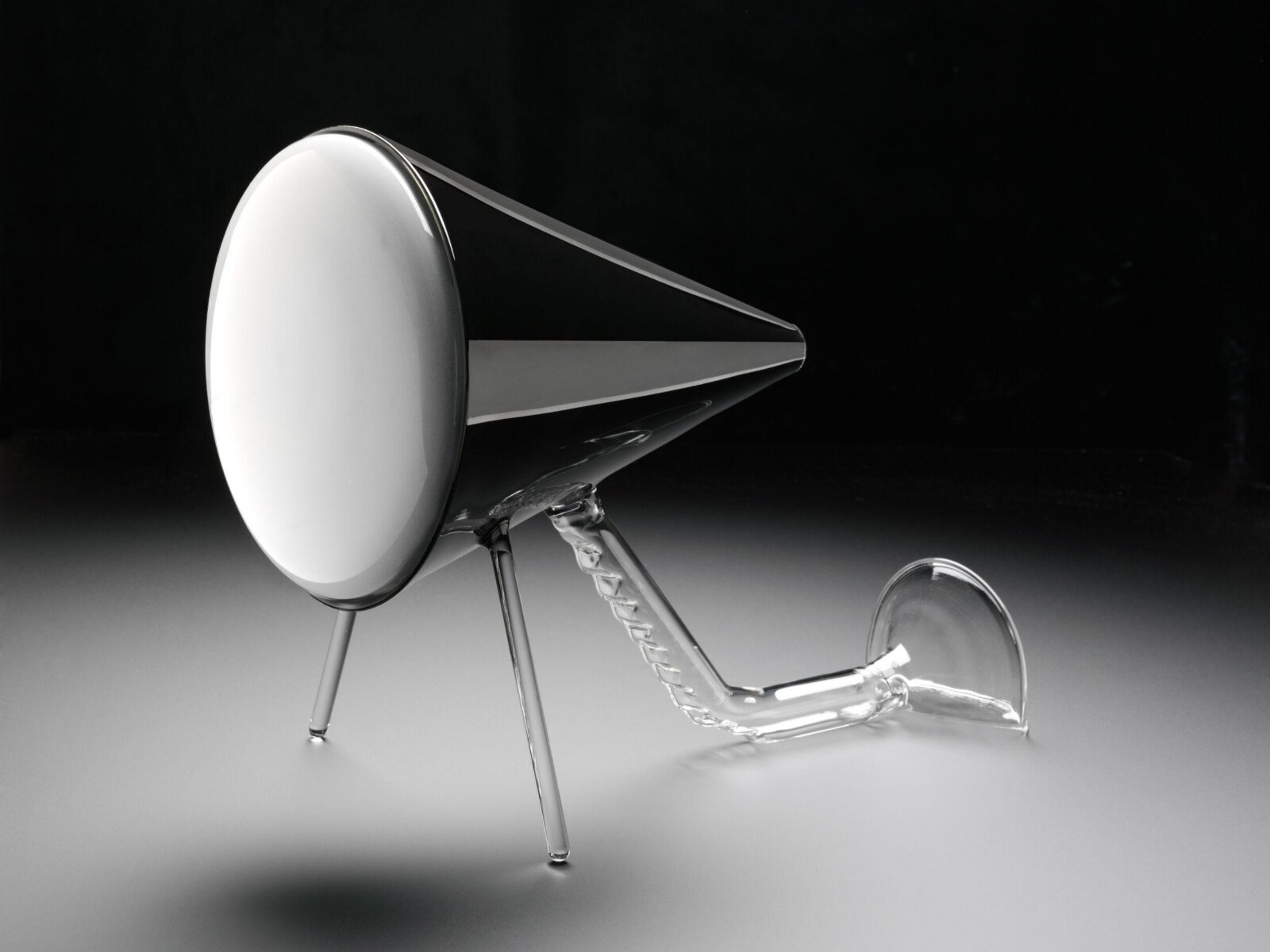
El Ultimo Grito
Cinema
Må man se det?
Tager ikke imod for tiden

Victoria and Albert Museum
London, Storbritannien
Det hører til samlingen, men er ikke udstillet for tiden.
- Kontrolleret
- Uændret siden
- Kilde
- Museets egne samlingsdata
About the sculpture
El Ultimo Grito is the highly acclaimed partnership formed by the London- based Spanish designers Rosario Hurtado and Roberto Feo. Their work takes a witty and questioning approach to the relationship between humans and the objects that surround them. As designers, they typically seek solutions that break from tradition, producing objects that provoke thought or communicate ideas about society and culture. They frequently utilise relatively modest materials, employing these in very direct ways. Their designs have been represented in the Furniture collections of the V&A since 2001, and the Museum of Childhood since 2010.
Read on
Cinema , is part of a recent series of unique works in glass, made in Murano, Italy, in a factory specialising in the production of laboratory glassware. Titled Imaginary Architectures , these works exist somewhere between abstract sculptures and architectural models, representing as they do imagined architectural forms made up of inter-connected spaces. Some of the works in the series represent the more generic architecture of houses, hotels or, as here, cinemas, while others take their cue from specific buildings, including Berlin's station and airport. Although highly abstracted, the works nevertheless strongly evoke the use and functionality of the spaces represented, and provide a clear sense of their physical and social dynamics, for example, through the inclusion of access points, transit spaces, areas for mass congregation and for more intimate gatherings.
The basic form of Cinema - a horizontally-oriented blown glass cone on narrow legs - evokes the futuristic character of 1950s design, and at first glance appears like a piece of esoteric technical equipment. Closer inspection however reveals its architectural character and its embodiment of the fundamental elements of a cinema comprising entrance, stairway and auditorium, the latter being an appropriately dark space through the use of coloured rather than clear glass. The particular delight of the piece is that it additionally functions as a camera obscura, the image gathered through the narrow open mouth of the cone being readable on its colourless solid base. As such it both makes reference to, and practically functions as, a site for projected images.
The Imaginary Architectures series is representative of a wide cross- disciplinary relationship in contemporary architecture, craft and design, which has seen on one hand architects draw inspiration from the forms and technologies of small-scale objects, and on the other, the evocation of architectural forms within craft and design. Imaginary Architectures is also significant in representing the increasing breadth and complexity of El Ultimo Grito's practice. It forms part of a resurgence of interest in glass blowing in Britain, while also demonstrating the conceptual depth and unfettered imagination that can be brought to the discipline by designers working outside the established conventions of studio glass making.
Victoria and Albert Museum
Oplysninger
- Inventarnummer
- C.105-2012
I kataloget
Kilder
- Victoria and Albert Museum: the museum's own open data · hentet for 11 dage siden
- Billede: Victoria and Albert Museum — © Victoria and Albert Museum, London