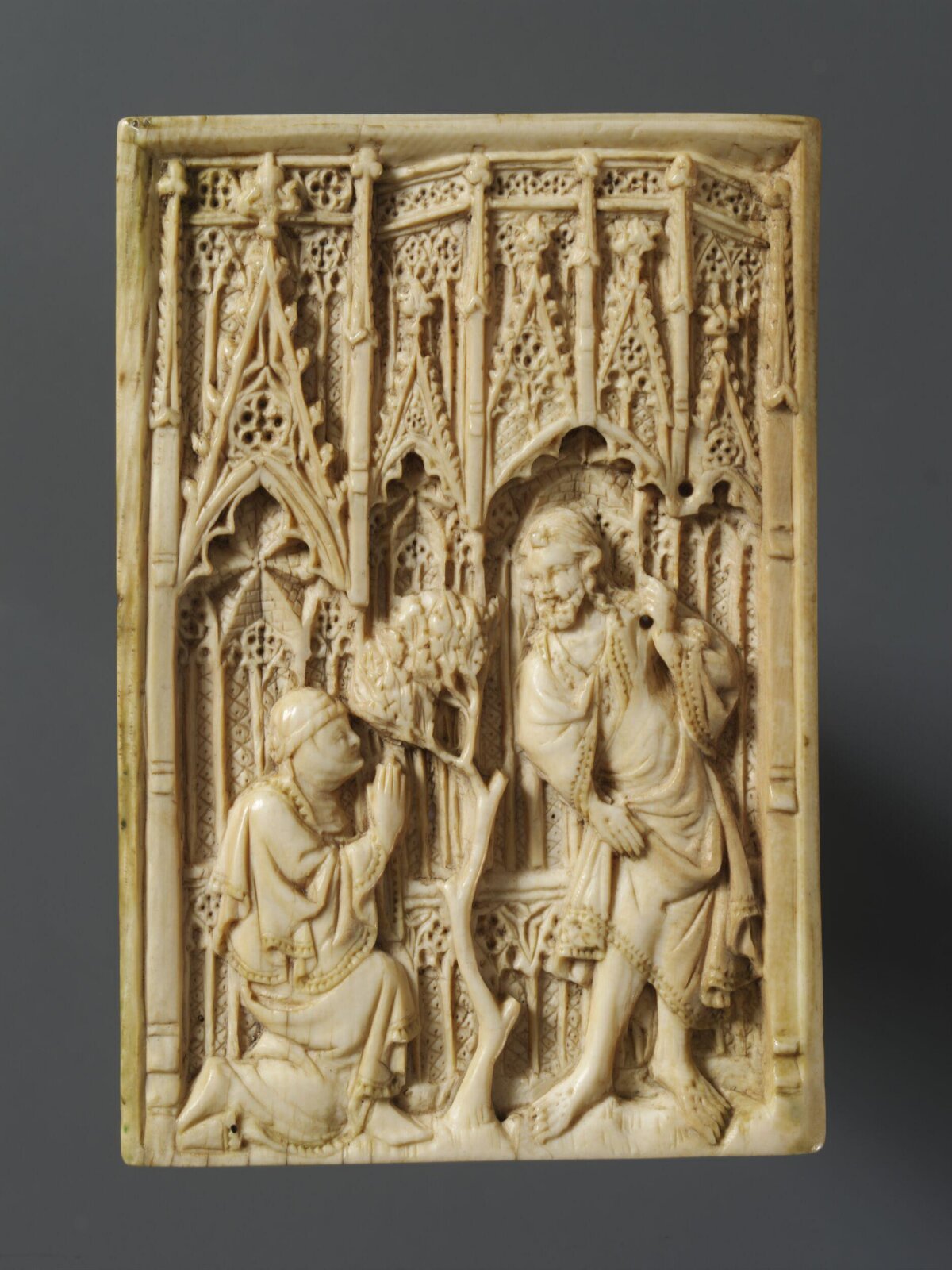
Christ Appearing to Mary Magdalene
Kan det ses?
Ja, udstillet nu
Hvor er »Christ Appearing to Mary Magdalene« i dag? Victoria and Albert Museum, Sculpture, Room 111, The Gilbert Bayes Gallery, London. Ja, udstillet nu. Kontrolleret 25. september 2026.

Lukket· åbner i morgen kl. 10.00
Udstillet for publikum.
- Kontrolleret
- Uændret siden
- Kilde
- Museet
Om skulpturen
This is an ivory plaque from a set of writing tablets, depicting the Noli Me Tangere. After his resurrection Christ appeared to Mary by the empty tomb. He asked her not to touch him but to go to the disciples with the message that he had now risen. Here the scene takes place beneath elaborate canopies and in front of a screen.
Læs videre
A remarkable feature of the plaque is the previous existence of the staff or spade once held by Christ: this was a separate piece, which was fixed to the ivory by a hole under Christ's left hand, and another at the lower edge of the canopy above him. Then the piece slotted into a further hole at the base of the tree. An addition of this sort seems highly impractical for an object of such use as a writing tablet. Also remarkable is the gesture of Christ: he gathers up his mantle, leaning towards the Magdalene, while normally in such scenes he would make a characteristic dismissive gesture. The most striking aspect of the plaque is the use of an extremely elaborate and dense architectural backdrop for what is ostensibly an outdoor scene.
Ivory covers for writing tablets survive in good numbers from the fourteenth century. Wax writing tablets or panels of a hard material filled with layers of wax that could be inscribed with a stylus, were common in Antiquity and continued in use throughout the early Middle Ages. They were particularly useful for note taking, given their portability and the fact that their surfaces could be erased and reused.
The majority of such tablets would have been made of wood, although other materials such as gold, silver, bone and ivory were also used. In most cases the tablets formed part of a group of up to eight panels, only the covers of which were carved with imagery on their outer faces. The imagery on most surviving tablets and boxes derives primarily from diptychs, with a quality of carving lower than that commonly found on diptychs, at least partly as a result of the thinner ivory material on the tablets.
Victoria and Albert Museum
Oplysninger
- Inventarnummer
- A.26-1958
Hvad det viser
I kataloget
Kilder
- Victoria and Albert Museum
- Billede: Victoria and Albert Museum — © Victoria and Albert Museum, London