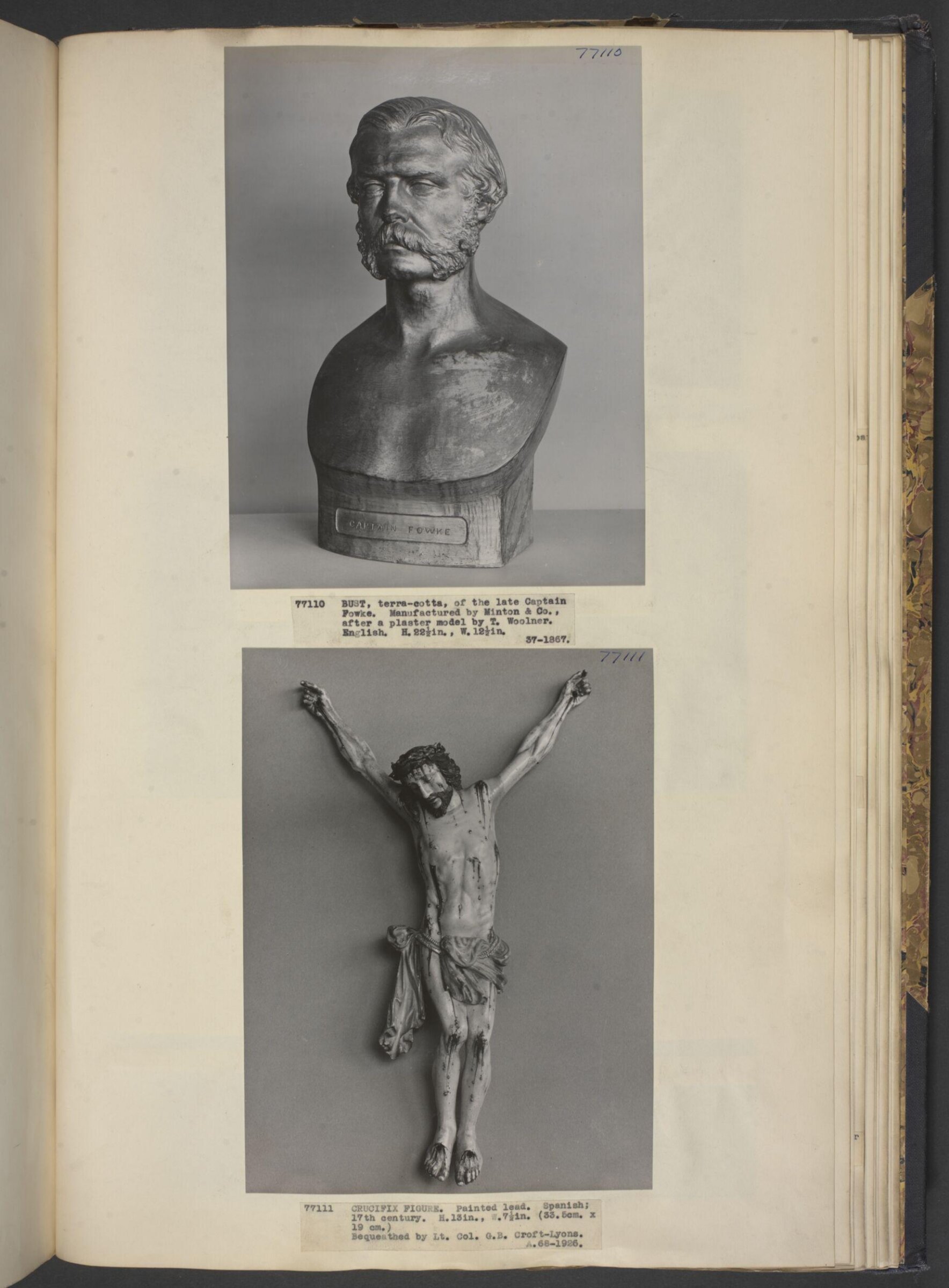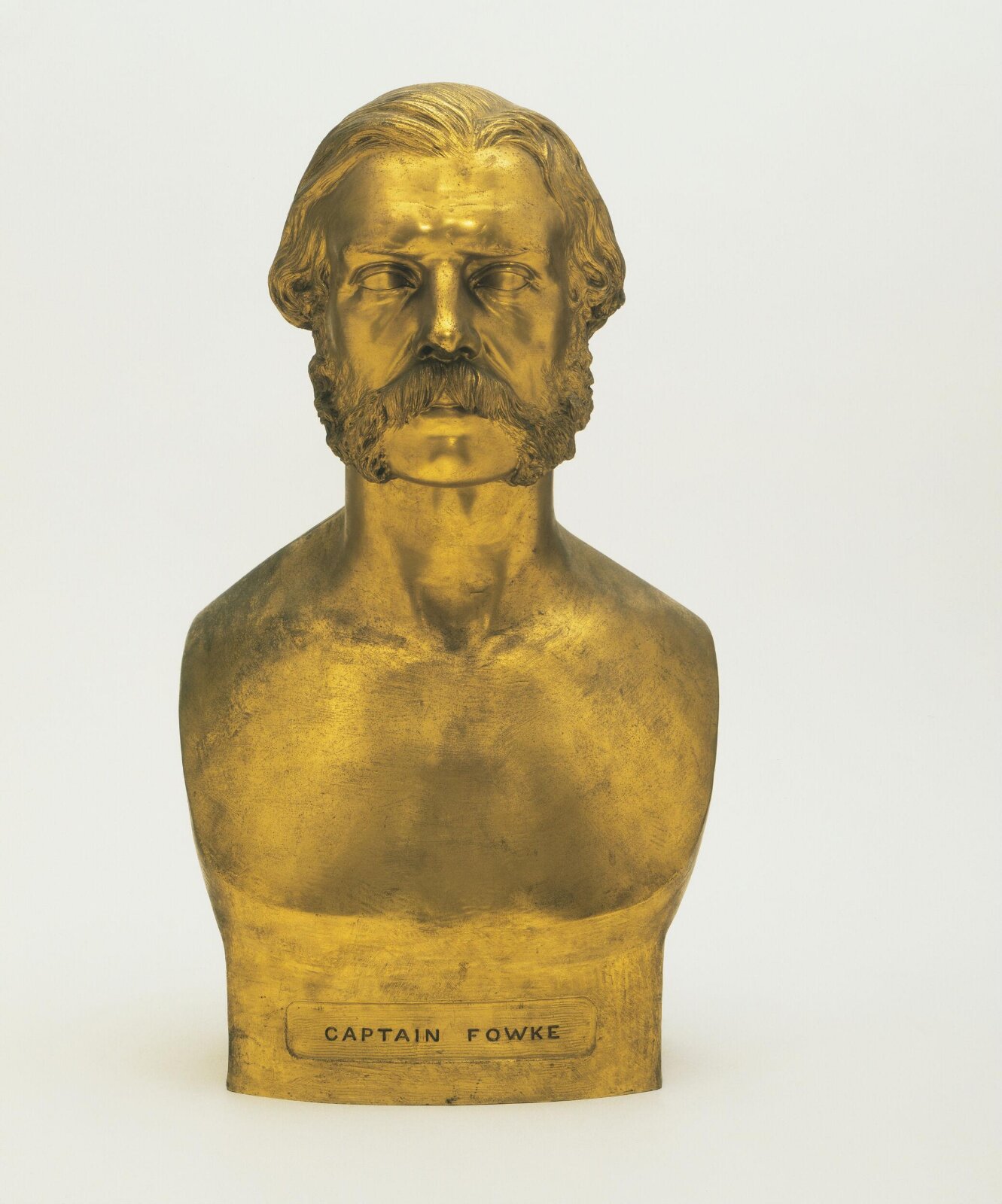
Captain Francis Fowke RE (1823-1865)
Kan det ses?
Ikke udstillet lige nu
Hvor er »Captain Francis Fowke RE (1823-1865)« i dag? Samling: Victoria and Albert Museum, London. Ikke udstillet lige nu. Kontrolleret 25. september 2026.

London, Storbritannien
Det hører til samlingen, men er ikke udstillet for tiden.
- Kontrolleret
- Uændret siden
- Kilde
- Museet
Om skulpturen
This bust was apparently cast from a plaster model produced by Thomas Woolner. It was manufactured by Elkington & Company. The depicted Captain Francis Fowke was the architect and engineer at the Science and Art Department of the South Kensington Museum, now Victoria and Albert Museum. He was responsible for the design of the first permanent buildings on the South Kensington site, and the gallery that housed the Sheepshanks gift of paintings.
Woolner (1825 – 1892) was apprenticed to William Behnes and later entered the Royal Academy Schools. In 1843 (aged eighteen and still studying at the RA Schools) he showed his first work in public at the Royal Academy, Eleonora sucking the poison from the wound of Prince Edward. He continued to show ideal works at the Royal Academy and at the British Institution until the end of the 1840s.
Læs videre
Woolner met Holman Hunt and Millais through D.G. Rossetti and became the only sculptor member of the Pre-Rapaelite Brotherhood in 1842. Disillusioned after his failure in the competition for the Westminster Abbey Wordsworth Memorial, Woolner emigrated to Australia in 1852 in search of gold. He did not find gold but work as a sculptor, building up an extensive practice in portrait medallions. After his return to Britain in 1854 he continued to specialise in portraiture: medallions, busts and public statues. His bronze figure of Captain Cook for Hyde Park, Sydney is considered his masterpiece. Woolner was also an acclaimed poet. Woolner was elected ARA in 1871 and a Member in 1874 and was briefly Professor of Sculpure at the Royal Academy (1877-9).
Elkington & Co. was one of the leading British silver manufacturers of the 19th century. The firm was probably established before 1836 as G.R. Elkington & Co. in Birmingham. It was known by various names, particularly Elkington & Co., until 1963. By the 1860s it employed over 1,000 people. Elkington's created grand presentation pieces for international exhibitions as well as mass-produced dinner services, dressing cases, tea wares and flatware. Between 1836 and 1840 Elkington's patented processes such as electrogilding and electroplating, which used electricity to coat cheaper metals with silver or gold. Imitation 'silver' products were thus made available to a much wider section of the population. Elkington's also used this technology to manufacture electrotype copies of famous art objects, such as the 16th-century cup and cover on display in the Bromley-by-Bow Room of the British Galleries.
Victoria and Albert Museum
Oplysninger
- Inventarnummer
- 1155-1868
Hvad det viser
I kataloget
Kilder
- Victoria and Albert Museum
- Billede: Victoria and Albert Museum — © Victoria and Albert Museum, London