Joseph Mallord William TurnerStorbritannien, 1775–1851
Caligula's Palace and Bridge
Kan det ses?
Ukendt
Hvor er »Caligula's Palace and Bridge« i dag? Samling: National Gallery, London. Ukendt.

London, Storbritannien
Ejeren er kendt; om værket er udstillet i dag, vides ikke.
- Uændret siden
- Kilde
- Museet
Om maleriet
Caligula's Palace and Bridge is an 1831 landscape painting by the British artist J.M.W. Turner. It is an imagined scene of the giant palace and bridge from Baiae to Puteoli across the Bay of Naples, built under the direction of the deranged Roman Emperor Caligula.
At the Royal Academy Exhibition of 1831 at Somerset House, this and another work by Turner Vision of Medea were hung either side of John Constable's Salisbury Cathedral from the Meadows providing a striking contrast which was picked up on by reviewers. This reportedly led to a row between the two men in front of their fellow artists, as Constable was on the hanging committee that chose were paintings would be placed.
Today the painting is in the collection of the Tate Britain in Pimlico, having been part of the Turner Bequest of 1856 Turner later engaged Edward Goodall to produce an engraving based on the work.
Oplysninger
- Inventarnummer
- NG512
I kataloget
Kilder
- Wikidata
- Billede: National Gallery — J. M. W. Turner · Public domain · Wikimedia Commons
Imens i livet hos Joseph Mallord William Turner
Hele livet1820s
Print series for publishers
In the 1820s he worked on several topographical print commissions: “Picturesque Views on the Southern Coast of England” (1814–1826) and “The Rivers of England” (1822–1826) for the Cooke brothers, “Picturesque Views in England and Wales” (1824–1838) for Charles Heath and “The Ports of England” (1825–1828) for Thomas Lupton.
1829
The death of his father
His father, who had lived with him for thirty years and worked as an assistant in his studio, died in 1829; the loss strongly affected Turner, who began to suffer fits of depression afterwards, and he finally abandoned his own gallery.
1829
Paris, Normandy and Brittany
In the twenty-year period from 1821 to 1844 he visited several European countries, studying the old masters and taking long hikes into the countryside: in 1829 Paris, Normandy and Brittany, and three years later Paris for the second time.
1830–1840s
Criticism in the 1830s–1840s and Ruskin’s defence
His innovative works, bordering on abstraction, gave him a reputation for madness: the Victorian public preferred realism and sentimentality, and Queen Victoria refused to knight him. John Ruskin came to his defence, calling him “the greatest artist of all time”.
1833
Vienna and Venice: down the Danube, back by the Rhine
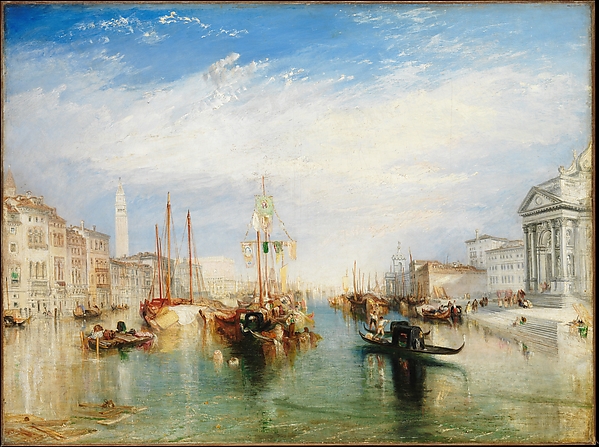
He visited Vienna and Venice, travelling down the Danube and returning via the Rhine; the trip to Venice inspired important works such as “Venice, from the Porch of Madonna della Salute” (1835), “Venice, the Bridge of Sighs” (1840) and “The Sun of Venice Going to Sea” (1843).