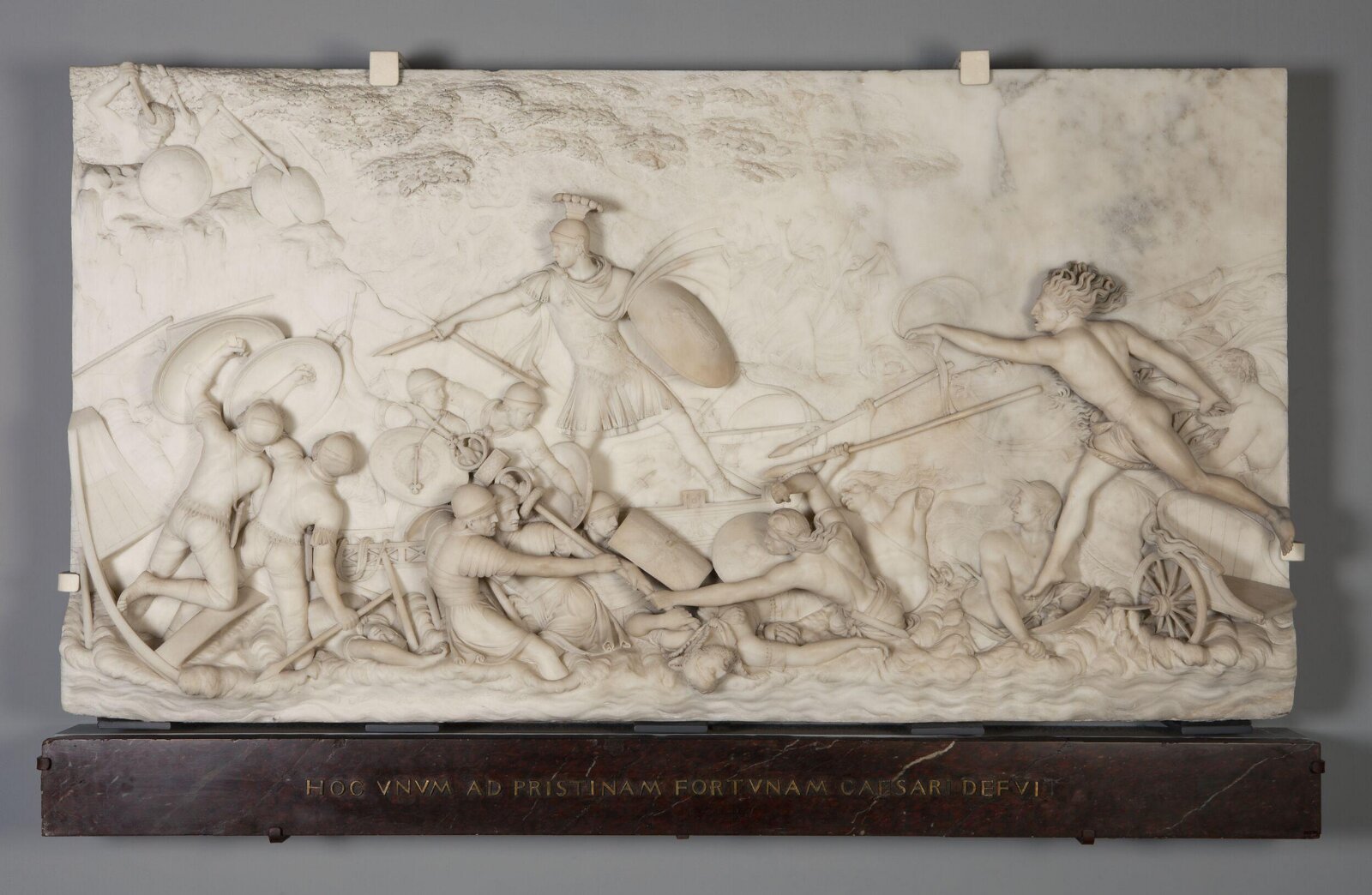
The British sculptor John Deare (1759-98), who was a native of Liverpool, spent much of his career in Rome. It was there that he carved this relief for John Penn (1760-1834), a grandson of William Penn of Pennsylvania. The relief was installed above a fireplace, also carved by Deare, in Penn's Buckinghamshire house, Stoke Park. The unusual and virtuoso composition shows the invading Romans being repelled by heroic native British forces on the shore. In the centre, the helmeted figure of Julius Caesar stands commandingly on a flat-bottomed boat, armed with a shield and spear, his cloak billowing behind him in the wind. Behind him one of his soldiers, carved in low relief, aims an arrow at the Britons coming in to attack from the right.
Read on
One of these, a long-haired figure, wearing only a loincloth, strides forth, his mouth open, shouting no doubt a battle cry, having leapt from his chariot, the wheel of which is armed with a knife blade. Three other bare-chested Britons fight in the water, whilst two others can be seen charging in from behind. In the shallows a dead centurion clutches a standard, which three of his fellow soldiers are wresting from a Briton who is attempting to seize it. Another Roman soldier is about to fire a stone from his sling, while a slaughtered Roman lies nearby in the water. The long hair and semi-nudity of the natives contrast with the more sober military demeanour of the helmeted Romans. To the left, two Roman soldiers are to be seen from the rear in a smaller boat, holding up their shields to defend themselves from the attack of the Britons, grasping shields and spears, and peering down at the invaders from their vantage point above on the cliff top. In the background at the centre right in low relief sorrowing bearded Druids with upraised arms bewail the scene.
John Penn was a British patriot and at the same time a supporter of the American Revolution. He would have sympathised with the plight of native forces struggling to combat a dominant imperial power. During the 1790s fears of French invasion of Britain were also apparent, and the subject of this relief may reflect those concerns. The Latin inscription, in bronze letters set into red marble, set below the relief, comes from Julius Caesar's own account of the invasion. It refers to a brief moment when the Britons managed to repulse the Roman invaders.