Viktor Vasnetsov1848–1926
Бюст Ильи Ефимовича Репина
Kan det ses?
Ukendt
Hvor er »Бюст Ильи Ефимовича Репина« i dag? Samling: Abramtsevo, Abramtsevo. Ukendt.
Abramtsevo, Rusland
Ejeren er kendt; om værket er udstillet i dag, vides ikke.
- Uændret siden
- Kilde
- Museet
Om skulpturen
Med museets ord — på russisk
Оплечно, прямолично. В сюртуке и рубашке с расстегнутым воротом, повязанным галстуком-бантом. Волосы курчавые, острая бородка, усы; взгляд устремлен вдаль. Ниже среза груди и плечей – часть палитры. Спереди надпись в гипсе: В. Васнецовъ1880.
Abramtsevo
Oplysninger
- Inventarnummer
- СК 4
I kataloget
Kilder
- Ruslands statslige katalog over museumsfonden
- Billede: Abramtsevo — © Абрамцево · Госкаталог музейного фонда РФ
Imens i livet hos Viktor Vasnetsov
Hele livet1878
He moves to Moscow, the city of his life’s work
In 1878, his resolve strengthened by Mamontov’s letter, he moved to Moscow, the city to which most of his creative life would be tied: he settled in a small flat in 3rd Ushakovsky Lane near Ostozhenka, walked the city for hours admiring the Kremlin and St Basil’s, and until 1885 the family changed rented flats in Moscow six times.
1878–1880
Mamontov’s commission for the Donetsk Railway
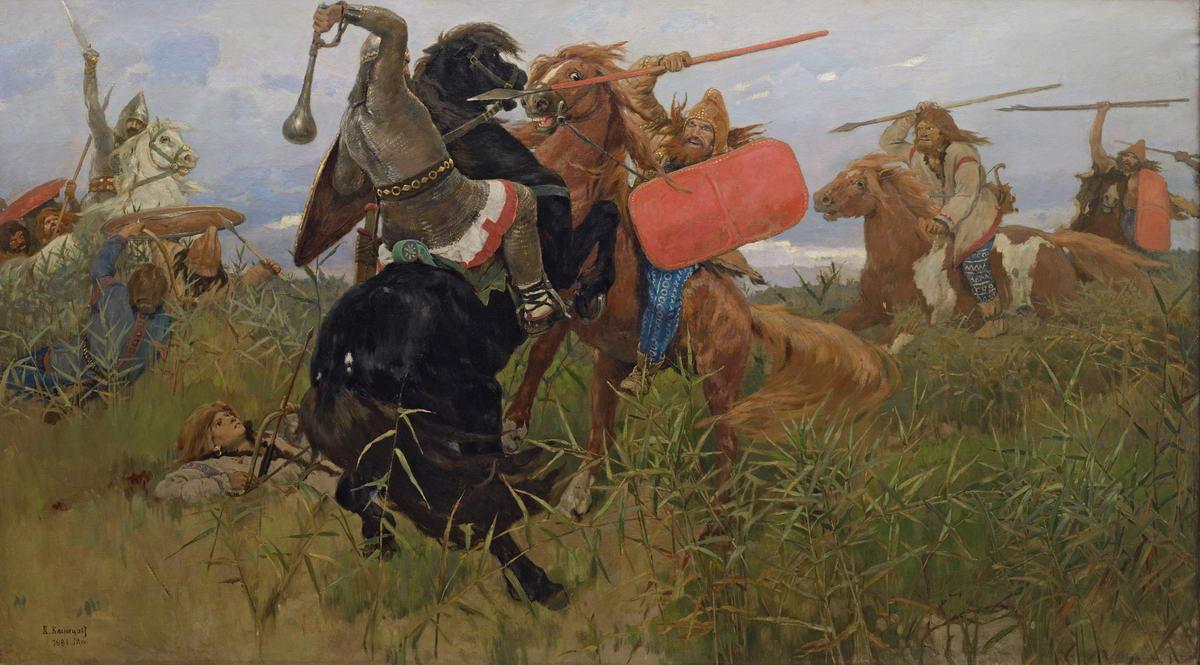
Repin brought him to the house of Savva Mamontov, who commissioned three fairy-tale pictures for the boardroom of the Donetsk Railway — “The Battle of the Russians with the Scythians”, “The Flying Carpet” and “The Three Princesses of the Underground Kingdom” (the princesses of gold, precious stones and coal); the princess Coal, a modest dark-haired girl in a black dress, was especially successful.
1878–1890 · Karriere
the Peredvizhniki
From 1878 he belonged to the Society of Travelling Art Exhibitions (the Peredvizhniki): he took part in its activity in 1878–1890 and exhibited with it until 1897; he was admitted for the realism and sharp social subjects of his genre paintings.
1879
His daughter Tatyana, the first of five children, is born
In 1879 his daughter Tatyana was born, later an artist and keeper of her father’s legacy; sons followed — Boris (1880), Alexei (1882), Mikhail (1884) and Vladimir (1889).
1880
His first visit to Mamontov’s Abramtsevo
In June 1880, with his brother Apollinary, he first came to Abramtsevo at Savva Mamontov’s invitation and joined the circle of Repin, Polenov, Serov and other artists, where he became one of the leaders of the national-romantic current.