 Viktor Vasnetsov1848–1926
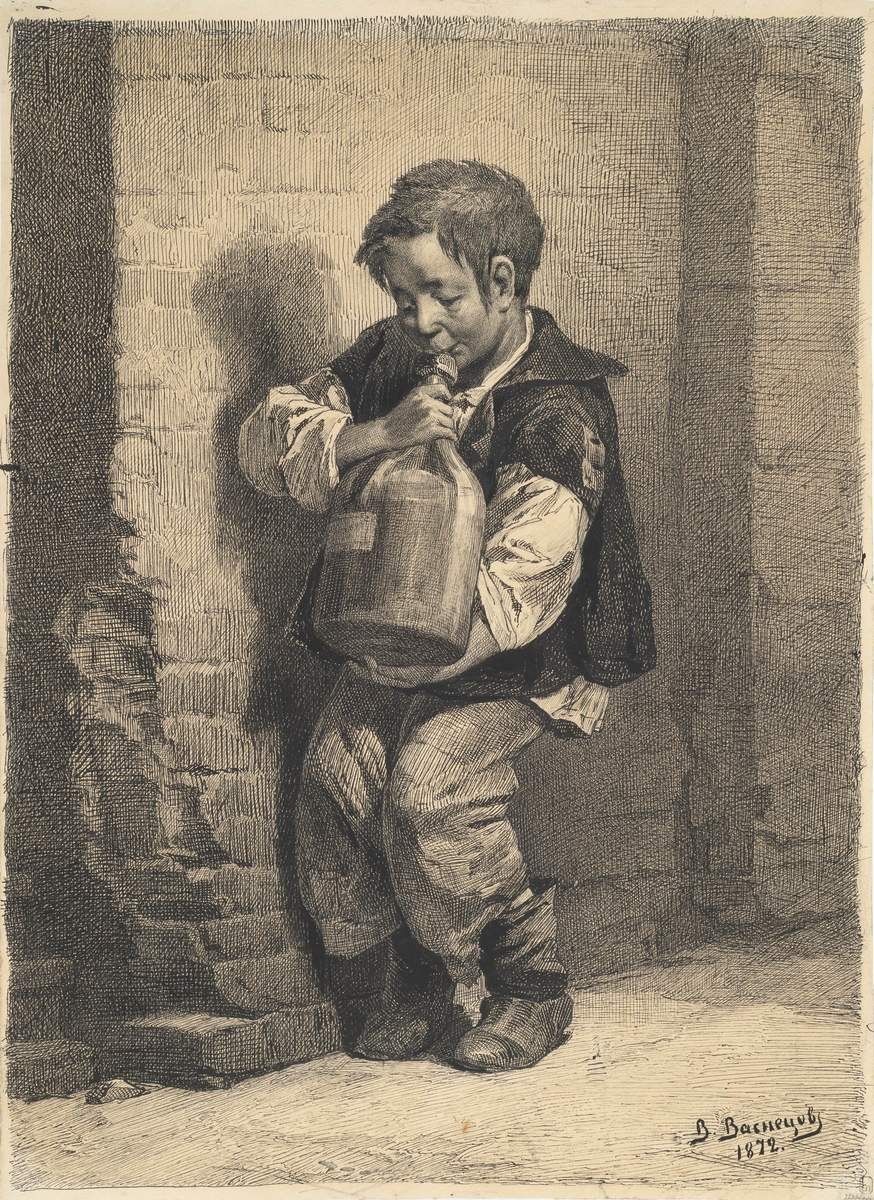
«Бутыль» (Мальчик с бутылью)
Kan det ses?
Ukendt
Hvor er »«Бутыль» (Мальчик с бутылью)« i dag? Samling: Det Russiske Museum, Sankt Petersborg. Ukendt.

Sankt Petersborg, Rusland
Ejeren er kendt; om værket er udstillet i dag, vides ikke.
- Uændret siden
- Kilde
- Museet
Om værket
Med museets ord — på russisk
Рисунок был гравирован в 1872 году. Виктор Васнецов. К 175-летию со дня рождения. СПб, 2024. С. 47.
« Все мы тогда считали себя реалистами, искали только правды в искусстве , — так позднее высказывался Васнецов об ученическом периоде, — а слово „идеал“ для нас не было пустым избитым словом без содержания …»*. Под влиянием демократических взглядов современников художник изменил свое отношение к академической исторической живописи и стал проявлять интерес к бытовому жанру. При этом он с особой теплотой вспоминал непродолжительные посещения мастерской П. П. Чистякова. Последний не был руководителем Васнецова в Академии художеств, но сумел передать ему «много света»** в понимании искусства.
Læs videre
Творческие поиски «правды» и «идеала» привели Васнецова к созданию большого количества произведений на сюжеты из жизни «низов» Петербурга — «Трубочист» (ГТГ), « Сборщик на храм », «Дворник. Этюд головы» (Р-13352), « Носильщики », « Мальчик с бутылью », « Продавец кваса » и многих других. С. В. Кривонденченков. «В своем истинно национальном отразить вечное». Эволюция реалистической тенденции в творчестве В. М. Васнецова // Виктор Васнецов. СПб, 2024. С. 6.
* В. М. Васнецов — В. В. Стасову, 3 октября 1902 // Виктор Михайлович Васнецов: Письма. Дневники. Воспоминания. Суждения современников / Сост., вступ. ст. и примеч. Н. А. Ярославцевой. М., 1987. С. 190.
** В. М. Васнецов — В. В. Стасову, 20 сентября 1898 // Там же. С. 150.
Справа внизу подпись: В. Васнецовъ 1872
Det Russiske Museum
Oplysninger
- Inventarnummer
- Р-339
Hvad det viser
I kataloget
Kilder
- Det Russiske Museum
- Billede: Det Russiske Museum — © State Russian Museum
Imens i livet hos Viktor Vasnetsov
Hele livet1868–1876
Friendship with Repin and the “evenings” at Antokolsky’s
In St Petersburg he grew very close to Ilya Repin; he attended the “evenings” at the apartment of Repin and the sculptor Mark Antokolsky, where the student Ivan Savenkov read bylinas in a slow chant, in the northern accent so familiar to Vasnetsov — and so his interest in early Russian culture and folk epic finally took shape.
1868–1876
Friendship with Arkhip Kuindzhi
In St Petersburg he grew especially close to Arkhip Kuindzhi: the taciturn Vasnetsov found the key to his reserved nature, and when Kuindzhi painted “Ukrainian Night” he exclaimed that it was the very night Gogol had spoken of — “now we see it”.
1870
He meets Pavel Chistyakov
Pavel Chistyakov, back from Rome, saw Vasnetsov’s drawing “A Prince’s Icon-painting Workshop” at an Academy exhibition, asked to be introduced to its author and soon made him a regular pupil; Vasnetsov remembered his teacher as “an enemy of the formula” who could show each pupil the road to his own development.
summer 1871
He meets his future wife, Alexandra Ryazantseva
In the summer of 1871, home in Vyatka on academic leave, he met Alexandra Ryazantseva in the local library — a merchant’s daughter who would become one of the first women from Vyatka with a higher medical education; he was struck by “her eyes — stern and extraordinarily kind”.
1873–1875
He leaves the Academy before graduating
In 1873, a year before the end of the course, he almost stopped attending the Academy and went only to Chistyakov’s studio: Chistyakov told him he had already got from the Academy all it could give, and Kramskoi advised the same; on 4 (16) February 1875 he was formally discharged, receiving a certificate that listed two small silver medals and one large one.
1874
“Tea-drinking in a Tavern” with the Peredvizhniki
In 1874 he took part for the first time in an exhibition of the Peredvizhniki, showing “Tea-drinking in a Tavern” (“Over Tea”).