Jacques de Baerze
Bust
Må man se det?
Ja, det tager imod

Victoria and Albert Museum
SalSculpture, Room 111, The Gilbert Bayes GalleryLondon, Storbritannien
Udstillet for publikum. Hvem der står inde for det, står nedenfor.
- Kontrolleret
- for 8 dage siden
- Uændret siden
- 25. sep. 2026
- Kilde
- Museets egne samlingsdata
About the sculpture
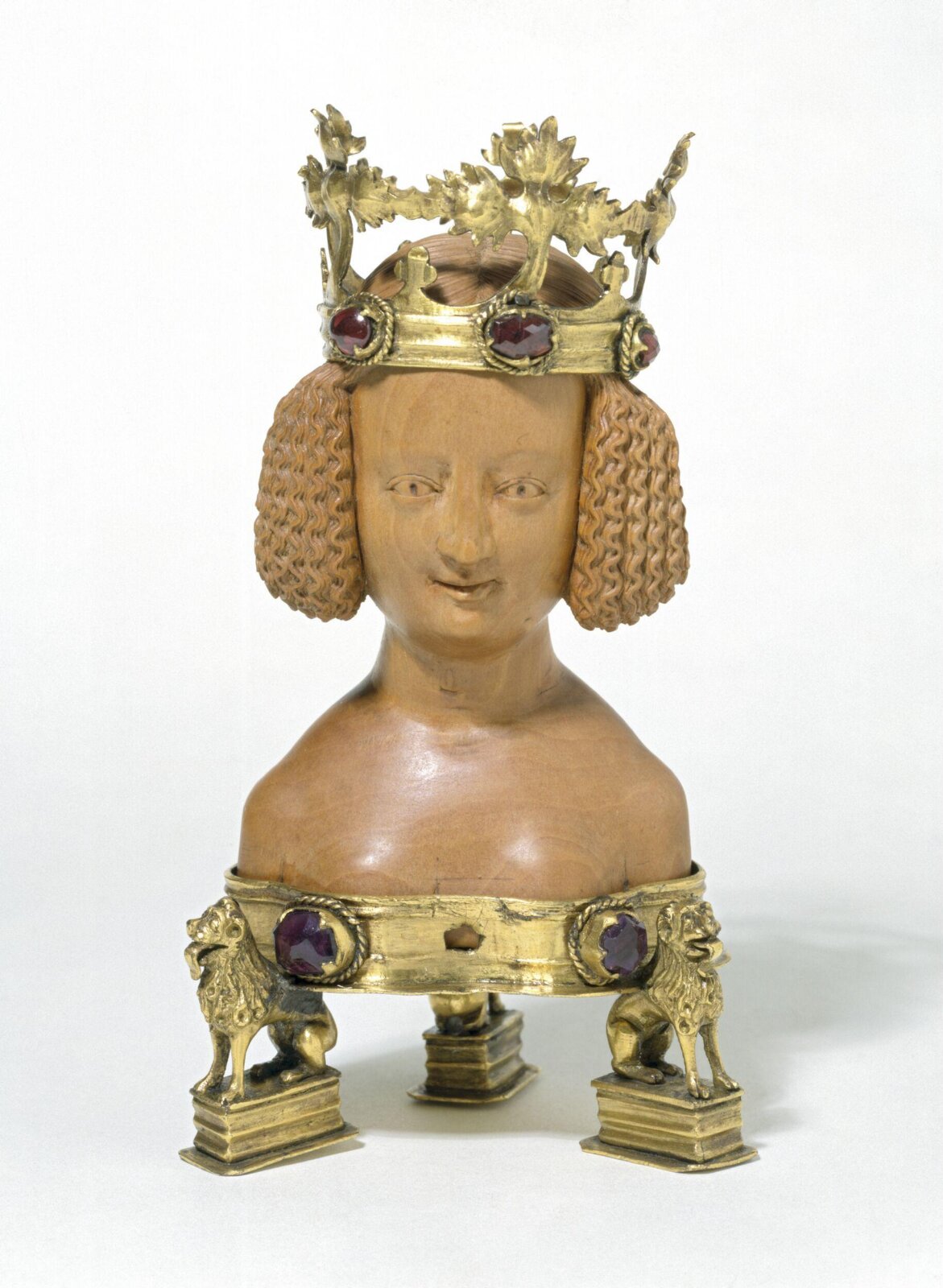
This is a boxwood bust of a young female saint, probably made in Dijon, France in about 1380-1400, and possibly produced by Jacques de Baerze.
Read on
Small boxwood figures like this were popular from the 1350s onwards. This example, carved with exceptional delicacy, is probably from a princely collection. The bust of a naked female figure has an elaborate hairstyle, parted in the middle, crimped at the sides and gathered into a pigtail at the back. She wears a gilt copper crown set with three red garnets (two of them faceted, and so not original, and one cabochon) and topped with five naturalistic leaf crestings. The bust sits in a base also of gilt copper, supported by three seated lions on moulded bases, set with two amethysts (there were originally three), which are also faceted and therefore replacements. Underneath the bust is a small square excavation with at its centre, a circular hole, presumably a space for for relics.
Throughout the ages artists and craftsmen have made virtuoso carvings as a display of their skill and ingenuity. Although ivory, wood and stone are relatively easy to carve, other materials such as gemstones are much more demanding. Most of these carvings were made for wealthy patrons and collectors, who delighted in the rarity of the material and quality of the carving.
Victoria and Albert Museum
Oplysninger
- Inventarnummer
- 399-1872
What it shows
I kataloget
Kilder
- Victoria and Albert Museum: the museum's own open data · hentet for 8 dage siden
- Billede: Victoria and Albert Museum — © Victoria and Albert Museum, London