Georges SeuratFrankrig, 1859–1891
Badere ved Asnières
Bathers at Asnières
Kan det ses?
Ukendt
Hvor er »Badere ved Asnières« i dag? Samling: National Gallery, London. Ukendt.

London, Storbritannien
Ejeren er kendt; om værket er udstillet i dag, vides ikke.
- Uændret siden
- Kilde
- Museet
Om maleriet
Bathers at Asnières (French: Une Baignade, Asnières) is an 1884 oil on canvas painting by the French artist Georges Pierre Seurat, the first of his two masterpieces on the monumental scale. The canvas is of a suburban, placid Parisian riverside scene. Isolated figures, with their clothes piled sculpturally on the riverbank, together with trees, austere boundary walls and buildings, and the River Seine are presented in a formal layout. A combination of complex brushstroke techniques and a meticulous application of contemporary color theory bring to the composition a sense of gentle vibrancy and timelessness.
Læs videre
Seurat completed the painting of Bathers at Asnières in 1884, at 24 years old. He applied to the jury of the Salon of the same year to have the work exhibited there, only to be rejected. The Bathers continued to puzzle many of Seurat’s contemporaries, and the picture would only be widely acclaimed many years after the artist's death at age 31. An appreciation of the piece's merits grew during the twentieth century; today it hangs in the National Gallery, London, where it is considered a highlight of the gallery’s collection of paintings.
Oplysninger
- Inventarnummer
- NG3908
I kataloget
Kilder
- Wikidata
- Billede: National Gallery — Georges Seurat · Public domain · Wikimedia Commons
Imens i livet hos Georges Seurat
Hele livet1 May – 20 June 1883
First exhibited work: the portrait of Aman-Jean at the Salon
Seurat's first exhibited work is a Conté crayon drawing of Edmond Aman-Jean shown at the Paris Salon of 1883; from that year until his death he exhibits at the Salon, the Salon des Indépendants, Les XX in Brussels and other shows.
1884
Meeting Paul Signac
At the first exhibition of the Groupe des Artistes Indépendants Seurat meets Paul Signac, a future follower of pointillism; Signac later wrote that “Bathers” is painted in broad flat strokes and looks less bright than the Impressionists' canvases, but that the systematic separation of light, shade and local colour gives it harmony.
15 May – 30 June 1884
The Salon rejects “Bathers”: a debut at the Indépendants
The official Salon rejects “Bathers at Asnières”, and Seurat shows the painting instead at the Groupe des Artistes Indépendants, which runs from 15 May to 30 June 1884 — his debut as a painter.
1886
Nine works, the public's mockery and the critics' defence
At the last Impressionist exhibition Seurat presents nine works; the critics R. Marx and Félix Fénéon write favourable reviews, but the public ridicules the “pictures painted in dots”, and the Swiss critic Émile Hennequin finds them grey and poor in light. The Impressionists are sceptical: when Pissarro says that “La Grande Jatte” is very interesting, Degas replies that he would have noticed, but it is so large; Seurat himself blames the hall for being too dark and cramped to give the picture the necessary distance.
15 May – 15 June 1886
“La Grande Jatte” is first shown at the eighth Impressionist exhibition
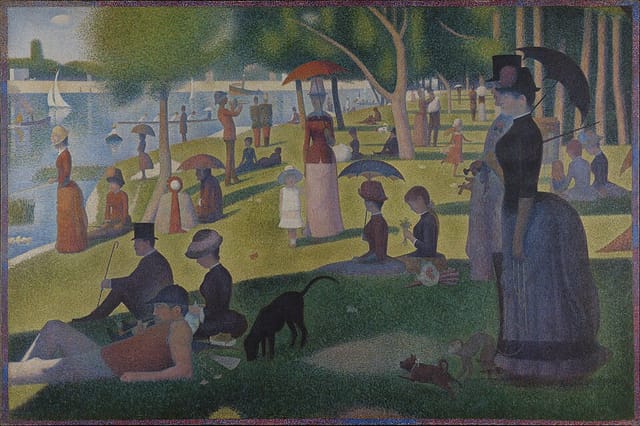
“A Sunday Afternoon on the Island of La Grande Jatte” is shown to the public for the first time at the eighth Impressionist exhibition, held from 15 May to 15 June 1886. The painting will initiate Neo-Impressionism and alter the direction of modern art.
19 September 1886
Fénéon names “Neo-Impressionism” and defends Seurat
Félix Fénéon, who gives the new movement the name “Neo-Impressionism”, defends the artist in an article for the Belgian paper “L'Art Moderne” of 19 September 1886: here, he argues, no virtuosity of brushwork or impasto is needed, but the eye must be quick, sharp and perceptive.