Anne-Louis GirodetFrankrig, 1767–1824
Self-Portrait
Må man se det?
Tager ikke imod for tiden

Eremitagen
Sankt Petersborg, Rusland
Det hører til samlingen, men er ikke udstillet for tiden.
- Kontrolleret
- Uændret siden
- Kilde
- Museet
Om maleriet
Med museets ord — på russisk
Жироде, один из самых талантливых и любимых учеников Давида, получив в 1789 г. Римскую премию, отправился в Италию, где прожил пять лет. Парадоксальным образом итальянское путешествие привело художника к пересмотру классицистической доктрины и формированию индивидуального стиля, который позволяет считать его провозвестником романтизма. "Автопортрет" лишен традиционных для картин подобного типа атрибутов профессиональной деятельности живописца. Жироде изобразил себя в прозаическом домашнем костюме. Объективная точность в передаче внешнего облика сочетается с убедительным воспроизведением эмоционального состояния. Слегка полуоткрытые губы и напряженный взгляд выражают динамику внутренней жизни художника.
Eremitagen
Oplysninger
- Inventarnummer
- ГЭ-5660
I kataloget
Kilder
- Eremitagen
- Billede: Eremitagen — Museum open access
Imens i livet hos Anne-Louis Girodet
Hele livet1807–1817
His powers begin to fail
In his forties Girodet's powers began to fail, and his habit of working at night and other excesses weakened his constitution.
1808
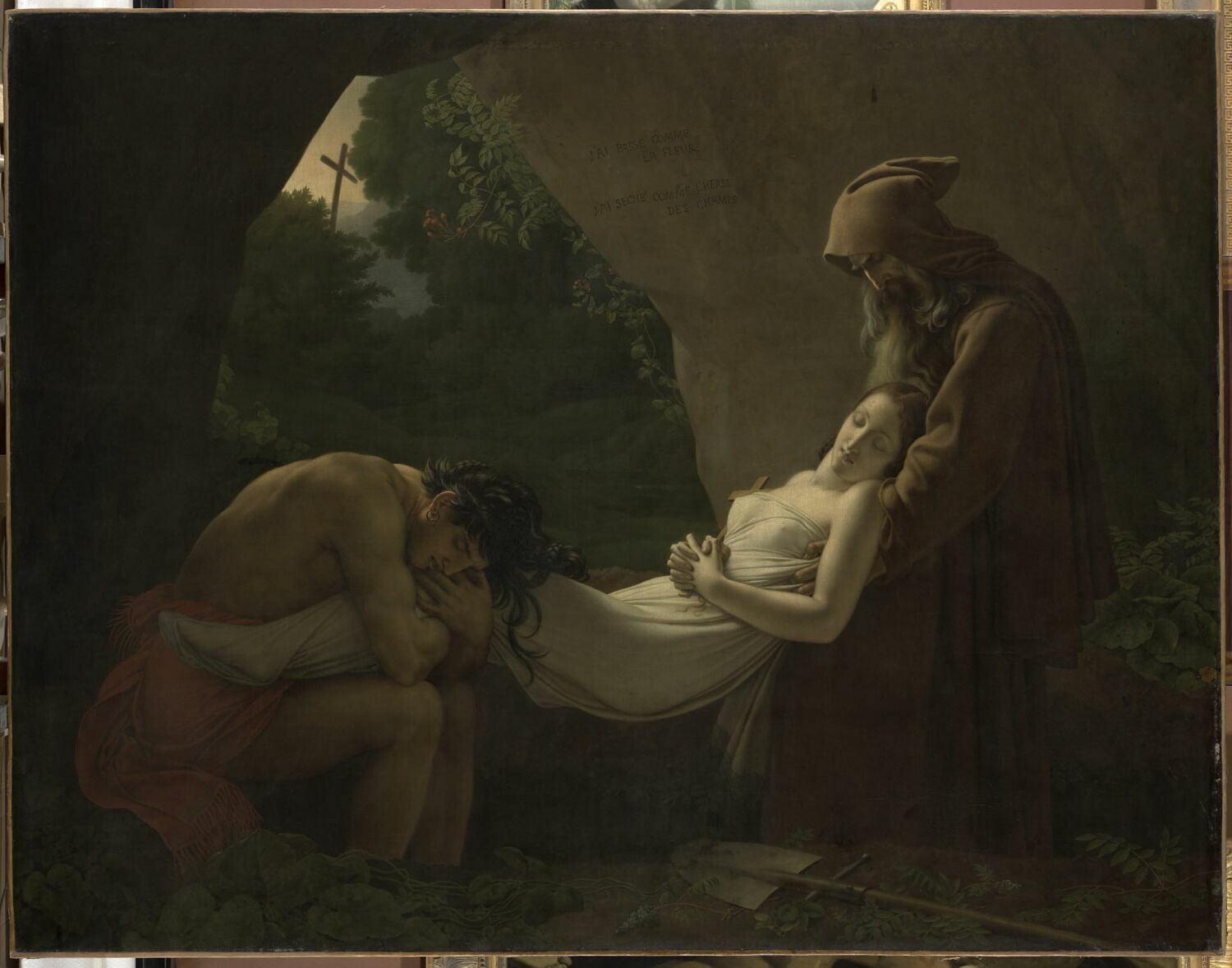
Immense success of “The Entombment of Atala”
The painting, based on François-René de Chateaubriand's novel “Atala” (first published in 1801), won immense popularity thanks to its fortunate choice of subject and its remarkable departure from the theatricality of Girodet's usual manner.
after 1810
From painting to illustration and writing
After 1810 Girodet painted very few pictures: he drew illustrations for Anacreon, Sappho, Virgil, Racine and other poets and dramatists, composed a poem about painting and several discourses on the art, and made translations of, and imitations after, ancient Greek poets.
1812
Takes the surname Trioson
After the death of his parents, when Girodet was a young adult, the care of his inheritance and education fell to his guardian, the prominent physician Benoît-François Trioson (médecin-de-mesdames), who later adopted him. The two remained close throughout their lives.
1812
Shows only a “Tête de Vierge” at the Salon of 1812
At the Salon of 1812 Girodet exhibited only one work, a “Tête de Vierge”.