Odilon RedonFrankrig, 1840–1916
Apparition
Må man se det?
Ja, det tager imod
Udstillet for publikum. Hvem der står inde for det, står nedenfor.
- Kontrolleret
- Uændret siden
- Kilde
- Museet
Om værket
This is one of Odilon Redon's *noirs*, charcoal drawings that he made over several decades in the late 1800s and so named for their dark tones and mysterious, often nightmarish, imagery. Here, strong black strokes of charcoal cover much of the warm-toned paper, creating an atmosphere of primordial gloom. From this dark void the capped head of a bearded figure appears. A strong, supernatural light emanates from him, and yet his eyes are cast in mysterious shadow. He smiles slightly. Rays of light shine down from an orb above the figure's head; the orb is shaped like a thought-bubble that seems to connote thoughts or imagination--or put more abstractly, the cerebral act that precedes creation. And perhaps creation is what the artist has implied here: the first passages in the book of Genesis that describe God's creation of heaven and earth and the division of day from night. On the other hand, the drawing's imagery is subtle and obtuse. Like a dream, the elements cannot add up to a purely rationalized experience.
J. Paul Getty Museum
Oplysninger
- Inventarnummer
- 2013.38
I kataloget
Kilder
- J. Paul Getty Museum
- Billede: J. Paul Getty Museum — Open Content
Imens i livet hos Odilon Redon
Hele livet1878 · Virkested
Amsterdam
1878 · Virkested
Rotterdam
1880
Married: Camille Redon
1884
Huysmans’s novel “Against Nature” makes him known
After the publication of Joris-Karl Huysmans’s novel “À rebours” in 1884 the public began to take an interest in Redon: the book’s hero assembled a collection of art that included Redon’s drawings.
1886
The eighth Impressionist exhibition
Redon took part in the eighth and last Impressionist exhibition.
from 1890
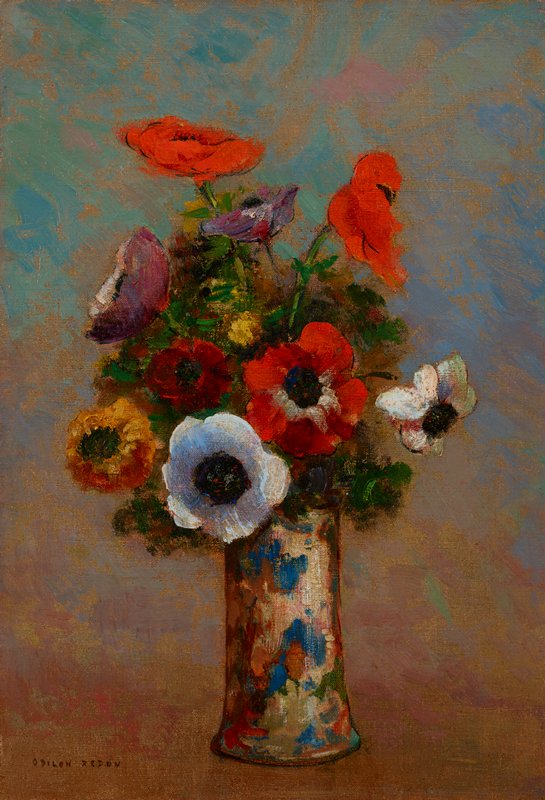
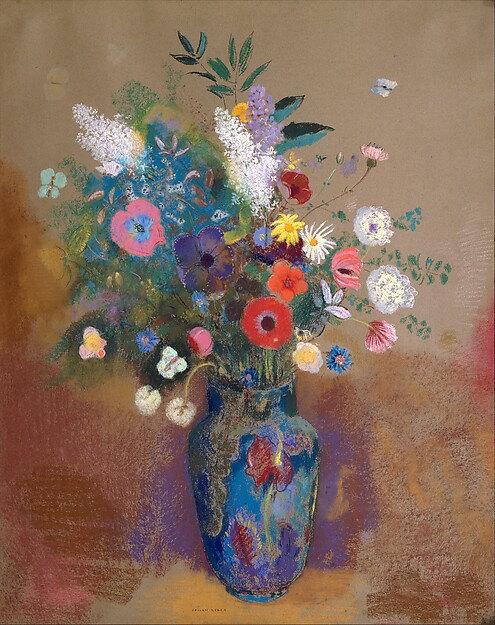
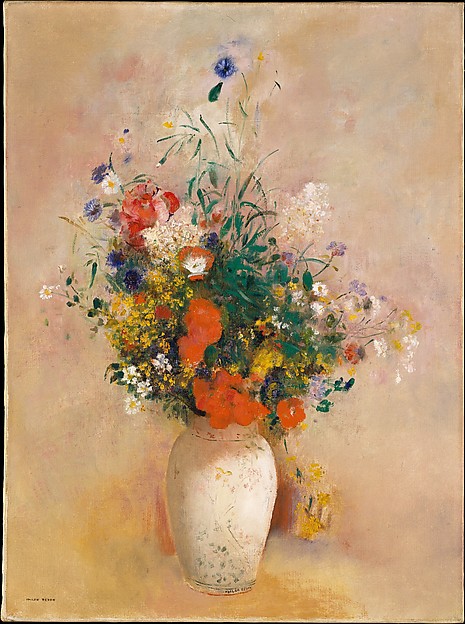
The turn from “noirs” to colour
From 1890 Redon turned more and more to oil and pastel and gave up his “black” works; after 1900 he made no more noirs. He explained the change by saying he had realised that the unwinding ribbon of life brings not only sorrow but joy.