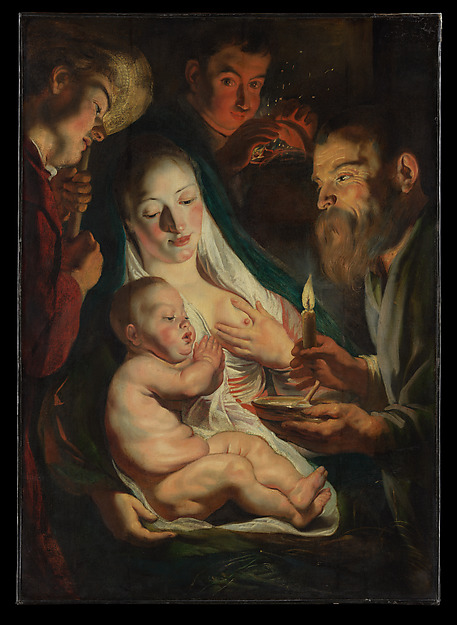
Jacques JordaensFlandern, 1593–1678
A Merry Company
Kan det ses?
Ikke udstillet lige nu
Hvor er »A Merry Company« i dag? Samling: J. Paul Getty Museum, Los Angeles. Ikke udstillet lige nu. Kontrolleret 7. oktober 2026.
Los Angeles, USA
Det hører til samlingen, men er ikke udstillet for tiden.
- Kontrolleret
- Uændret siden
- Kilde
- Museet
Om værket
While enjoying the pleasant weather outside a tavern, this rowdy group of merrymakers finds added delight in wine, song, and women. Seated at the center of the table, a woman clutching her glass shrinks from the brazen advances of a drunken man. On the left, a man throws his arms in the air, abandoning himself to song and capturing the attention of a dog whose paws rest in his lap. Other singing men surround the table, accompanied by a bagpipe player in the rear. On the far left, an intoxicated fellow has knocked over the crockery and is vomiting. Jacob Jordaens heavily worked this drawing with gouache and watercolor to create a rich finish that reflects the earthy humor of the subject. Using broken, angular lines and a delicate balance of light and shadow, Jordaens imbued his figures with movement and depth.
Læs videre
Jordaens's raucous scene may have served to illustrate a popular proverb of the 1600s: "Ill gained, ill spent." Like many Dutch artists of his time, Jordaens depicted moral sayings in many of his drawings and in a set of tapestry designs that was purchased by the governor of the Spanish Netherlands in 1647.
J. Paul Getty Museum
Oplysninger
- Inventarnummer
- 2000.59
I kataloget
Kilder
- J. Paul Getty Museum
- Billede: J. Paul Getty Museum — Open Content
Imens i livet hos Jacques Jordaens
Hele livet1621–1667
His workshop: fifteen pupils in the guild records
Between 1621 and 1667 the guild registered fifteen pupils with Jordaens (the best known being Jan Boeckhorst), and six more are named in court documents; his son Jacob and his cousin Arnoldus also trained with him. His fame drew foreigners: after 1642 the Polish painter Aleksander Jan Tricius became his pupil, and in 1645 Queen Christina of Sweden meant to send her protégé Georg Waldau, but the threat of war in Flanders prevented it.
c. 1635 – 1645
Publishes prints after his own designs
Like Rubens and van Dyck, Jordaens realised that prints spread an artist's fame and on his own initiative issued 14 engravings under privilege (cum privilegio), cut by Marinus Robyn van der Goes, Schelte a Bolswert, Paulus Pontius and other Antwerp engravers. Beneath each image stood his name as inventor and a short explanation in Latin verse.
1645
Converts to Calvinism
Raised a Catholic, Jordaens converted to Calvinism (other accounts say only that this was towards the end of his life), yet the Catholic Church went on commissioning altarpieces from him. He belonged to the Protestant community De Brabantse Olijfberg and towards the end of his life opened his house for private services.