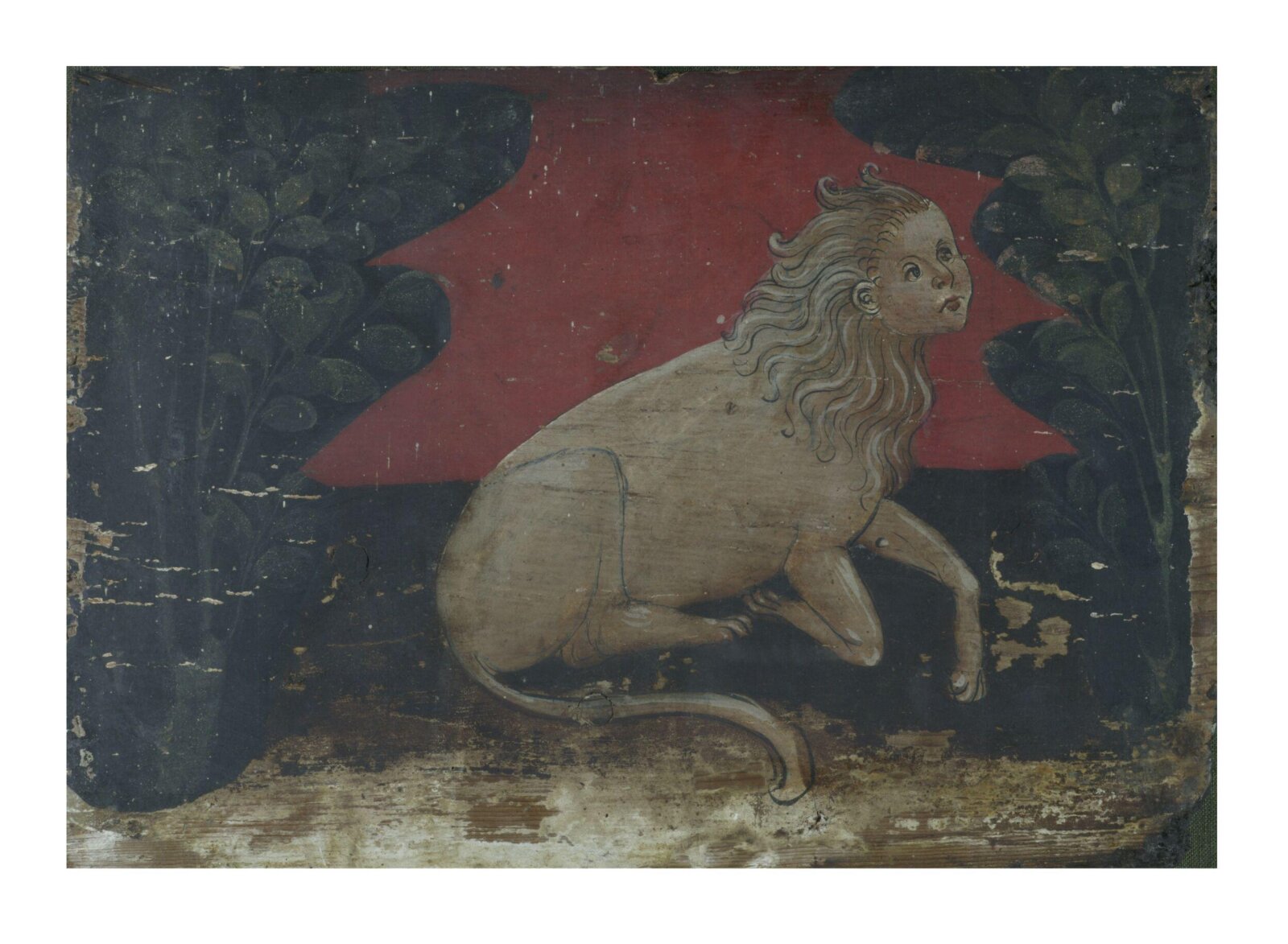
A Human-headed lion in a landscape
Kan det ses?
Ikke udstillet lige nu
Hvor er »A Human-headed lion in a landscape« i dag? Samling: Victoria and Albert Museum, London. Ikke udstillet lige nu. Kontrolleret 25. september 2026.

London, Storbritannien
Det hører til samlingen, men er ikke udstillet for tiden.
- Kontrolleret
- Uændret siden
- Kilde
- Museet
Om maleriet
W. 48-1913 and its companion panels (W.46-1913; W.47-1913; W.49-1913) were probably painted in Cremona in Lombardy, famous for its Medieval and Renaissance architecture as well as for a school of painting that flourished in the 15th and16th centuries, particularly under the patronage of the Sforza family. This increase in artistic commissions led to the decline of small family workshops, such as that of the Bembo (who may have painted these works) and the creation of larger corporate institutions. The Cremona school of painting, is notable for its rich use of fantastical elements and brilliant colour.
Læs videre
The V&A panels imitate the Cremonese tradition of decorating with terracotta tiles to articulate architectural membering in ceilings of private palaces. They are very similar to two surviving ceiling panels probably painted by the Bembo workshop in the Raccolta Parmiggiani, Reggio Emilia, and those from the same series now in the Museo del Seminario, Cremona attributed to Bonifacio Bembo. Despite their fragmentary state we can get a sense of the original appearance and context of the V&A panels by comparison with an intact painted ceiling decoration from the period in the former Palazzo Vimercati, now the Banca Popolare Agricola, in Crema. On this ceiling the sides of the supporting beams are decorate with a frieze of paired male and female busts alternating with coats of arms and other heraldic symbols, each painted within a fictive arch.
The human-faced lion represented in W.48-1913 recalls the emblematic fantastical animals from Cremonese ceilings and may have heraldic associations. The figure may be considered more generally within the context of contemporary drawings of domestic and exotic beasts by Antonio Pisanello, Paolo Uccello and Benozzo Gozzoli or of the fantastical human headed pig and stag in Piero di Cosimo's Forest Fire 1495-1505 (Ashmolean, Oxford). These beasts are generally described with reference to Lucretius' De rerum natura (V:821-924) in which the Roman poet describes oddities, deformities and monsters in nature but may simply be a statement of artistic fantasia, poetic licence and whimsy.
Victoria and Albert Museum
Oplysninger
- Inventarnummer
- W.48-1913
Hvad det viser
I kataloget
Kilder
- Victoria and Albert Museum
- Billede: Victoria and Albert Museum — © Victoria and Albert Museum, London