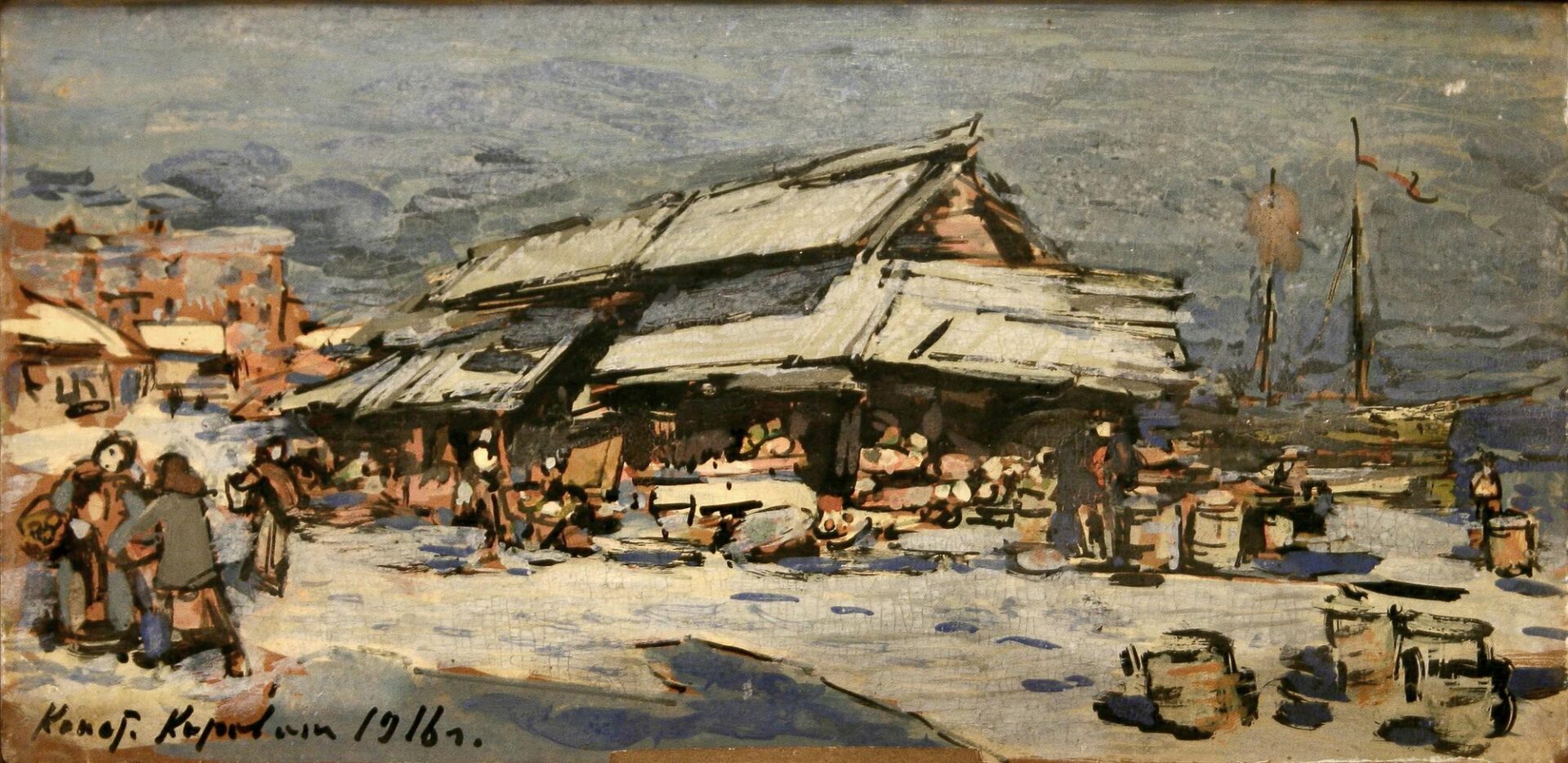
 Konstantin Korovin1861–1939
Χειμωνιάτικο πανηγύρι
Må man se det?
Ukendt: museet holder tæt

National Gallery – Alexandros Soutsos Museum
Athen, Grækenland
Ejeren er kendt. Om det er udstillet i dag, siger museet ikke, og at gætte har vi ikke lært.
- Uændret siden
- 27. sep. 2026
- Kilde
- Museets egne samlingsdata
Oplysninger
What it shows
Kilder
- National Gallery – Alexandros Soutsos Museum: the museum's own open data · hentet for 5 dage siden
- Billede: National Gallery – Alexandros Soutsos Museum — CC BY-NC-ND 4.0
Imens i livet hos Konstantin Korovin
Hele livet1881–1923 · Virkested
Moscow
1910–1917
The Salammbô dacha in Gurzuf
In 1910–1917 Korovin lives for long periods and works a great deal at the Gurzuf dacha built to his own design on the site of a former tavern; he named it Salammbô in memory of his successful work on the sets for Arends’s ballet Salammbô. Repin, Surikov, Gorky, Kuprin, Mamin-Sibiryak and Chaliapin visited it; after the 1917 revolution Korovin never came to Gurzuf again.
1910–1922
Chief decorator and artist of the Moscow theatres
Korovin becomes the chief decorator and artist of the Moscow theatres, a post he holds from 1910 to 1922.
1914–1918
Camouflage consultant at an army headquarters
During the First World War Korovin works as a camouflage consultant at the headquarters of one of the Russian armies and is often seen on the front lines.
after 1917
Protecting monuments and auctions for political prisoners
After the October Revolution Korovin actively works to preserve monuments of art, organises auctions and exhibitions for the benefit of released political prisoners and continues to collaborate with theatres.
1918
The Ostrovno estate and the workshops at the Chaika dacha
From 1918 Korovin lives on the Ostrovno estate in Vyshny Volochyok district, Tver Governorate, and teaches at the Free State Art Workshops at the Chaika dacha.


![Пруд. Осень, Konstantin Korovin, [Конец 19 в.]](/api/img?u=https%3A%2F%2Fgoskatalog.ru%2Fmuzfo-imaginator%2Frest%2Fimages%2Fpublic%2F1600%2F29700169%2F29700169.jpg)