 Georges BraqueFrancie, 1882–1963
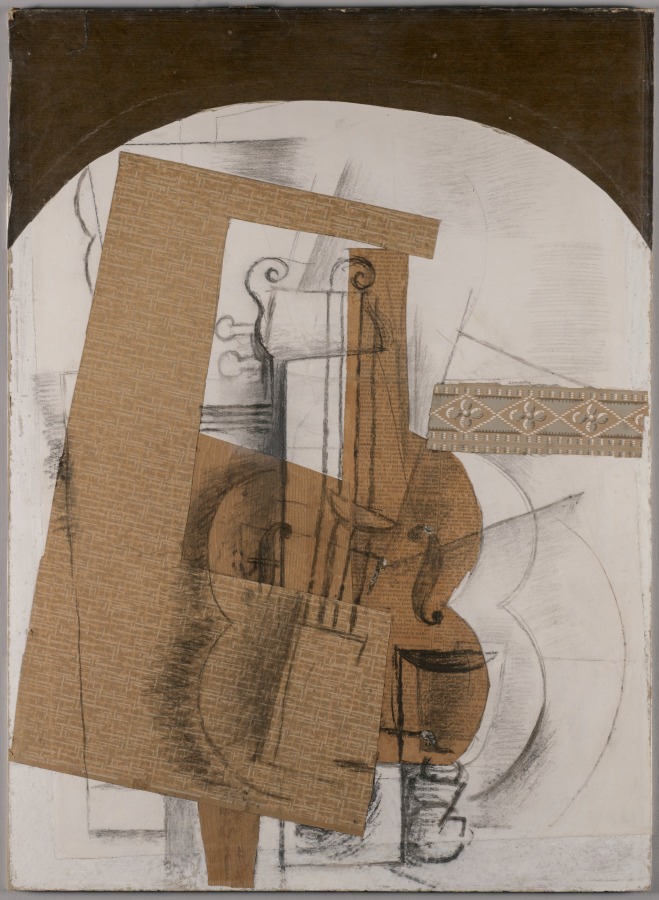
Violin
Je k vidění?
Momentálně není vystaveno
Kde je teď „Violin“? Sbírka: Clevelandské muzeum umění, Cleveland. Momentálně není vystaveno. Ověřeno 2. listopadu 2026.

Cleveland, Spojené státy americké
Patří do sbírky, ale momentálně není vystaveno.
- Ověřeno
- Tento stav platí od
- Zdroj
- Muzeum
O díle
Georges Braque assembled Violin in early 1914; the drawing and collage is at the Cleveland Museum of Art, Cleveland. A glass accompanies the instrument on a table with one wooden leg. Charcoal lines meet newspaper, wood-patterned paper and a decorative strip to define the violin. Their intersecting planes disrupt a straightforward reading of space. Braque had introduced papier collé in 1912, using inexpensive wallpaper printed with wood grain. His close exchange with Picasso over collage continued until the First World War interrupted their collaboration.
Slovy muzea
This drawing belongs to a series that Georges Braque made with papier collé, a technique he invented in 1912 that featured collaged elements made from inexpensive wood-patterned wallpaper. Around the same time, Braque's frequent collaborator, Pablo Picasso, was also experimenting with collage, and the two worked closely together until World War I interfered in 1914. Here, Braque represented a violin and glass on a table supported by a single wooden leg. The violin is defined with lines of charcoal, a newspaper fragment, a piece of paper with wood grain, and a strip of decorative patterned paper. Using this combination of materials, Braque placed his subject in a complex space of intersecting planes that defies the logic of representation.
Clevelandské muzeum umění
Podrobnosti
- Inventární číslo
- 1968.196
V katalogu
Zdroje
- Clevelandské muzeum umění
- Obrázek: Clevelandské muzeum umění — © Artists Right Society (ARS), New York / ADAGP, Paris
V životě: Georges Braque
Celý životopis1909–1912
Creates Cubism together with Picasso
From 1909 to 1912 (other accounts say from as early as 1908) Braque worked with Picasso on the theoretical foundations of Cubism and became one of the movement's founders; for many years their paintings of the period were indistinguishable. Braque likened their partnership to being roped together on a mountain.
1912
Invents papier collé
In 1912 Braque and Picasso began experimenting with collage, and Braque invented the technique of papier collé — pasted paper.
1914
Goes to war, ending the partnership with Picasso
Braque and Picasso worked closely together until the outbreak of the First World War in 1914, when Braque enlisted in the French Army.
1915
Severe head wound at Carency
In battle at Carency Braque suffered a severe head wound and temporary blindness. He was trepanned and needed a long period of recuperation.
1915–1916
Friendship with Juan Gris
While recovering from his wound, Braque became a close friend of the Cubist painter Juan Gris.
late 1916
Returns to painting
At the end of 1916 (other accounts say only in 1917) Braque took up painting again. Working alone now, he softened the harsh abstraction of Cubism; in these years still life almost entirely dominates his work.